
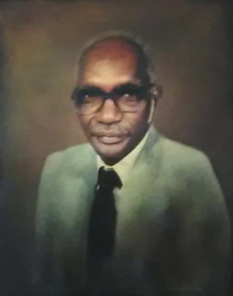
John Corn
More than 50 years ago, in 1969, the concept of Black History Month was proposed by a group of African American educators and students at Kent State University. A year later, the first celebration of Black History Month was observed.
In 1976, President Gerald Ford officially called February Black History Month and it has been observed as such every year since. Several other countries have begun the observance, including Canada, the Netherlands and all the United Kingdom. Each year, the impacts made by African American teachers, scientists, writers and others are recognized.
John Corn was such a person for Clay County. Corn died in 2002 at the age of 78, but many Clay County residents remember him and his influence. In June 1994, he was named Citizen of the Year from among six finalists.
According to information written about Corn and the award in the Clay County Progress at the time, his military service, his love of Clay County and his church were all important to him. “Fort Hembree Baptist has served as the focal point of his life,” the article written by Publisher Becky Long said.
Ordained as a church deacon in 1956, Corn served in that capacity for decades, in addition to being president of the Sunday School Congress, as well as treasurer and chairman of the Deacon Board.
“John Corn was a good, loyal man,” Annie Lloyd responded, when asked about Corn this week. “Not just to the church, but to everything. I believe he made an impression on the county; after all, they named the VFW building after him.”
Corn served as Commander for VFW Post 6812 in Clay County for many years. Jack Moody, who is also a member of the local VFW, did not know John Corn very well. “Everyone I have ever talked to has a high regard for him though,” Moody said. “He was commander during the time they were transitioning from the Quonset hut to the building where they are now.”
Moody said he knows Corn was responsible for saving a lot of the military memorabilia to keep it safe. However, Corn did not live to see the transition through and much of the memorabilia was lost.
Along with being an active role in his church and the VFW, Corn was a Mason, a Shriner and served on several boards involving economic development and rural health. “The list of volunteer organizations from which he has served is quite lengthy,” the 1994 article said.
During the Citizen of the Year awards ceremony, Corn was gifted with an American flag which had flown over the United States capitol. Corn was reported to have said, “I have always wanted one of those flags — it is very special to me.”
Yet life did not start out so well for John Corn, who was born in Cherokee County, despite always considering Clay County to be home. The article explained more about Corn’s youth in western North Carolina, as well as his philosophy of hard work. “Like many young men growing up in the ‘30s and ‘40s, hard work was as much a part of his life as eating and breathing. His earliest memories of growing up here include the day his family’s home went up in a blaze, leaving only debris behind. He was only 4 years old at the time,” the article said.
The Corn family was not home at the time of the fire, so no one was hurt, but they lost many of their belongings. The young man started school in the one room, wooden schoolhouse known as the “old” Shooting Creek School. When he was only seven, his father died, leaving Corn’s mother, two sisters and him.
The quiet, reserved man was said to have enjoyed education a lot. Unfortunately, the family’s need was too great and the young man left school and went to work in the fields when he was only 9 years old.
For the earlier article, Corn reminisced, “The wage I received was a bushel of corn a day. You had to wait until the fall to get paid. When the harvest came, I would take the corn and buy whatever I needed, clothing, food, you name it. Money seldom changed hands in those days, we swapped for whatever we needed.”
At the age of 14, Corn went to work at Arthur Penland’s farm for $3.50 a week. His work there allowed him to attend school occasionally. “Mrs. Penland was always so good to me,” John said. “She was a fine lady who frequently introduced me as her son.”
When he was 17, Corn joined the TVA construction project for the Chatuge Dam. The article explained, “This afforded many local men much needed employment opportunities and Corn was one of them. The year was 1941 and Corn says at the time no one ever imagined what a big undertaking this was or what the end result would be. ’It was hard to imagine, but then the lake area was comprised of homes and farmland. Some of the folks were reluctant to sell out to TVA. They wanted to stay in their homes, but eventually most everyone did sell.’”
In 1942, Corn joined the project to construct Fontana Dam. The same year, he was drafted into the U.S. Army, which provided more training opportunities and took him overseas.
“We used to handle bombs and didn’t think about it,” Corn said years later. “The worst part of this was the raids. That’s about the only time I was truly afraid. There we were loading the ships and then an air raid would come out of nowhere. All you could do was run, while searching for a foxhole. My first real break came when I talked the Army into going ahead and giving me a skills test. Much to their amazement, I passed with flying colors.”
He was eventually promoted to staff sergeant and left the Army behind in 1946. Corn looked forward to returning home and felt good about his options and his future since he could run heavy equipment. Despite plans to work for the highway department, Corn was unable to secure a job with them. “For a short while, he was disillusioned with Clay County,” Long’s article continued. “’I just wanted to leave and never come back. This soon gave way to a renewal of home and the love I felt for my county returned in earnest.’”
John worked odd jobs which eventually led to the dairy business, later saying, “I guess I’ve had more jobs than anyone.”
In 1949, he met and married Estee Nicely, of Helen, Ga., and the couple had one child. A few years later, he began a career with Job Corps in Franklin. Then his retirement kept him so busy as deacon, VFW Commander, board member and more, his fellow citizens decided to nominate him for the Citizen of the Year Award. Even today, a portrait hangs in the VFW Post building and he is mentioned in the Historic Hayesville Exhibit.
Perhaps his popularity stems from what he said about himself after winning the award in 1994. “I live by the Golden Rule. Do unto others as you would have them do unto you. If we all obeyed that passage there would be no problems in the world, it’s really very simple.”