
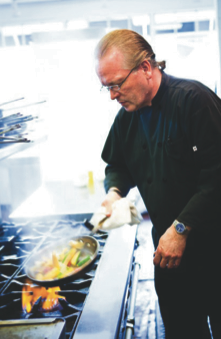
Photo submitted (Right) Dennis Barber, owner and chef at The Copper Door, prepares food for his award-winning restaurant in downtown Hayesville. This pre pandemic photo was taken prior to the strict restaurant guidelines being followed by Barber and staff.
While coronavirus can certainly take a physical toll on people, it has also impacted the local economy. Restaurants and other businesses are reopening, some with more limited schedules than others. Still, the impact could be long term.
Business owners are working to develop a new normal. In some cases, the normalcy requires customers to wear masks, while normalcy for others may be limiting the number who enter, requiring workers to wear masks or taking care of business from behind plexiglass. A few business owners shared the measures they are taking, along with their thoughts about how business has been impacted.
Restaurants were ordered by the governor to close in March as a response to the pandemic. Nancy Fitzgerald, of Black Dog Tavern, and Dennis Barber, of The Copper Door, shared how this impacted their restaurants in downtown Hayesville.
Fitzgerald said sales at her restaurant and bar are struggling. They are working hard to return to a normal schedule despite a staffing shortage. “My business is down at least 60 percent compared to last year,” she said. “My takeout sales have increased two to three times what it was last year.”
For Fitzgerald, a staffing shortage has hurt business. “The biggest problem is get- ting employees. I have enough front of the house right now. Getting cooks and dishwashers is a struggle,” she added. “I have had to change my hours to accommodate the number of employees. We tried to stay open from 11 a.m. to 7 p.m., with one crew but we were all getting burnt out. As my staff increases, I will increase my hours. I will not overwork my current workers just to stay open.”
Black Dog Tavern has tried staying open later on Fridays and Saturdays but they usually end up closing early due to lack of business. Fitzgerald said they will see if more people come in for live music from 6-8:30 p.m. Saturday, Aug. 29 and Sept. 5.
Just down the street, the Copper Door also tried take-out; however, it did not work well for the full-service, fine dining establishment.
“Operating expenses far exceeded revenue, so we shut down,” Barber explained. Instead, they used the closure time to make some changes. “Phase 2 allowed for inside dining at 50 percent, so we re-tooled the restaurant with limited seating and a smaller staff.” Both have instituted guidelines in their restaurants. Fitzgerald said all servers must wear facemasks or shields. Staff without direct customer contact are not required to wear masks, which are optional for customers.
“All of my staff must stay in the local area and use caution when going out and dealing with the public,” she said. “If any of my staff leaves the area, they have been quarantined as per health department and CDC guidelines. Staff must report if they have a fever and if they do goto the health department for a COVID test or their doctor and quarantine until the test results come back.”
Barber said The Copper Door follows North Carolina restaurant guidelines, including increased cleaning schedules and actively monitoring employee health.
“We have made every effort to take the restrictions and turn them into enhancements,” he said. “For example, we use white dress gloves for service instead of latex. Servers remove their gloves when clearing dishes, then wash and sanitize their hands before putting gloves back on to serve food. We keep a fresh supply of clean linen gloves each evening. We've added hand sanitizing stations for guests and ultraviolet HEPA air filters. Guests are required to wear masks, except while seated at their table. Servers wear masks and gloves. We've re- moved high touch items from the table so that every guest is presented with a fresh tabletop. No items remain on the table between guests, like saltshakers, candles, etc.”
The tables at Black Dog have always been sanitized between customer seatings as well. Now all condiment bottles, menus and checkbooks are also wiped down.
“Instead of just plain wrapped wipes for customers' hands I have ones with sanitizer in them for the customers to use when they sit down,” Fitzgerald added. “All of our tables have been placed for 6 feet distancing. We can still accommodate larger tables in sections of the restaurant and patio. Last, I sanitize all surfaces that customers touch like door handles, soap dispensers, light switches etc. every couple of hours to try to pre- vent cross contamination by touching surfaces.”
Other businesses are affected in different ways. A staffing shortage has not been a problem for Shelley Gordon, owner of Stardance Performing Arts who had to stop face-to-face classes in March.
“I have staff. Teaching dance virtually has a lot of challenges, especially in an area where internet is not great. Plus, kids often don’t have room to dance and leap in their bedrooms or kitchens, so they are not getting much practice,” she explained.
Almost as soon as the closure mandate occurred, her enrollment dropped by about 50 percent.
“We were not able to have a recital, which usually pays for itself and helps pay the summer rent,” she said. “We could not have summer dance camps either so students have not set foot in the studios for almost six months. In the meantime, I have paid rent on three units for almost six months.” As a part-time dance teacher at Young Harris College, Gordon is teach- ing students again. She must wear a mask while teaching and students must also wear masks. After 30 minutes of dancing, they are required to take a 15-minute break.
She said people don’t often think about those working in the arts as struggling, but cos- tumers, writers, set designers and others in the industry are. “The arts have been hit extremely hard and it's going to take years to recover,” she said sadly.
Barber agrees the impact will be long term. “I imagine we will see social distancing for some time,” he said. “Therefore, our seating capacity will remain limited.”
Fitzgerald added, “I do not know what the impact will be for our business, only time will tell. Right now, we are doing OK and will continue to be open and serving our customers the best we can with the staff we have.
I think the community will suffer from lower sales tax dollars until the business can recover back to normal levels.”