
By Jared Putnam
Staff Writer
Emojis have become a part of daily communication during the 21st century.
Recent studies have shown that 92 percent of people who have internet access use emojis on a daily basis — with more than 10 billion sent across the world each day. These small digital images like smiley faces and thumbs-up icons are routinely used to represent our thoughts and reactions to phone texts, emails and social media messages.
The Clay County School District hopes emojis can also be part of a successful, proactive approach to monitoring local students' mental health. The Clay County Board of Education approved a school-based mental health plan during its June meeting on Monday, highlighting a variety of mental health tools and resources that will soon be available to students.
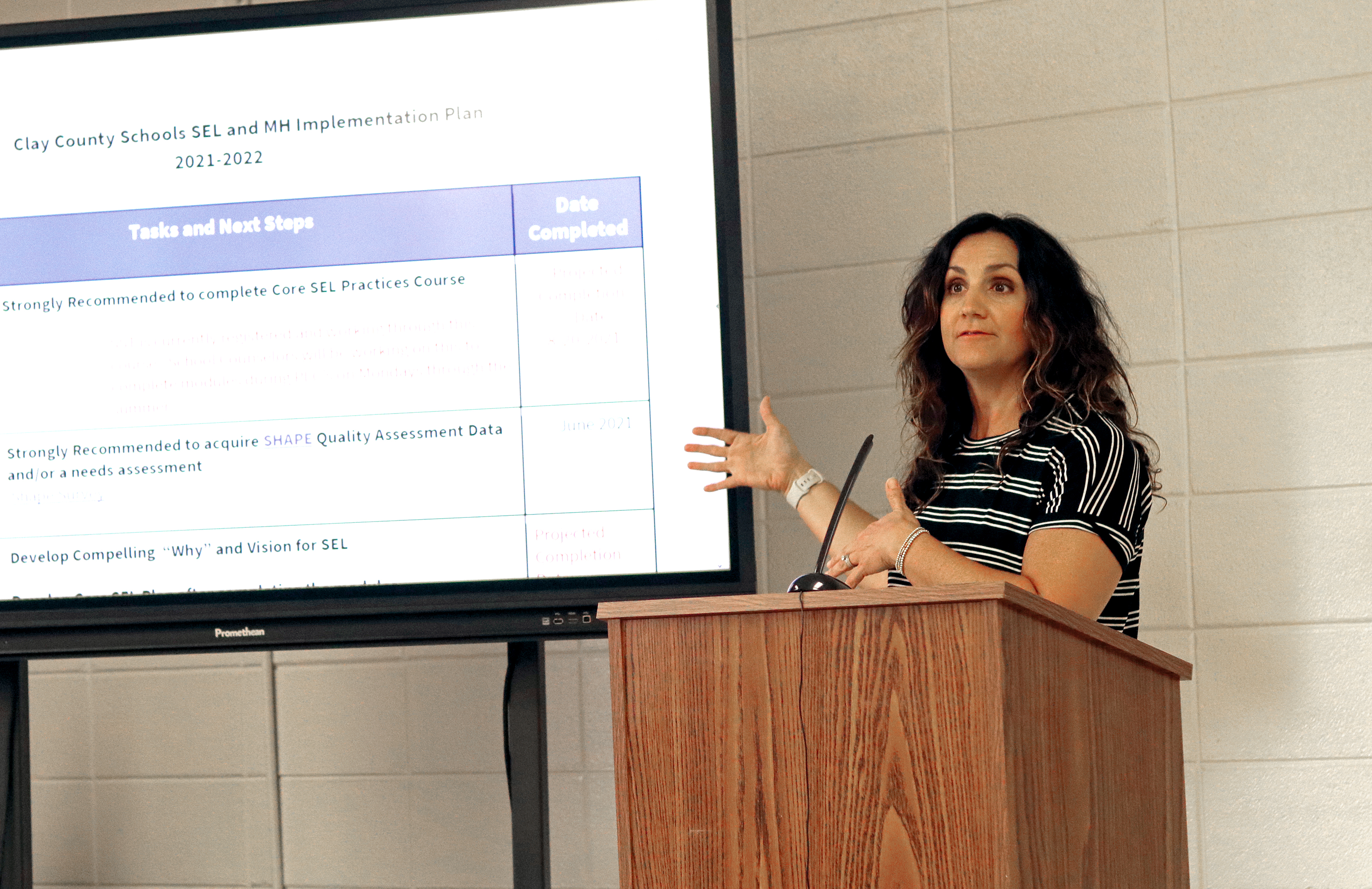
"Overall, I think we're moving in a really positive direction on social-emotional and mental health," said Emily Hedden, Clay County Schools' Social-Emotional Learning Coordinator. "I think this year we're going to see a lot more issues and problems, but we have a substantial amount of more help that we can offer to kids."
Superintendent Dale Cole said the emoji-based assessment is part of the Rhithm App, which will be installed on students' Chromebooks and pop up when they log in each day. The app provides a series of seven questions, all of which are answered by selecting a particular emoji to represent a feeling. Cole said the initiative stems in part from research showing that teenagers are typically unlikely to approach a teacher or faculty member about a problem, but will share it on social media.
"Students are much more apt to log on to that app if they're given an opportunity every day and they'll be honest about how they feel in those different frameworks," Cole said. "Just by selecting that emoji, our counselors and principals get a daily data sheet that shows which kids have selected something that maybe we need to check on. That may be the difference in that kid's day and hopefully we can take care of something before they get in a fight or before they do something else that would be negative for the school environment."
Clay County Schools will implement another SEL assessment tool, the one-minute-long Dessa-mini screener, during the second half of the summer learning session. The school system plans to later test it with "transition" grades — kindergarten, third, sixth and ninth — at least twice in the fall. Based on the Dessa-mini, if problem areas are identified, counselors can implement the full screener to better assess areas where a student needs help.
The full Dessa SEL Assessment is a standardized, strength-based behavior rating scale which is completed in a matter of minutes and used to measure the social-emotional competence for children. It is funded through a partnership with Mountain Area Health Education Center and Dogwood Health Trust for SEL Student Support. Dogwood Health Trust will also pay for a mental health employee on campus, targeting students determined to have the most pressing (tier 3) needs.
During a February meeting, Cole told the board to expect to see plenty of the acronym SEL in the coming years. SEL is the process through which children and adults acquire and effectively apply the knowledge, attitudes and skill necessary to understand and manage emotions, set and achieve positive goals, feel and show empathy for others, establish and maintain positive relationships and make responsible decisions.
Cole summarized SEL as "a lot of the qualities that allow us to be successful adults" and emphasized the need to be intentional about teaching them to students, especially in light of the challenges posed by the COVID-19 pandemic within the past year.
"Not only are our students going to have achievement gaps specific to academics, after all this time, they also have social-emotional gaps that are going to have to be addressed as well," Cole said. "These ideas fall in line with our ability to be able to better support the mental health needs of our students. The research shows that social-emotional learning leads to a decline in students' anxiety, behavior problems and substance abuse."