
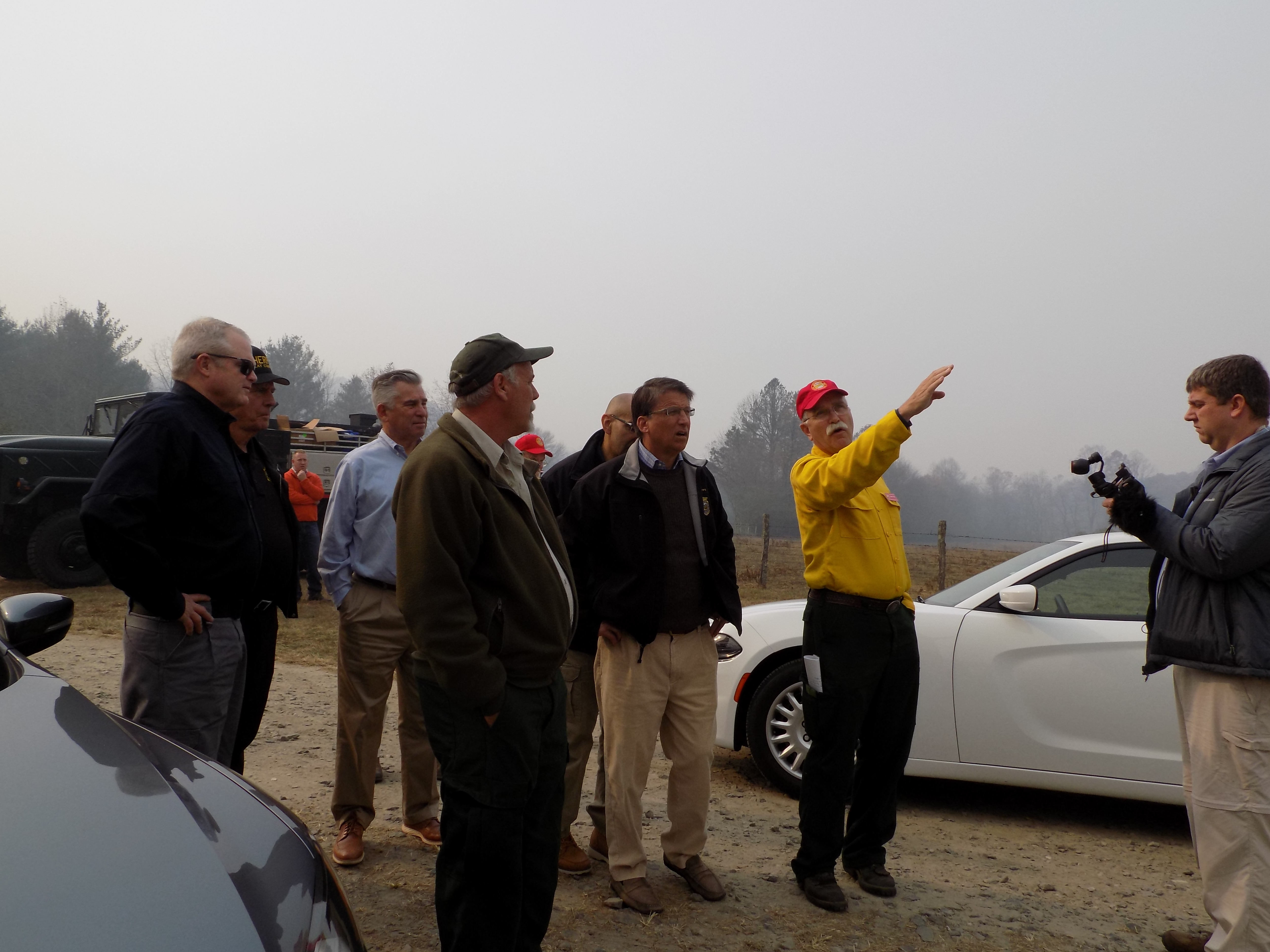
Three years ago, at the end of 2016, the western North Carolina mountains had finally stopped smoldering. Until then, over a period of several weeks which began in late October, about two dozen forest fires had burned tens of thousands of acres. Amazingly, no homes were burned in Clay County and no one was seriously injured.
While those things in themselves were miraculous, the community response was something to be remembered. Hayesville was even named number four on the ten friendliest places in the United States, partially as a result of the community spirit of gratitude to the firefighters.
As we enter a new decade, we look back at the event. The local volunteer fire departments worked hand in hand with the forestry firefighters. Official forestry press releases said it was mostly the volunteer efforts which saved the structures and allowed them to concentrate on fighting the wildland fires.
Shooting Creek Fire Chief Pete Trocchia had the largest local fire in his community. While the Boteler Fire alone burned over 9,000 acres, a few others also popped up near Shooting Creek. “Just taking on the position as Fire Chief, it was literally baptism by fire,”Trocchia said. “I learned several things personally. Training can help prepare you to fight fires like this, but nothing is more of a learning experience than standing out in the forest and reacting to the movement and speed of fire.”
Even though fires continued to show up around the county in the drought-stricken forests, volunteer firefighters from Warne, Brasstown and Clay Central assisted Shooting Creek with the largest fires. These departments routinely help each other fight fires.
Warne Fire Chief Henry Angelopulos, who is the Director of Public Safety Training at Tri County Community College, said the fires taught him. “I learned a lot of wildland firefighting techniques from how to triage houses to incident command,” he said. “I learned when our community faces emergencies, we come together and get the job done. Our community reached out to the firefighters, both local and from other areas, with open arms. They supported them and were very thankful.”
Brasstown Fire Chief Paulette Tonielli is grateful, too. “The fires three years ago were a frightening and life-changing event for many,” she said. “I think we now all think in different ways about wildland fires. If the fires taught us anything, it is that it takes a team effort to deal with large fires, and we should all be grateful all of Clay County stepped up and worked together on the problem.”
Hayesville Mayor Harry Baughn was touched by the support, as well. “The tremendous response from the firefighting teams, as some came voluntarily. Plus, the local response from people that tried to volunteer to help fight the fires,” he said. “I remember the outpouring of love and thanks to the visiting firefighters, from cards and letters to gifts of food, all of which overwhelmed the firefighters. They had not experienced such caring from a community before.”
The fire chiefs’ advice to the community includes better awareness, prevention, safe burning practices and becoming Firewise, a free program offered by the North Carolina Forestry Service and the local volunteer fire departments.
“We receive dozens of smoke investigations each year,” Trocchia said. “I would like to remind the community to be vigilant and cautious when burning outdoors.”
Tonielli said residents have become more cognizant. “Removing fire hazards near your house is very important, as is early reporting. Residents call to ask if it is safe to burn, and for the most part, they are aware of the dangers and are acting responsibly,” she said.
Angelopulos reminded, “Don’t take public safety for granted. North Carolina Forestry is one of the most progressive and action-oriented forestry departments in the country. They manage our forests land very well. That is why the fire, which could have been a lot worse, had very few structural losses.”
Unfortunately, an early December fast-moving forest fire in Gatlinburg illustrated what can happen with wildfire. Fourteen people died, over 14,000 had to flee, and more than one hundred were injured as thousands of acres burned and hundreds of homes and other buildings were partially or completely burned.
“I learned a few weeks after our fires how lucky we were that we did not have the high winds they experienced in Gatlinburg,” Trocchia explained. “It was also driven home how much support we received from the volunteers, community, state and federal personnel. Again, I would want the community to remember how lucky we were. We did not lose one home to this fire. We did lose several camps and old homesteads that were not occupied. It later hit me driving through areas in Tennessee where entire neighborhoods were leveled.”
In most places here, it is hard to tell there were such large fires just three years ago. “I’m certainly no expert,” Baughn said. “But my perception is the forests are rebounding though not the same as before. I am sure that many of the former types of trees like oaks and poplars have been replaced by faster growing trees like wild cherry and box elder.”
Trocchia agreed. “I have been out recently to many of the areas involved in the fires and you cannot even tell there was a forest fire. However, you can still see areas on the mountain riding down Hwy 64 where the trees have still not recovered.”
Chief Tonielli added, “We are fortunate to live in a national forest, an area of great natural beauty. I believe we now realize the responsibilities that go with that privilege. We must be more aware of the possibility of large wildland fires in dry spells, and we must do what we can to prepare for that eventuality.”
To find out about fire prevention measures, contact the fire department in your community. Tips may also be found at http://www.resistwildfirenc.org.