
By Jared Putnam
Staff Writer

Critical Race Theory has been ushered to the forefront of the United States' partisan culture wars in recent months.
After decades of limited attention, CRT has undergone a dramatic spike in number of mentions across various media outlets in 2021, fueling heated confrontations at board of education meetings and other public venues across the nation.
While CRT is often not even mentioned by name, Republican legislators in at least 22 states have recently proposed legislation to limit the teaching of historical racism and its impact on modern American society. So far, at least five states — Idaho, Iowa, Oklahoma, Texas and Tennessee — have signed such bills into law.
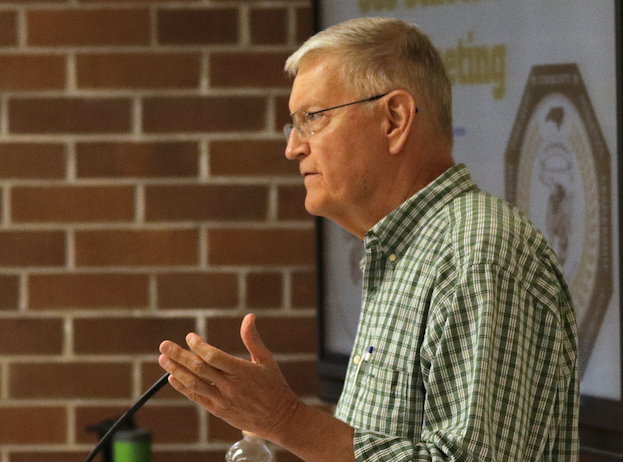
This public debate over CRT found its way to the Clay County Board of Education room Monday, as concerned citizens voiced fears over North Carolina's planned social studies standards and the idea that they could open the door to future CRT teachings in local schools.
"Marxism is alive and well in North Carolina public education," Jim Johnson said during the public comment portion of the meeting.
"We believe that CRT is Marxist and we are concerned that it will be taught to students here in Clay County, not as a specific subject called 'CRT,' but it will be interjected or woven into subjects like social studies, history, English and others. Because these standards are so vague and open-ended, this type of indoctrination could easily take place in classrooms."
The Clay County Board of Education room was standing room only during the meeting. Public commentary sometimes veered into a broad swath of political hot-button issues and societal grievances, including drag queens reading books to children, censorship of Dr. Seuss books, a transgender Olympic athlete, defunding the police, the installation of fencing around the Capitol following the January 6 riots, border security, Antifa, controversy over phrases like "black lives matter" and "all lives matter," removal of public statues and more.
Superintendent Dale Cole used a portion of the meeting to discuss the current status of Clay County Schools' social studies standards and outlined the processes by which curriculum is developed and implemented. Cole said he had already planned to address the topic before Johnson and others asked to be allowed to provide public comment.
"Obviously there's been a lot of discussion statewide, really nationwide over this," Cole said. "I just felt like it was important to kind of explain where we are on all of this to the best of my ability."
According to a study by left-leaning nonprofit organization Media Matters, FOX News alone has referenced "critical race theory" more than 1,900 times in its programming over a recent three-and-a-half month period.
Encyclopedia Britannica defines CRT as an "intellectual movement and loosely organized framework of legal analysis based on the premise that race is not a natural, biologically grounded feature of physically distinct subgroups of human beings but a socially constructed — culturally invented — category that is used to oppress and exploit people of color. Critical race theorists hold that the law and legal institutions in the United States are inherently racist insofar as they function to create and maintain social, economic and political inequalities between whites and nonwhites, especially African Americans."
Put more simply, those in favor of CRT may typically argue that it does not attribute racism to white people as individuals or groups of people. Rather, it contends that United States social institutions such as the criminal justice system, education system, housing market and healthcare system are infused with longstanding racism in laws and regulations, leading to differential outcomes by race. Those opposed to CRT often argue that it serves to do little more than sow division between minorities and whites.
However, even the presence of CRT in public schools — or lack thereof — is often one of the biggest points of contention between the two sides. Proponents often argue that it is merely being used as the latest political boogeyman, having very little actual presence in public schools, while detractors argue that elements of its teachings are woven into public education in less than overt ways.
In North Carolina, Republican Catherine Truitt, State Superintendent of Public Instruction, has expressed concerns over the new social studies standards adopted in the spring. She has been granted permission by the State Board of Education to develop and present more specific guidelines to the board for review in August.
In the meantime, Cole recommended that citizens contact their state legislators if they have concerns. North Carolina's new standards were only released in July and Clay County Schools will continue to use the 2010 standards while local educators review the updates and wait for the final outcomes of ongoing legislation at the state level.
"We're going to continue to use the 2010 standards while our teachers study these new standards and we kind of let things shake out at the state level and see what happens," Cole said. "I would ask that, again, the community work with us, give us time to study these standards and let the state sort these things out."
Cole clarified that state standards sometimes have less impact than the public may realize due to a variety of factors. He used the example that textbook companies typically build curriculum along national standards, not state standards, making it difficult for schools to find textbooks that fit state standards, especially at the high school level. Teachers, to a large extent, are then left to build their own curriculum.
"Mr. Johnson, he mentioned state curriculum, and one thing I did want to clear up is that the state does not provide a curriculum," Cole said. "Curriculum is a local board of education authority, along with the teachers and principals."
Cole added that new curriculum is advertised on the school system Facebook page and webpage to allow the public to provide feedback before the board ever votes on its approval. New social studies curriculum will eventually adhere to the same review process.
"We will be prepared for next year to have a curriculum in place that has been created by our teachers and our principals that has been opened up to the public for review for at least a month, because we're always going to be transparent," Cole said. "We will listen to our community and our parents, we will bring that to our board members and make changes as we feel like we need to, and then we will approve a curriculum to move forward going into next year."