
Coalition hosts community town hall
“Clay County students do not think alcohol or marijuana is as dangerous as tobacco,” said Kelly Teague, regional coordinator for Community Impact NC, while presenting statistics from the PRIDE school culture surveys completed in May 2019. “We want that perception to go up because when they see a perception of risk, they are less likely to use a substance or more likely to wait until they are older.”
Underage drinking was the main topic of conversation at a community town hall organized by People of Clay Coalition Allies for Recovery and Education held Tuesday, Oct. 15. Held at Clay County schools auditorium, it was funded by a stipend from 2019 Communities Talk: Town Hall Meetings to Prevent Underage Drinking initiative, sponsored by Substance Abuse and Mental Health Services Administration.
Teague, who is a mathematician and is trained in adolescent mental health, had compared survey results by Clay County students in grades seven, nine and 11 from 2004 through 2007 to the 2019 results. Current students began using tobacco at a later age, which is due to the perception of risk. In 2004, the average age for seventh grade to begin using tobacco was 10, but increased to 11.6 in 2019 — about the national average. In addition, the 2004 survey showed 4.7 students in grade seven had used tobacco in the past 30 days, but only 1.89 had used within 30 days in 2019.
While Teague is impressed with many community statistics — some are alarming. The 2019 average age for Clay County seventh graders to have tried alcohol is 11.2, close to the national average. Unfortunately, seventh graders who drank in the past 30 days was much higher in 2019 at 10.19 percent of students versus 4.8 in 2004.
“Many students still get their alcohol from their own homes,” she said. “They still do all the old tricks you heard about as kids, like filling the bottles with water. Consider locking your alcohol up.”
Marijuana use has increased in younger students. Teague said, “that will probably become worse as students hear about marijuana being used as medicine. There are gummy bears with marijuana in them and Pot Tarts,” she said. “The market is trying to attract younger people.”
Teague went on to compliment our area. “I can tell you’re doing some good work in Clay County,” she said. “I can tell you love and support your kids.”
Teague also shared this information:
• People who wait until 25 to drink are less likely to become dependent on substances.
• Of 6,200 adults diagnosed with substance use disorder, 90 percent started before 18.
• For every two and a half kids drinking, there are seven and a half who are not drinking.
• If someone drinks, there is an increased chance of cancer. Alcohol is a carcinogen.
Hayesville Middle School seventh grade student Lauren Gottlieb enthusiastically asked for audience feedback as she shared alcohol myths and facts. “Beer and wine are safer than liquor is a myth,” she said. “Alcohol is alcohol. A 12-ounce beer, a five-ounce glass of wine and a 1.5 ounce shot of liquor all have the same amount of alcohol.”
She continued. “Your brain does not stop growing until about age 25 and drinking can affect how it develops. Also, people who begin drinking before they turn 15 are more likely to develop a drinking problem at some point in their lives than those who begin drinking at 21 or older.”
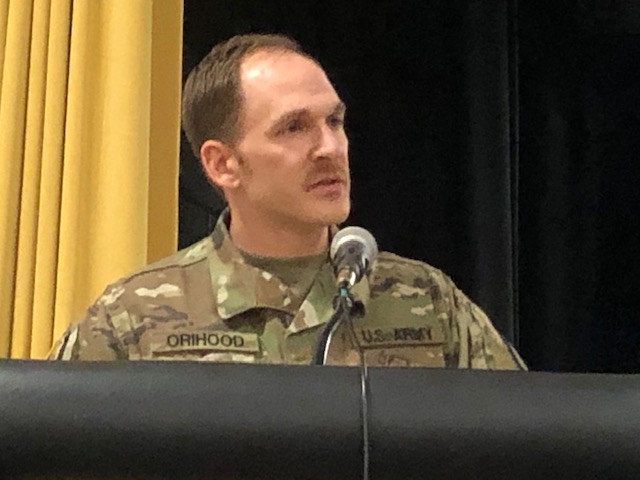
Mayor Harry Baughn, the announcer for the evening, introduced Sergeant Josh Orihood of the North Carolina National Guard Counterdrug Task Force.
“The North Carolina Counterdrug program does almost all of what the National Guard does,” Orihood said. As full time Title 32 National Guard, not only do they assist with disaster relief, but they work with law enforcement and others across the state on ground reconnaissance.
“We can bring things to help law enforcement and volunteers from community coalitions,” he continued. “All we do in the military is logistics and planning and we can encourage you with this and take you through the logic models. We encourage you to seek multiple data sources. It is important to get data feedback. I applaud you for getting these surveys done. Law enforcement has a lot of data, too, and we want to encourage you to bring that together.”
Patti Tiberi, prevention coordinator for Mountain Strong, worked with the coalition in Clay County in the past. She encouraged the community to continue working together as neighbors. “We know more about the brain now than we did then,” she said. “Alcohol acts as a depressant for older people, but it is a stimulant to young people. Our prefrontal cortex does not always work as well as teens. A lot of addiction begins with teens using tobacco and alcohol.”
Tiberi encouraged everyone in the community to visit: Talkitoutnc.org and sign the online pledge. “Adults, talk to your
young people. Talk to others over 21 who are providing it,” she urged. “Young people, if you have friends talking about things that concern you, have them talk to a trusted adult.”
Teens in western North Carolina are not drinking as often, but they drink more when they do. “Our alcohol overdose rates are higher than the state level,” Tiberi said. “The Good Samaritan Law also applies to alcohol so call 911 if you think someone seems passed out or is having trouble breathing. Law enforcement will protect you.”
Clay Schools interim Superintendent Scotty Penland added, “There is no single solution. We have all got to try to make a difference.”
The schools have the DARE program, random drug tests for athletes and Mendez Too Good For Drugs curriculum was used in the past.
School Resource Officer Donovan Byers said DARE is moving into grade seven this year and the Students Against Destructive Decisions program has been reinstated with 50 students.
“Today’s youth are tomorrow’s leaders,” Byers said. “It is unlawful to consume alcohol under 21. It can result in criminal charges and can impact future employment and the ability to gain admission into college.”
People of Clay CARE does not yet have a web site. To be added to the email list or request statistics, call Ricky Hill at Hinton Center 389-8336 or (828) 226-3048.