
By Linda Hagberg
Guest Writer
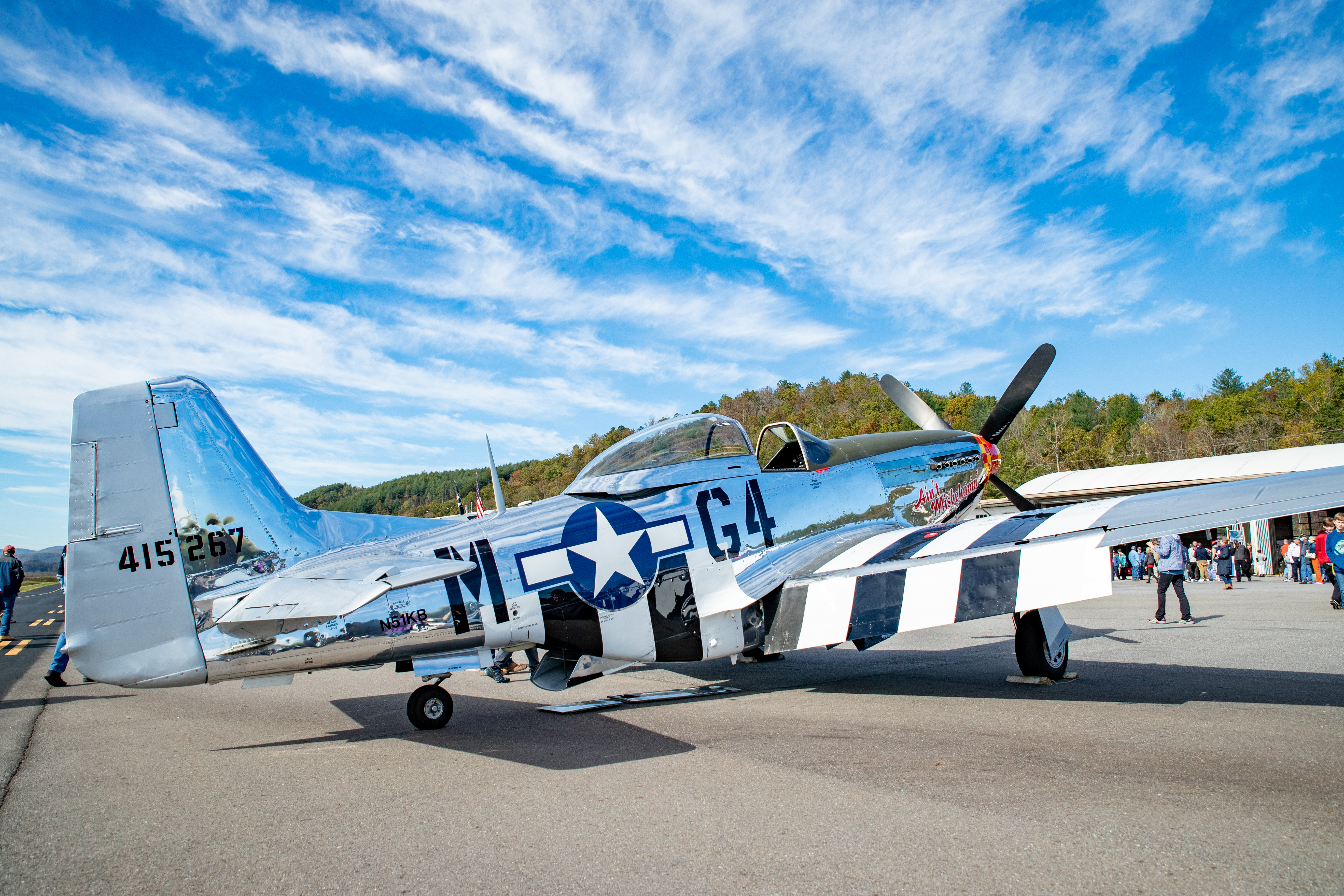
Welcome Home - A Tribute To All Who Serve will host its third annual event to celebrate veterans at Western Carolina Regional Airport on Saturday, Oct. 30. This event showcases several different vintage aircraft from different periods of conflict. While visiting this event, you will have a chance to view these aircraft. A series of articles about each aircraft that will be at the event and its purpose in the conflicts it served in will inform the public about them. The series will begin with the P-51 Mustang from WWII and beyond.
The North American Aviation P-51 Mustang is an American long-range, single-seat fighter and fighter-bomber used during World War II and the Korean War among other conflicts. The Mustang was designed in April 1940 by a design team headed by James Kindelberger of North American Aviation in response to a requirement of the British Purchasing Commission and first flew on Oct. 26, 1940.
The Mustang was designed to use the Allison V-1710 engine which had limited high-altitude performance in its earlier variants. The aircraft was first flown operationally by the Royal Air Force as a tactical-reconnaissance aircraft and fighter-bomber. Replacing the Allison with a Rolls-Royce Merlin resulted in the P-51B/C model and transformed the aircraft’s performance at altitudes above 15,000 feet without sacrificing range allowing it to compete with the Luftwaffe’s fighters, according to the National WWII Museum.
During World War II, Mustang pilots claimed to have destroyed 4,950 enemy aircraft. At the start of the Korean War, the Mustang, by then redesignated F-51, was the main fighter of the United States until jet fighters, including North American’s F-86, took over this role. The Mustang then became a specialized fighter-bomber. Despite the advent of jet fighters, the Mustang remained in service with some air forces until the early 1980s. After the Korean War, Mustangs became popular civilian warbirds and air racing aircraft.
There were a total of 8,000 produced and were equipped with six .50 caliber machine guns. The Mustang could carry 2,000 pounds of bombs or 10 five-inch rockets. The maximum speed was 437 miles per hour and could reach an altitude of 41,900 feet, climbing at a rate of 3,200 feet per min. The fuel capacity for this plane was 269 gallons. The “P” stands for pursuit on the aircraft. It was later changed to “F” to designate it fighter.
Come out to Western Carolina Regional Airport during the “Welcome Home” event and see this airplane. It will be one of several on display. You will be able to see the inside and maybe watch it take off and do a flyover around the airport. There will be free food and lots of entertainment for you to enjoy. Make a day of it while helping celebrate our veterans.