
Board takes step to prohibit these kinds of commercial projects
By Becky Long
Publisher
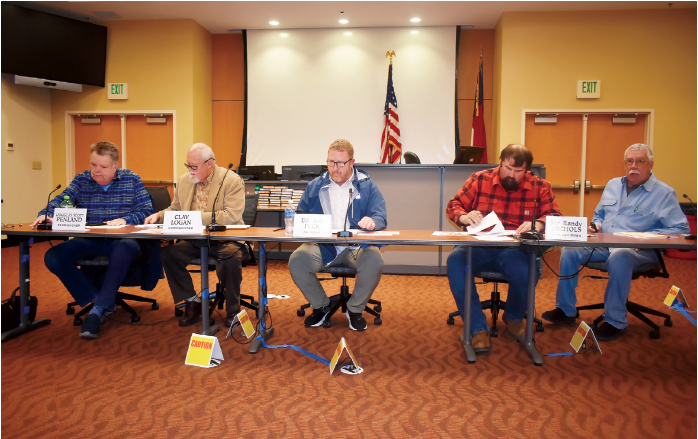
Clay County commissioners received applause on several occasions from a crowded room during the Jan. 8 board meeting. One reason was support for a resolution that prohibits commercial data centers from operating in the county. It is believed Clay is the first county in the state to enact this kind of ordinance.
The resolution passed the board unanimously upon a motion from Clay Logan, seconded by Randy Nichols. It was also supported by the county’s planning board. The prohibition applies to all of Clay County with the exception to the municipality and extra-territorial jurisdiction of Hayesville, which could opt to adopt the ordinance.
Before voting, commissioners heard several comments during the public hearing portion — all of which supported the ban on commercial data centers here.
“I’d like to begin my comments by thanking our board of commissioners for taking action in prohibiting crypto mining in Clay County back in 2022,” said Michael Benoit. “This proactive decision has protected our community from the noise, pollution, property devaluation and disruption that our neighbors in Cherokee County have been forced to endure.”
Benoit pointed out that disadvantages of a commercial data center are enormous. “A1 data centers are even worse with regard to scale, intensity and community impact,” he said, “They are built to operate a maximum capacity and run continuously round the clock, 24/7.
“These data centers can consume enough electricity to power an entire town, and cooling them can use up to 5 million gallons of fresh water per day,” Benoit said.
Other negatives included water contamination risks, more servers, more cooling, more power and more water.
“Prohibiting commercial data centers is not anti-technology,” he said. “It is pro-community, pro-water security, pro-nature, pro-property rights and is all about protecting our land for generations to come.”
Amy Price who worked at a data center and has a background in the field said, “These new data centers are resource hogs. “One location is expected to use the power of Atlanta.”
The resolution
The resolution supporting the prohibition of commercial data centers is self-explanatory. It reads in part:
• Authority: Pursuant to NCGS 160D-701, the local governments are granted the power to adopt land development regulation ordinances for the purpose of promoting health, safety, and the general welfare of its citizens.
• Purpose: To promote the health, safety, and the general welfare of Clay County citizens, this ordinance prohibits the establishment or operation of Commercial Data Centers (including those supporting artificial intelligence or otherwise) in Clay County, North Carolina.
• Jurisdiction: This Ordinance shall apply to the unincorporated areas of Clay County outside the corporate limits or extraterritorial jurisdiction of any municipality. Municipalities within Clay County may elect to adopt this ordinance for application within their corporate limits and extraterritorial jurisdictions
• Definitions:
a. “Commercial Data Center” means any facility, campus of facilities, or array of interconnected facilities that is used by a non-governmental entity or business enterprise to operate, manage, or maintain computers or organized assemblies of hardware and software for processing, storing, retrieving, or transmitting data, with a peak power demand of 2 megawatts or greater and which are required to obtain a building permit, an electrical permit and/or any other permits as are required by the North Carolina Building Code to operate.
b. Exemptions. This Ordinance shall not apply to the following:
1. Data processing or server facilities owned or operated exclusively by government entities (federal, state, county, municipal or public authorities) for public purposes only, including emergency management, public safety communications, disaster response, public utilities or essential government operations, provided these facilities do not house facilities that are non-government, have no public utility data,or do not provide any essential public services and/or purposes.
2. Small-scale data facilities with peak demand below 2 megawatts.
3. Non-commercial or internal business data operations incidental to otherwise permitted principle uses.
The ordinance is written to withstand the test of time. It says, “No zoning district or land use classification (current or future) in Clay County shall permit Commercial Data Centers as a principle, accessory or conditional use.”
Regarding the possibility of a variance of the ordinance, the document says that would only be considered in “extraordinary circumstances,” and it must go through a hearing process. “No variance shall be granted unless it is clearly demonstrated that denial would result in unique and undue hardship not created by the applicant and that the variance is consistent with the public health, safety and welfare of Clay County.”
See the full text of the six-page ordinance at the Progress web site: www.claycountyprogress.com.
Jim Reach, who was spoke on behalf of Save our Mountain commended the commission board: “I want to thank the board. Your leadership sends a strong message that it values quality of life among our greatest assets.”
Shooting Creek Transmission project
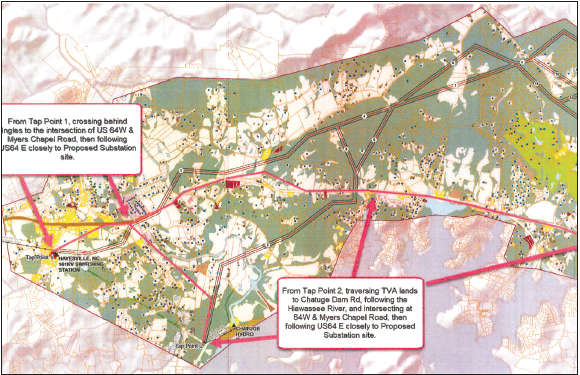
In another matter regarding the environment and land rights issue, County Attorney Merinda Woody, working with the county’s planning board, came up with alternate routes that have been forwarded to Blue Ridge Mountain EMC and TVA to consider in a proposed Shooting Creek transmission project.
The original route caused controversy because it would cross private property lines, could hamper the views, and could create environmental issues, according to oppontents. The purpose of the project was to provide additional power now and in the future. TVA opened a public comment period regarding the issue in November which closed on Jan. 5.
Woody presented an alternate route and map to the commissioners and the public.
• Proposal No. 1: From Tap Point 1 on Hwy 69 across from Mountain Valley store, crossing behind Ingles to the intersection of U.S. 64 west and Myers Chapel Road, then follow US 64 east closely to the proposed substation site and would see the lines follow Highway 64 all the way up to their proposed substation.
•Proposal No. 2 From Tap Point 2, traversing TVA lands to Chatuge Dam Road, following the Hiawassee River and intersection at 64 west and Myers Chapel Road, then following U.S. 64 east close to proposed substation site. A benefit is that is already a right of way on Highway 64.
•Proposal No. 3: Go through the lake. “TVA has to do work on the dam, it’s a good time to put that in,” Woody said.
Woody said the Planning Board would like to meet with BRMEMC and TVA. They are asking for a 90-day extension for further review and comment.
Edward L. Roach honored
Commissioners approved a resolution to support the honorary designation in the name of Edward L. Roach of a section of Fires Creek Road (NCSR 1300) from the Shallowford Bridge at Mission Dam Road northeast to the Fires Creek Bridge at Slate Stone Lane, consisting of a total of 3.l miles.
Citing Roach’s years as service, the resolution said: Edward L. Roach retired after 30 plus years of teaching, having served his community as the Hayesville High School Agriculture Education Instructor from 1969 until his retirement.
Roach served on the Clay County Board of Commissioners from 2014 to 2018 and served as its chairman from 2014 to 2015. During that time, he served on many local and statewide boards and committees.
He has been very active in the community, taught Sunday School at Fires Creek Baptist Church and Little Brasstown Baptist Church for over 20 years; served as a member of the Hiawassee River Bass Club for over 40 years; helped to create the Quarterback Club athletic booster club and was very active in its fundraising activities; has been very instrumental in fundraising efforts of various community activities; and has served on various local and statewide civic and agricultural committees, according to the resolution.
Grant money
• The county is receiving four grants from Office of State Budget and Management’s Helene Local Government Capital Grant Program.
• Viper System to replace the repeater damaged by Helene - $8,534.
• Ambulance for EMS and equipment - $329,929.
• Clay County Emergency Management Complex- $1,850,067
• Hayesville - Emergency Management Complex- $2,188,530.
County Manager Debbie Mauney thanks Emergency Services Director Jeff Ledford and Hayesville Mayor Benita England for assisting in the process and supporting the applications. Commissioners noted in seven or eight years Mauney has helped bring in about $90 million in grant money.
In other matters:
• Delinquent taxes will be printed in the Progress the week of March 9 which will be the March 12 issue.
• Commissioners approved the appointment of a Board of Equalization and Review. It comprises Ed Ream, chairman; Chris Cotton, vice chair; Gary Reffit, Shelagh Whitney and Michael Anderson.
• Mauney was given the green light to apply for an EPA Helene Recovery Fund which will help with the $10 million estimated cost to bring the landfill up to date.