
By Lorrie Ross
Staff Writer
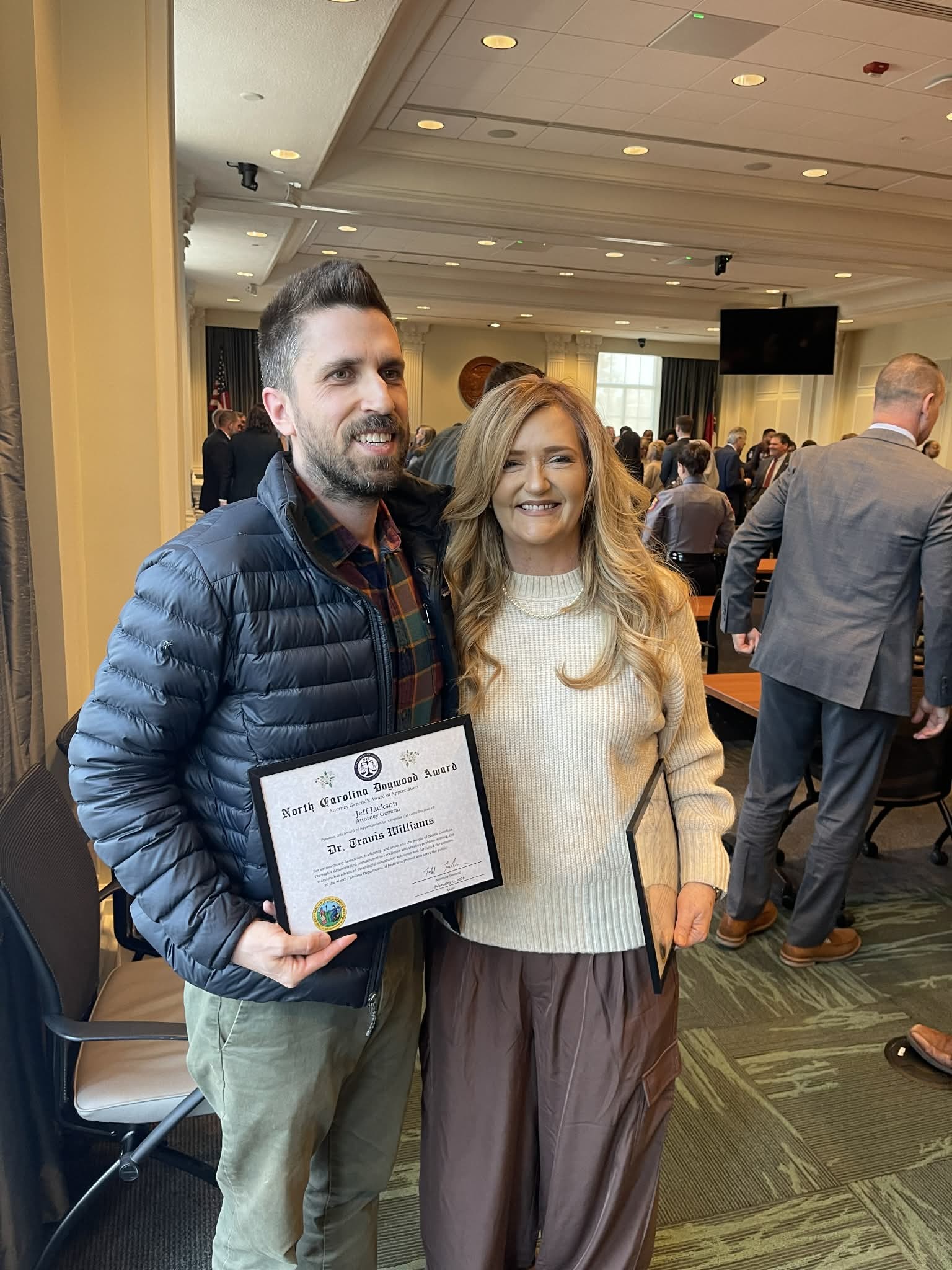
Clay County residents Stacie Ledford and Dr. Travis Williams trekked halfway across the state to Raleigh last week. That may not be an uncommon trip for some locals, but Ledford and Williams returned bearing Dogwood Awards from North Carolina Attorney General Jeff Jackson.
When Governor Josh Stein visited Clay County several weeks prior, he met Ledford and Williams, along with others working to address substance use disorder. The governor was impressed with their work, so he recommended Ledford and Williams to the attorney general as award recipients. Both are very grateful to be honored, but also to bring more attention to the needs of the local recovery community. This week, they shared their thoughts about hearing the news, along with how it feels to be honored.
Ledford almost did not answer the phone that Friday when she received a call. “I typically wouldn’t answer an unknown number but something said ‘answer this call,’” she laughed. “It was Jake Bertolini-Felice from Attorney General Jeff Jackson’s office.”
The caller said Stein told the attorney general he was impressed by the work she had done with Rock Bottom Recovery and Support. She was invited to Raleigh to receive an award. “Shock was my response followed by an immediate yes,” Ledford said.
Williams said Ledford called him, screaming the news. “That’s what’s funny about all this. Stacie called me on one of my days off to say she was being given this award after meeting the governor a few weeks prior,” he said. “She deserves this more than anyone given all the tireless effort she’s exuded over these years, with minimal help.” Williams did not know he had a message waiting at work inviting him to also receive an award.
After a weather postponement, the awards ceremony was held on Friday, Feb. 13. Williams was born and raised in that area, but had not been in downtown Raleigh since he attended NC State. “It was nice to be home for a visit,” he said. “Plus, I haven’t seen the capitol area since childhood. I was able to attend with my mother, who exhibited the typical southern mother pride.” Ledford was accompanied by her husband, Jason Ledford
The two were among several award recipients from around the state. When asked about connections made, Williams replied. “Absolutely. Dr. Nabaran Dasgupta is a well-known, respected researcher at UNC-Chapel Hill that currently runs the Opioid Data Lab, which accepts samples.”
According to Williams, Dasgupta partners with MAHEC and other large organizations. In addition, Dasgupta’s lab runs free testing to determine the composition of current substances on the streets. “This allows for contact with various community members, physicians, peer support specialists, folks struggling with addiction and others to know what may be contaminating or altering their supply,” Williams said. “Stacie and I had a conversation with him about partnering for our region so we know what types of drugs are on the streets and notifying those that may be susceptible.”
Ledford added, “I made some connections that will hopefully be resources. There honestly wasn’t much time for chit chat.”
Williams said this paves the way to continue assisting those with mental health disorders and substance use. “Also, the hard work the county has continued to pursue in advancing our healthcare and similar needs in the future. This includes prevention work,” he said. “It puts our county on the map after we’ve been isolated and forgotten for so long.”
The Attorney General’s Dogwood Awards were created in 2017 by Stein who was then N.C. Attorney General. The awards honor North Carolinians dedicated to keeping people safe, healthy and happy in their communities. Some past recipients include Casey Cooper, Cherokee Indian Hospital CEO; District Attorney Ashley Hornsby Welch; Tessie Castillo, with Carolina Harm Reduction; Blake Fagan, Physician and Chief Education Officer at Mountain Area Health Education Center; Amy Upham, Buncombe Opioid Response Coordinator; Sarah Gayton, who developed the first North Carolina medication-assisted treatment program for incarcerated people; Chase Holleman, Guilford Naloxone Task Force; Ethan Clark, founder, North Carolina’s Weather Authority; along with numerous law enforcement professionals and Hurricane Helene responders.
“I am not sure I should even be in the categories of the heroes that helped with Helene,” Ledford said. “However, it was very humbling and such an honor to be recognized alongside such remarkable people.”
Williams said, “Years ago, my medical school mentors told me you need to not only understand what your community needs, but understand the sacrifices you and others must make for that rural community. So it’s humbling and grounds you. As someone who was born and raised in North Carolina with nearly my whole life spent here, along with all of my ancestors and before me, it’s immense pride for your home. There’s a quote I’ve always liked, ‘I like to see a man proud of the place in which he lives. I like to see a man live so that his place will be proud of him.’”
Williams said other people who deserve recognition for their efforts throughout the process are County Manager Debbie Mauney; Health Department Director Clarissa Rogers and the Director of DSS Todd Goins, “None of this is possible without their leadership, having an open mind to something that’s an evolving field and willing to stick to evidence-based medicine, gold standard of addiction medicine,” he said. “We will never have certain harm-reduction strategies, such as needle exchange and that’s fine because it may create distraction, friction and animosity throughout the community, particularly since some harm reduction strategies don’t necessarily help people get into recovery. They have been realistic to our needs, our main players and how we can build a steady ship along the way. In addition, mental health counselor Andrew Gray has been an integral part of our team and none of this would be possible without him. Some of the opioid settlement money assisted in our collaborative model of integrating behavioral health into the clinic and community and Andrew’s wisdom and experience working in addiction and mental health have been a foundation we want to build upon.”
Williams believes Stein and Jackson have been pro-recovery, but also advocates for Western North Carolina, especially since Hurricane Helene. ”They have been on a crusade to help this region heal over the past few years,” he said. “It’s well-known that Clay, Cherokee and Graham County have been negatively affected by limited access to treatment of substance use disorders and mental health, Hepatitis C and more, based on data over several years. I think recent conversations have allowed us to take a front stage to the incredible things we’ve been able to achieve; also, how much work we have left to do and how much more we hope to accomplish.”
“This is a perfect example of ‘people don’t care how much you know until people know how much you care,’” Ledford said. “People respond to connection. If we can get past the stigma of substance use and view it as a disease and seek proper treatment, we can knock down the walls of judgment.”
Ledford ended. “Every life matters. We all are made in the image of God and should look for opportunities to serve others.”