
By Lorraine Bennett
Staff Writer
If disaster strikes in Clay County, be it flood, fire, hurricane or tornado, the time to prepare is before it happens.
That was the overriding theme of the Thursday, Sept. 4 Disaster Preparedness Workshop at Hinton Rural Life Center.
A surprisingly small number of citizens turned out for such a heavy subject. Only about 30 people showed up to hear from two former retired nurses – one of them a former Red Cross disaster volunteer, a representative from the Clay County Sheriff’s Office, Hinton’s construction ministry coordinator who had relevant home protection tips, a Cooperative Extension Service staffer with suggestions on protecting original documents, and the founder of Virtual Storefronts, who shared a new app available via Smartphone for getting reliable information quickly during an emergency.
Retired nurses Jill Long and Sheila Rodgers who are affiliated with the Institute for Continuing Learning at Young Harris College and share more than 70 decades of nursing experience between them, opened the evening’s presentations after introductions by Rev. Dawn Martin, Hinton’s minister of mission outreach.
Long, who recalled her experience on the Red Cross Disaster team, said absolute necessities in preparing for any disaster are a ready-to-go bag, portable, preferably on rollers and easy to transport and luggage tags in case the bag gets misplaced.
The to-go bag needs to be secured in a place easy to reach in a hurry. She said she keeps hers in her closet, just in case she needs to grab a jacket or change of clothing on her way out.
Preparations for a tornado include:
• Taking shelter in an interior room.
• Securing all outdoor furniture.
• Taking care of animals.
• Activating an alert system so neighbors or relatives know where to find you.
Preparations for flooding include:
• Moving furniture to an upper room if you have one.
• Moving all valuables to a safe place.
“It takes only two inches of water to drown in,” Long warned. “Six inches of water can wash you off your feet.”
Preparations for a fast-moving fire include:
• Clearing brush five feet away from your house.
• Anticipating the need to evacuate in a hurry.
• An n95 respirator mask for protection against smoke inhalation.
• Taking any medical equipment you may need.
Preparations for an earthquake include:
• Standing in a door frame, preferably a closet door frame.
• Securing your pets.
Long strongly suggested signing up for emergency alerts on your telephone, purchasing a small weather radio and keeping a supply of batteries you may need for backup. If power goes out, Long suggested unplugging whatever you can because there will be a power surge when electricity is restored.
“Make sure your neighbors have your emergency contact numbers. If you live in a neighborhood, establish a meeting place where you can share information,” Long suggested.
Both nurses agreed the to-go bag needs to include a small emergency kit with medical supplies, vital personal documentation including house insurance information and your agent’s number, your car title, passport, voting card, driver’s license, social security card and supplemental health information. They suggested putting such pertinent information in your phone but backing it up with a hard copy in case the phone is not usable and keeping the hard copy in a waterproof pouch or folder.
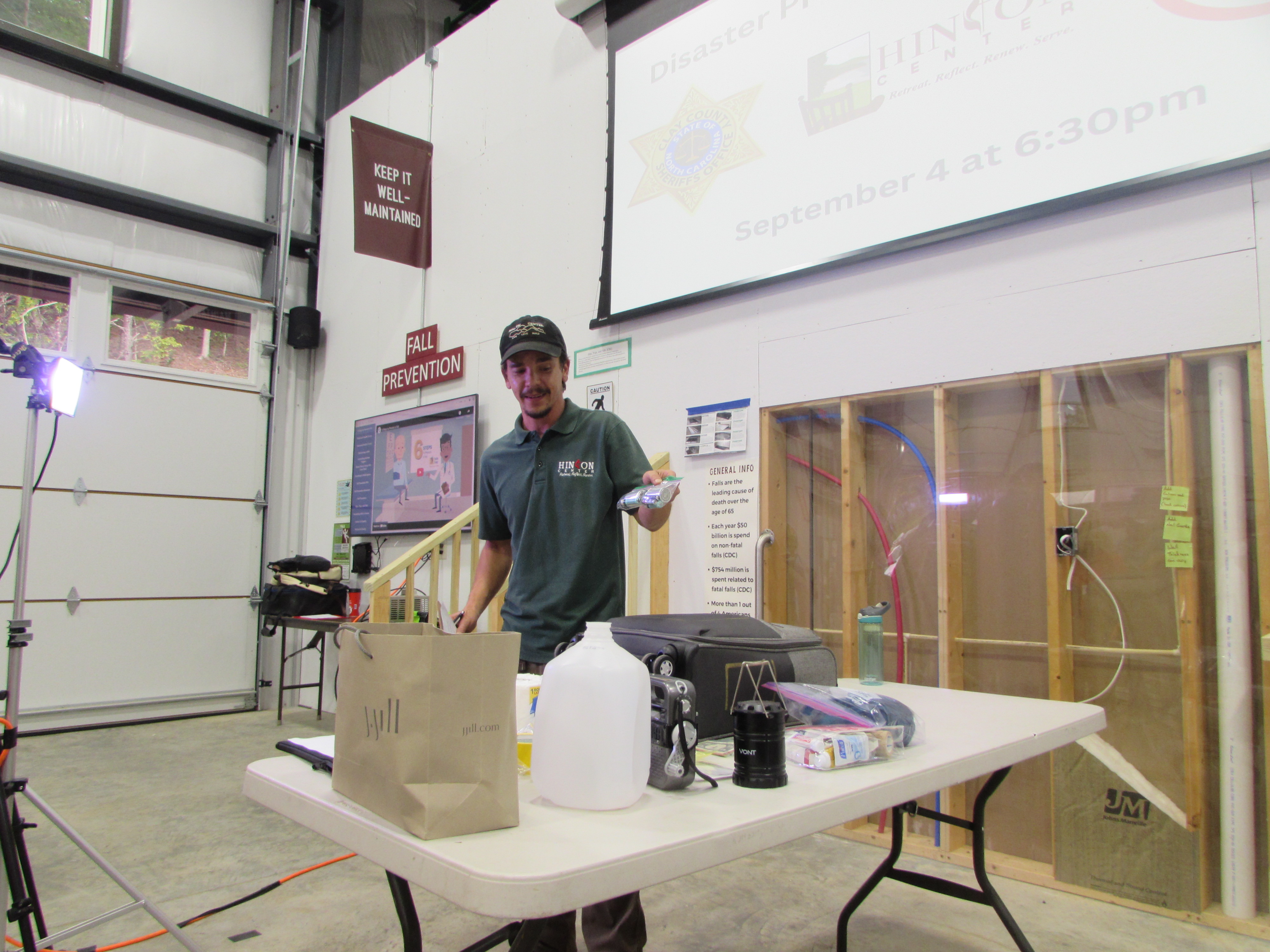
Also included should be a gallon of water a day for each person, medication to last a week and portable food such as peanut butter and granola bars. People who have pets should include pet food, water, a leash and carrier. Further needed will be a change of clothes, cash in small bills because $100 bills are difficult to change in an emergency, birth certificate, phone chargers and cables, flashlight and extra batteries.
Blankets, extra car keys, extra toiletries, hand sanitizer and a note pad and pen might come in handy if life is disrupted for an extended period of time, the nurses suggested.
Nick Oliver, Hinton’s construction ministry coordinator, said if homeowners have to leave in a hurry they should shut off the breaker in their home and always know where the flashlight is.
“Practice and prepare,” he suggested. “Now is the time.”
Because a disaster could happen anytime to a local community or even across the nation, “Now is the best time to make your list and find the weak points,” Oliver said. Having a tarp stored in the garage would be helpful if a roof is compromised. Tape to reinforce windows and doors would be useful to keep cold weather or rain out of a damaged home.
“If a tree is weak have it removed. Anchor your projectiles. Know how to cut off your power. If you have county water, know how to turn off the valve,” he said.
Danny Ferreira, N.C. Cooperative Extension Service’s digital skills agent, advised that all important original documents need to be kept in a fireproof safe or box and what goes into the to-go bag should be copies. He also suggested putting pertinent information on the Google Cloud as backup.
“Get a mobile banking app and a pharmacy app if you need medications,” he said. “FEMA has an app. Red Cross has an app. You can apply for disaster relief through FEMA’s app but you will need an email address. Put a medical ID on your phone so emergency workers can get to it without having to know your pin number.”
Todd Wingate, chief deputy from the Clay County Sheriff’s Office, recalled some of the challenges Hurricane Helene presented and what his office has learned from them.
The sheriff’s office provided help in stricken areas with impacted roads, safety, welfare checks, recovery and security issues, Wingate said. Food, water and medical supplies were needed and personal hygiene was a “big deal,” he said, as was wound care because of the presence of bacteria in the water supply. That’s another good reason to keep tetanus shots up to date, he added.
Regarding the aftermath of the storm, Wingate said, “I personally have not seen anything like that since I was overseas.” He noted the very long-lasting effects it will have on the communities hit and how strategic planning needs to go into surviving that type of event.
Clay County’s response to the storm event was noteworthy, he said, because of the generous way its citizens responded with donations of food, clothing and other items needed in impacted areas.
“Clay is one of the great counties because of the way her people give,” Wingate said.
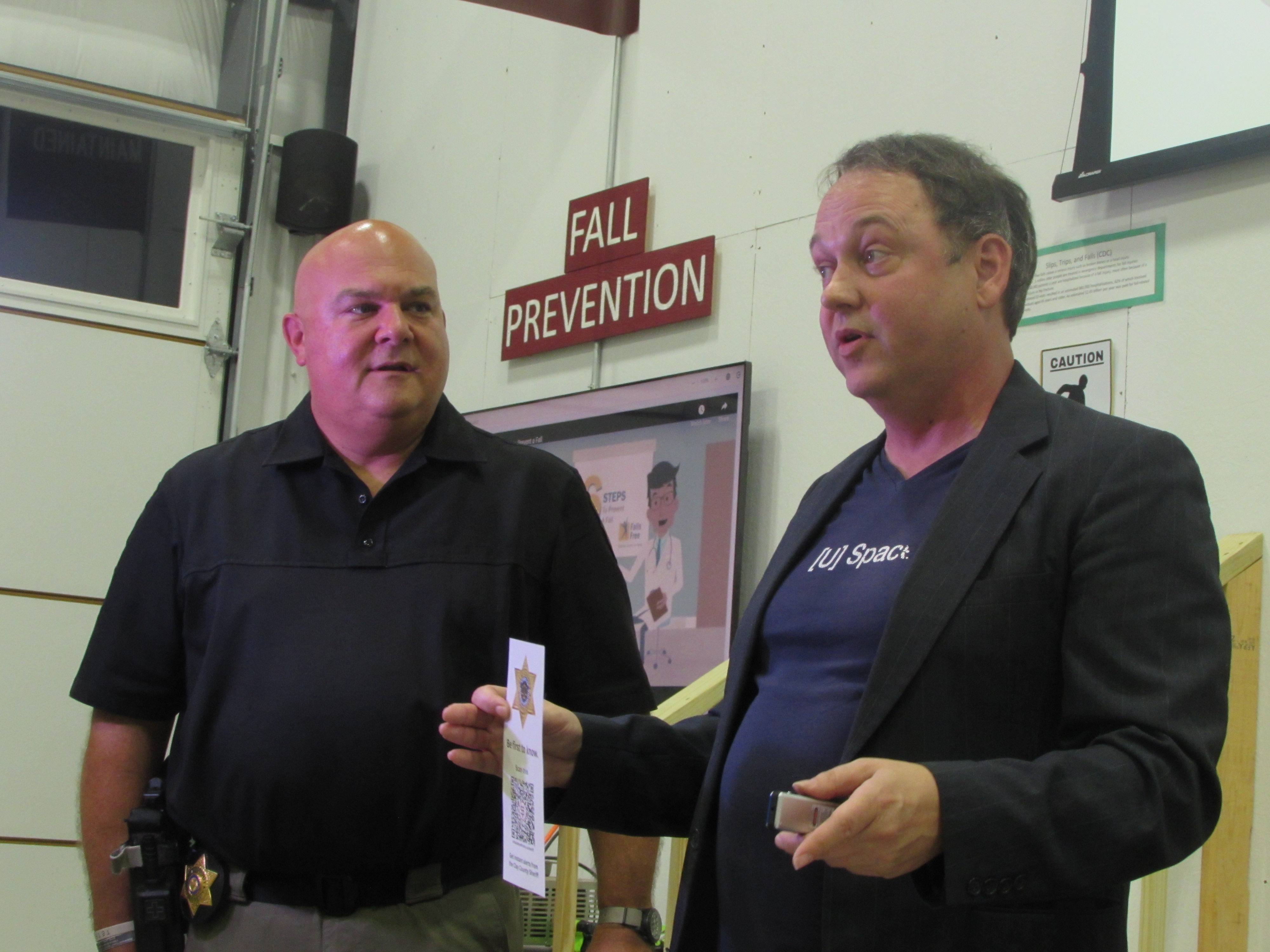
Wingate and Sheriff Mark Buchanan have been working with Tobin Brogunier, chief executive officer of Virtual Storefronts, which is a public safety broadcast plan developed for local areas as a way to get fast, reliable, verifiable information out to citizens as quickly as possible and much more reliably than Facebook.
“Facebook is the TV of the 21st century,” Brogunier said, but it is not verified information. “During Helene you did not have information about what was happening in other areas and that was a problem.”
Wingate recalled the harrowing experience of Jacqueline Gottlieb, Hinton’s chief executive officer and president, trying to reach her daughter after Helene struck. She searched frantically for accurate information on open roads and storm damage aftermath. Social media and even local radio stations were of no help.
Wingate has been working with Brogunier to develop a localized sheriff’s emergency broadcast system that will send out timely and reliable information to residents who might be stricken by a storm or other threatening event.
Nixle, the community information service, sends automated alerts and most of the alerts relate to weather events.
“No one wants to know about tornado information six hours after it happened,” said Brogunier, briefly recalling the recent flash flood disaster in Texas that took more than 130 lives. Most victims had no prior warning.
He said the sheriff’s system could broadcast emergency information only and send timely alerts to local residents.
He said his new app is simple to use and can be accessed via Smartphone for a cost of $199 per year. More information is available at: www.virtualstorefronts.co/sheriff.