
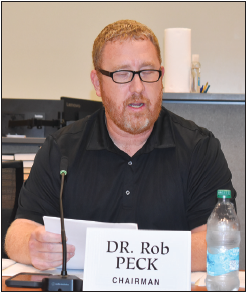
Becky Long • Clay County Progress Commission Chairman Rob Peck reads a prepared statement regarding questions concerning the solid waste use/ availability fee which is itemized on the 2025 tax listings.
By Becky Long
Publisher
A larger crowd than usual attended the Aug. 7 county commission meeting, presumably many were there to hear more about an itemized fee that recently appeared on their 2025 residential property tax listings.
Formally called the “solid waste use/availability” fee it’s a $100 addition most residential property owners will pay in lieu of the current $125 annual permits.
The exception is residents living within the city limits of Hayesville who already pay for garbage and recycling services through their town taxes.
Campers and campsites will pay $50 per unit for solid waste disposal services.
The funding generated from the fee is earmarked for transfer station use only.
When the ordinance was approved in July, commissioners agreed the revenue will help pay for sustaining the county’s transfer station and making improvements which they say have been needed for years.
“The worse thing we can do is do nothing,” said Chairman Rob Peck.
The solid waste fee was not on this month’s agenda, but Peck opened it up for comment after reading a 9 1/2 page “chairman’s statement” detailing circumstances that led to the fee. The document was read on behalf of the board and appeared to answer questions that had been posed by local residents, particularly on social media.
The statement can be read in full at: https://www.claycountyprogress.com/local/chairmans-statement-solid-waste-availability-fee but among the items Peck underscored was the need for the ordinance which was passed on July 17. Titled “Regulating the Assessment of Solid Waste Fees and Solid Waste Tipping Fees.,” Peck reiterated that the proposed ordinance was posted and advertised in two issues of the newspaper and online.
Referring to the history of transfer station issues, Peck read in part:
“Since FY 22/23 the Clay County Transfer Station has lost a total of $113,568.34. (expenditures $1,862,461.78 minus revenues $1,748,893.44 from 22/23 through 24/25) In the last fiscal year alone, the transfer station lost $85,433.36. This is primarily due to the increase in the cost of operating. During this time, revenue from permits, daily user fees, scrap metal, commercial hauler fees, white goods and scrap tires have remained essentially the same with only a slight increase in collections over that three-year period in a total amount of $27,405.42.”
Peck continued, “The largest operational increase year after year is the increase in Solid Waste Transport. This is the cost associated with hauling off the refuse. In addition, there are increases in the cost of disposing of tires. Prior grants are falling short of covering this expense. In recent years, the old landfill had to drill and install monitoring gas wells and vents, make modifications in the old facility, and cover the cost to monitor the water testing of the closed landfill. In addition, other contracted services have increased including calibration of the scales. Currently, the scales are having to be reset every couple hours of operation by staff. The failure of the scales is due to worn bushings and rods. This is an item that will need to be addressed as it is essential for daily operations. The cost estimate from 2024 to be replaced as part of a larger plan to expand and improve the facility ran approximately $100,000.00. In addition, the scale house itself needs to be replaced. A prefab scale house has been estimated at $50,000.00.
Additionally, and of critical note, a November 1, 2022 Department of Environmental Quality (DEQ) Facility Compliance Inspection Report, Division of Waste Management, Solid Waste Section, noted the following:
#11. “Spalling was observed on the tipping floor and aggregate was visible. Some of the aggregate is becoming dislodged from the surface. Continue to monitor the floor and if any rebar becomes exposed, contact the Section, as a repair plan will be necessary. The tipping floor will have to be replaced or repaired in the future and significant costs should be expected during this process.”
#12. “The push wall on the south side of the building has been damaged and rebar is showing. The push wall should be repaired to prevent further damage and to ensure the facility is being maintained in accordance with the Permit to Operate, Attachment 3, Part I, #8.”
See DEQ Inspection Report dated 11/1/2022
The estimated cost to repair the transfer station in 2024 was $150,000.00.
On March 6, 2023, the Board of Commissioners took proactive measures to work towards addressing the concerns above while planning for the continued growth of the county by contracting with McGill Associates, 55 Broad Street, Asheville, NC 28801. McGill was charged with developing a plan to overcome the notable issues of the recent inspections on November 1, 2022. As noted by McGill, to resolve the issues, Clay County would need to cease operations at the current facility so repairs could take place. At the direction of the board, McGill was tasked with developing a capital improvement plan which would allow operations to continue, while simultaneously increasing safety and efficiency with expansion of the facility to meet the growing population. After numerous site visits, BOC feedback, and multiple conceptual drawings, Clay County received the “Master Plan Concept for Clay County’s Transfer Station” and associated cost estimates on April 4, 2024. The day after (4/5/24), County Manager Mauney was on a zoom call for another county project (EMS) with the USDA and inquired about a USDA grant/loan to fund the Transfer Station Project. The 2024 cost estimates from McGill for multiple proposals ranged from $5.65 to $8.34M. Obviously these costs estimates are now dated.”
After Peck concluded reading the statement, the public comment period followed. Among the few concerns raised was how campgrounds would handle the $50 individual fees per camper.
“We do not use the transfer station. I have dumpsters that I have picked up. The people who haul my trash don’t dump it here — they dump out of state, “Now I have $2,000 worth of fees,” ” said campground owner Johnny Claude Ashe.
“I want to know is your campground exempt from that?” Ashe said referencing county operated Gibson Cove and Clay County Recreation Park at Lake Chatuge. “Your trash don’t go to the landfill either.”
County attorney Merinda Swanson Woody explained that under N.C. statutes, a county cannot tax itself so the county is exempt from that fee.
“You as a property owner are able to use that [transfer station] if you ever wanted to,” Woody said noting that the ordinance refers to it as an “availability fee.”
Clay County’s solid waste is hauled from the transfer station to Homer, Ga. for disposal.
Regarding the fee, Derek Laugher, speaking on behalf of Betty and Wylie Penland of Penland Point, said he thinks it’s not fair that campground fees are all the same. “It’s unfair to burden campgrounds; some campgrounds are open seven months compared to others that are open nine months, but they both get charged the same fee. Is that fair?”
Swanson also explained that state law requires government to be equitable in assessments.
One person said they live on Social Security and was concerned about paying an extra $100 per year. Peck offered suggests for getting help.
“The Clay County Board of Commissioners realizes that while most people pay for curb side pick-up out of convenience, some may have legitimate financial hardships or physical limitations which may require residential trash pickup,” Peck said. “For those individuals, a combination of the solid waste availability fee and the cost for private pickup may be a burden.Fortunately, programs exist that offer property tax relief that may help offset the solid waste availability fee for qualifying homeowners. They include:
“• Homestead Exclusion (elderly or disabled). This program excludes the greater of the first $25,000 or 50% of the appraised value of the permanent residence from taxation for homeowners who are 65 or older or totally and permanently disabled, a Clay County permanent resident, with a 2025 income not exceeding $38,800.
“• Disabled Veteran Exclusion- Excludes up to $45,000 of the appraised value for disabled veterans with a service-connected total and permanent disability or their surviving spouse.
“• Circuit Breaker Deferment- For homeowners meeting the same age or disability criteria as the Homestead Exclusion, who have owned and lived in the property for at least five years, this program caps property tax payments at 4% of income if 2025 income is $38,800 or less, or 5% if income is between $38,800 and $58,200. Any taxes over the limitation amounts are deferred and remain a lien on the property. A disqualifying event will result in three years of deferred taxes to become due and payable with interest on the date of the disqualifying event. The program must be applied for annually.“
Another topic broached during the comment period was the county budget of which preparations begin in March before it is adopted in June.
Another resident, Lynn Grove asked commissioners to be more inclusive and interactive with the public during the budgeting process.
“Local governments should provide opportunities for public input,” she said. “Much could be done to engage the public. When you publish next year, I would hope the process starts in January and you consider printing the budget in the newspaper. Your constituents deserve to know what is being considered.”
Commissioners meet the first Thursday of the month at 6:30 p.m. in the mutli-purpose room of the county courthouse.