
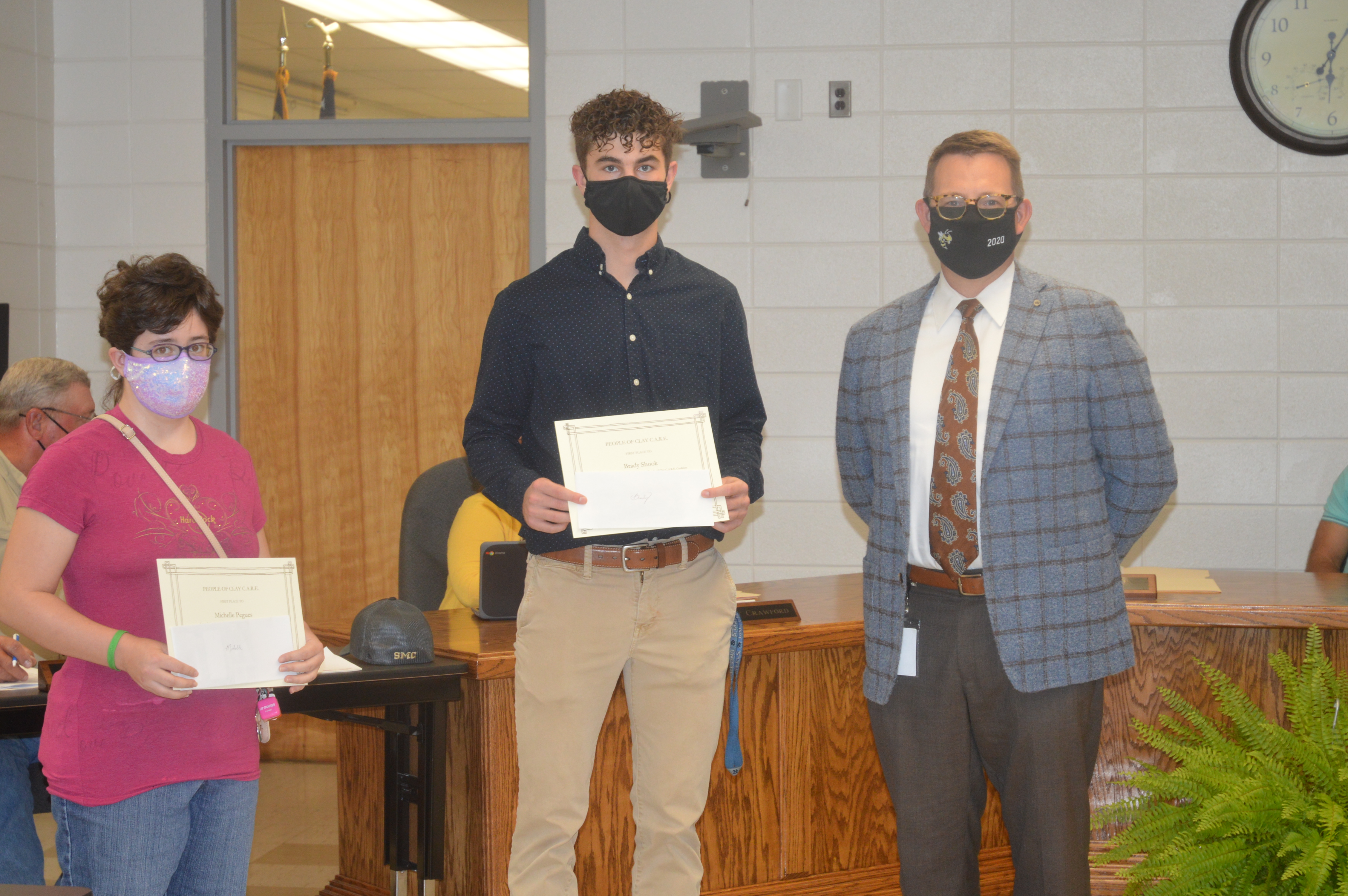
October’s meeting of the Clay County Board of Educa- tion began with student and staff recognitions. Hayes- ville High School students' Michelle Pegues and Brady Shook received awards for logo designs they submitted to People of Clay CARE.
The students' logos were combined into one logo for
the coalition. Youth engagement is an important part of primary prevention, therefore the coalition asked youth to submit designs for its logo.
In addition to presenting the youth certificates, Cole recognized Clay County Schools principals commemorating October's National Principals Month.
“Being a principal is difficult. I want to recognize their work, especially since March when the difficulty has gone to a new level. I could not lead the school system without their help,” Cole said, as he named them. “It truly is a team effort. I can't ask for a better team and we have wonderful leaders in this school system, so I want to recognize them and give them a hand.”
Hayesville Primary School principal is Lindsey Hodnett and Hayesville Elementary School has Melissa Godfrey as principal, while Tommy Hollingsworth is principal at Hayesville Middle School and Jim Saltz is principal of Hayesville High School.
After recognitions, reports were given to start the business portion of the Monday, Oct. 26 meeting. Communities for Schools Director Theresa Waldroup shared information about Faith- Based Partnerships for Childcare Needs. It started when The Village Pastor Andrew Brown asked how to serve Clay County students during remote learning days. Waldroup contacted County Manager Debbie Mauney, DSS Director Todd Goins and Cole, along with churches in the community. Churches wanting to help were The Village, New Life and Mount Pleasant, which was already working on a plan to serve the church children.
Some funds were acquired for needs, ranging from thermometers and hand sanitizer, to masks and gloves. Breakfasts and lunches are being provided by the schools for students being hosted by churches on remote learning days.
In addition to a $10,000 grant from Community Foundation of WNC, a $8,828 grant was given by Nantahala Health Foundation to provide an HVAC system in the Community Service Center where an after-school program serves under-served students.
An application was submitted for an additional grant through Nantahala Health Foundation to staff the church remote learning locations and expand to the full community.
“This speaks of the partnerships we have in Clay County,” Waldroup said. “It’s all about serving these children.”
Angel Owens, Clay County Schools director of Feder- al Programs, explained the 2020 CCS Federal Programs Audit process.
“It was a virtual visit this year, but they typically come out from the state. We passed and I have to say I was very appreciative of the compliments we received during our interviews. They were very impressed with Clay County Schools and we are using our funding to serve our students with the best of our ability,” Owens said. There are 42 indicators and 150 documents she was required to submit.
There were no required changes, although the one recommendation given to the schools was to develop a written protocol to iden- tify migrant students and explain how services are implemented. Owens said Clay County Schools does not currently have migrant students, although they have identified them in the past and will write the recom- mended protocol.
Cole added, “I have done a few of these and this audit is as good as it gets. Kudos to Angel and her team.”
Clay Schools Director of Technology Adrian Jefferies discussed improvements to student internet access.
“Prior to COVID, 70 percent of teachers nationwide assigned homework which required internet access and 33 percent of students have access at home nationally,” he said. “Locally, we conducted surveys in March and found approximately 10 percent did not have home internet access. In August, we still have about 10 percent without internet.”
About 75 percent of staff and students do not have broadband as defined by the FCC, Jefferies said. Using state allotted COVID relief funds, 20 Verizon hotspots were purchased and distributed to students whose inter- net need was verified. Multi-student households were given priority. NC Student Connect gave 40 additional packs and those will also go out soon.
“This does not get rid of our need for better internet, but it drastically helps,” he said. “The community has helped a lot. If you know any kids who do not have internet access, have them get in touch with us in case we don’t know.”
Cole explained each school’s improvement plan team had chosen goals based on 12 key indicators found in high-performing schools across the country. Each of those teams presented its top objectives.
Hayesville Primary School’s team showed a video introducing team members who were selected by an anonymous Google survey. The plan’s main points include:
• Standard based report cards to provide families with a more informative view.
• A virtual family resource guide for 2021-2022 school year.
• Teachers will come together for professional learning teams.
In her presentation regarding Hayesville Elementary Godrey said, “My school improvement team has been amazing,” as she listed her team’s names. HES has had a 10-point increase in the overall school performance rate, indicating it is on the right track, she said.
• All grades third through fifth students will make prog- ress in math and reading proficiency as measured by EOGs.
• All students will achieve an 85 percent or higher on Class DOJO behavior ratings.
• Professional learning community meetings are held weekly.
• A tiered based instruction system is being initiated, as well as interventions for student needs.
“We need to be intentional with transitional plans from primary to elementary andfrom elementary to middle school,” she said.
The HMS report was given by HMS assistant Principal Heather Plemmons and the HMS improvement team.
“We want our students to be life-long learners with the ability to make a positive impact in our community,” she began. A major focus for HMS is to reduce bullying and cyber-bullying. Having a full-time counselor at the school helps, especially since she teaches social-emotional curriculum. The school also has a goal to increase math and reading proficiency and to decrease absences.
HHS principal Saltz presented his report for the high school. “It’s been amazing to have a functional school improvement team,” he added as he asked assistant Principal Stacey Overlin to explain the school’s plan.
HHS has already fully met three of its 12 key indicators,
Overlin explained. “It’s kind of like getting a fly-wheel going,” he said. “You have to keep turning it and pretty soon it is almost running itself. That was the goal when we got started. We have had 72 action steps on our plan in the last year; 57 of those are met and 17 are still being worked on.”
The group is focused on student educational out- comes. Some of the highlights include using an educators’ handbook, departmental planning time, increased communication for at-risk students which reduced failure rates by 42 percent, a system for social-emotional learning has been instituted and a college advisory staff member is working with seniors.
Board members complimented the school teams for their efforts.