

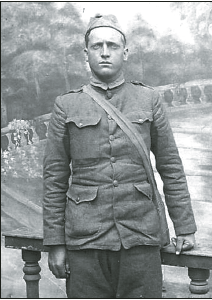
William Leonard Hall, a descendant of Absalom Hooper, served as a private in the United States Army in World War I.
By Marcia Barnes
Feature Writer
An American Revolutionary soldier, Absalom Hooper was born on the main Broad River near the mouth of Green River in South Carolina. In the year that the Declaration of Independence was signed, Hooper enlisted in the army of the United States in Charleston with Captain Richard Doggett.
The foot soldier began serving in the South Carolina regiment under Colonel William Henderson, Commandant; Major Brown; Captain Richard Doggett and Lieutenant Jesse Baker. Hooper was about 13 years old.
His father had died while he was very young and Hooper’s widowed mother was an adherent of the Tories. During the American Revolution, adherents of the British royal government opposed the colonists who were fighting for independence from England.
Absalom Hooper, the boy patriot, ran away from home to join in the fight for freedom. The remarkable story of Hooper’s service is fully documented in voluminous papers mapping his movements in the sieges which took place in the south. Hooper’s fifth great-granddaughter Nancy Cody who resides in Hayesville said that family members followed in her great-grandfather’s footsteps.
William Leonard Hall, Cody’s paternal grandfather, fought in World War I. He was inducted into military service April 1, 1918. Hall was a private in the United States Army and underwent basic training at Camp Jackson, S.C. He was sent to Liverpool, England and from there went on to Belgium and France and served as a messenger boy on the battle front at the Hindenburg Line. Hall had joined the fight with his best friend Bill Martin from Hayesville and they came back from the war together.
Albert Edward Hall who was Cody’s uncle served in World War II. His infantry division went in to relieve the 99th division which had suffered severe casualties. Edward Hall was in communications and lost many partners during the battles.
“All three of my mother’s brothers were veterans of foreign wars,” Cody said. “They followed Absalom Hooper in defending the country.”
When Hooper joined his unit in Charleston in 1776, he served at Sullivan’s Island and at Fort Moultrie helping to repel the British in their first attempt to capture Charleston. The attempt failed and Hooper then went with General Howe into Florida against the British post on Little St. Mary’s River. On the approach of the American forces the British evacuated and the army was marched back to Charleston where General Lincoln took the command. This happened about the time the British took Savannah.
The Southern Campaign of the American Revolution was a vital part of the war because following the British failures of their military campaigns in the northern United States earlier in the war, British military planners decided to embark on a southern strategy to gain control of the ports of Savannah and Charleston.
Hooper was at the Siege of Savannah, also known as the Second Battle of Savannah. The battle was one of the bloodiest of the war and Hooper was in an attack led by the French General DeEstaing at Spring Hill in the attempt to take Savannah back from the British. In this fight, Hooper was wounded by a musket ball in his right arm.
After that battle the Americans returned to Charleston where they remained until the town was besieged by Sir Henry Clinton and Lord Cornwallis. Hooper was with Benjamin Lincoln’s Army defending Charleston and was then wounded in his left thigh by a musket ball. When Lincoln surrendered all of his forces, Hooper became a prisoner of war.
Hooper recuperated from his wound and escaped and having no unit to go back to he went into Georgia trying to reach his uncle’s house. En route, he was captured by Tories and held for five days before being released.
A tireless patriot, Hooper heard of Elijah Clarke’s Georgia Militia, found them and joined. In Clarke’s Militia, Hooper was at the siege of Augusta and was at the capture of Fort Brown and Fort Greyson. He was at a battle on the Little River in South Carolina and he stayed with Clarke until the treaty was signed. After the war he settled on Pistol Creek in Wilkes County, Ga.
How close do we stand to the bloody battlefields where Hooper fought for country and freedom? How close is the memory of his descendants who fought in wars to keep a free world alive?
Very close. Perhaps as near as the length from our shoulder to the hand we raise to our heart as we say, “I pledge allegiance to the flag of the United States of America, and to the republic for which it stands, one nation under God, indivisible, with liberty and justice for all.”