
By Marcia Barnes
Staff Writer
Catherine Brown said that Steve Jackson ran the television station in northwest Alabama and wanted to expand. On Sept. 11, 2001 Brown and her husband had moved from Laurel, Md. to Hamilton, Ala. Jackson hired her to host a local show because she didn’t have an accent.
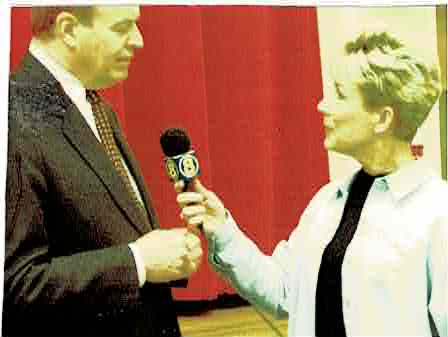
The show was titled “Around Town with Catherine Brown” and Brown flatly admits that she became a country version of Martha Stewart as soon as the shows began to air. Topics were serious when Brown interviewed Alabama’s State Senator Richard Shelby. She interviewed him eight times and said that he called her “his blonde reporter.” Brown also interviewed Governor Bob Riley, but at the beginning of the series it all started out light.
“My first show was called “On a Budget.” I turned linoleum upside down and painted it like rugs to put on porches, took flower pots and turned them into things for Mother’s Day,” Brown said.
When Brown wasn’t in front of a camera she was at work with Sonja Leonelli at the Christian Center of Concern in Hamilton. Brown worked in a voluntary position there for 10 years.
“Sonja and I were co-directors. She did the books, I did public relations and raised the money. That’s how we bought the food, we raised the money. There were no grants. We got $823 a month from the Catholic Church and that’s all we got to pay rent on the building, utilities or something.”
Brown’s life in Hamilton didn’t stop at hosting a TV show and volunteering at the Christian Center. Brown said she continued sewing clothes that were art to wear for her private enterprise, Catherine Brown Designs. She did commercials for a Marion County funeral home and hosted non-profit political commercials. Active in her church, she was president of the ladies group for a year. David Brown had retired from a career in the U.S. Air Force and the couple was building a new home.
As a working woman in Hamilton, Brown was just being her natural self. Looking back, she saw herself as an every day girl growing up with her parents and twin brother in Laurel.
Brown was born on Selfridge AFB in Michigan to Jean and Donald Henyon and said that her parents were an instrumental force in her life.
At 16, the every day girl was chosen as a Seventeen Magazine model. Brown said that the publication had an offshoot, the Hecht Company chain of department stores.
“You were actually interviewed by Seventeen Magazine and they selected 15 girls. We represented the magazine in Hecht Company stores. I was 16 years old and mom said, ‘If you want to try it, go for it.’”
Brown said that her mother had grown up as an Army brat attending many schools. She went to three different high schools in one school year and eventually, would register herself at the next school.
“My grandfather was a career Army man and a colonel in finance. Mom graduated from high school in Washington, D.C. during the war. She always wanted me to have the smarts, independence and self-confidence to see my way through things. She wanted me to be an individual, not one of the pack and to be able to navigate through life.
“Mom was no Donna Reed,” Brown said. “She didn’t wear pearls to vacuum and she worked very hard to keep a house and go to school full time.”
Brown said that Jean Henyon was a mother and home economics teacher and middle school counselor for 20 to 30 years. Her mom worked part time at sewing couture clothing for diplomats’ families and Brown said that “homemade” is not the word.
“When I graduated high school, mom wanted me to work for the U.S. Postal System. I refused. At that time, I would have had to wear a white shirt and blue Bermuda shorts in the summer and I absolutely could not tolerate that thought.
“So, I worked full time and went to school part time and earned a business and marketing degree. At 21, I moved out with my parents’ blessing. I had my mother’s laundry table for my kitchen table, mismatched plastic china and anything I could cover with contact paper.
“Rent was $130 a month and I was working at the hospital in the clinic for $90 a week. I worked part time as a nanny, part time as a seamstress and worked part time at Columbia Mall in retail stores. Then, I moved from the clinic to the emergency room doing triage on patients.”
Her life took a turn in the road. Brown moved to Norfolk after Montgomery Ward pirated her from a part time retail job at Columbia Mall. The new job was to open divisions for the retail chain. Brown said that she opened what they called soft lines, clothing and jewelry and 12 guys ran the expansion of products and new stores.
Brown moved to Moultrie, S.C., then she moved back to Virginia In the move north she became director of advertising for the region and one of the 12 guys.
“At that time everything was done in newspapers. Remember those fliers you’d get in the Sunday paper,” Brown said. “They were called double-trucks. I had four stores to cover every other week and it was labor intense. There were no computers.”
Brown began doing live television spots for Montgomery Ward on a show called “Three in the Morning” and she realized later that it was her first experience in television.
“I had no clue what to say, what camera, how to do it,” Brown said. “The first spot was all about cooking with products from the kitchen department and every TV in every store in the region was tuned to the show.”
A transfer to another location was offered to Brown when Montgomery Ward began cutting her region down. The job was in Chicago in January. That’s when she decided to move back to Laurel and get back with family.
“I was kind of burnt out on retail, a lot of work and decided to get a job managing hotels and started in the catering division working for a tough lady. If you wanted to move up, you moved from hotel to hotel.”
Brown said that she had hotels burn down, guests committed to Saint Elizabeth’s mental hospital, people jumping from the second story into the interior pool and even hanging on sheets out of a window to paint the outside wall.
“One man drove into Room 101. You were dealing with drugs, calling ambulances and the state police to remove prostitutes.”
Brown said that through all the jobs and moves she talked with her mom all the time, keeping the tough stuff to herself. Brown was wearing the suit and high heels she wore every day at the hotel when a fall off a step at home kept her from leaving for work.
A broken ankle sent Brown back to the hospital emergency room where she had worked years earlier and the doctors recognized her. Brown said that while she was getting a cast applied someone from human resources came down and asked her if she would like to work for them again?
“I was so fed up with the hotel business. I was burnt out and fried around the edges.”
Brown started out in a clinical setting again. The hospital was associated with John Hopkins in Columbia, Md. So, they sent her to Annapolis to open a clinic, a satellite in ophthalmology.
“All of my collective skills came together. I talked with mom all the time about cooking and sewing and did things with mom and dad. We worked well as a group.”
Brown said that in her whole time growing up her dad was in banking and always involved in volunteerism. Brown said that her mom, dad and she shared a red blazer worn for assigned volunteer work.
“When I came back, I knew that I was going to end up working with dad in volunteerism. I did. I joined the Lion’s Club and went to meetings. I joined Pet’s on Wheels and was assigned to a nursing home with Ralph the dog.”
One of the events which grew under Donald Henyons’ help was the City of Laurel Fourth of July and it was televised. Brown was back in front of the camera again. Her future husband, David, was involved and would come to help support events.
Brown said that there was Christmas for Kids. They raised money for the City of Laurel Volunteer Fire Department and for the Rotary Club.
“Some of the earlier angst in my life was brought on because I was a single, blonde, skinny woman and that I couldn’t change,” Brown said. “I started out gullible, but mom and dad would have never let me suffer. I knew that.”