
By Lorrie Ross
Staff Writer
Long before he traveled into space, Ron Garan started dreaming about becoming an astronaut. As a young boy watching Americans walk on the moon in July 1969, he made the decision which would eventually have him travel more than 71 million miles. Over time, the former NASA astronaut would spend 176 days in space and orbit earth 2,842 times.
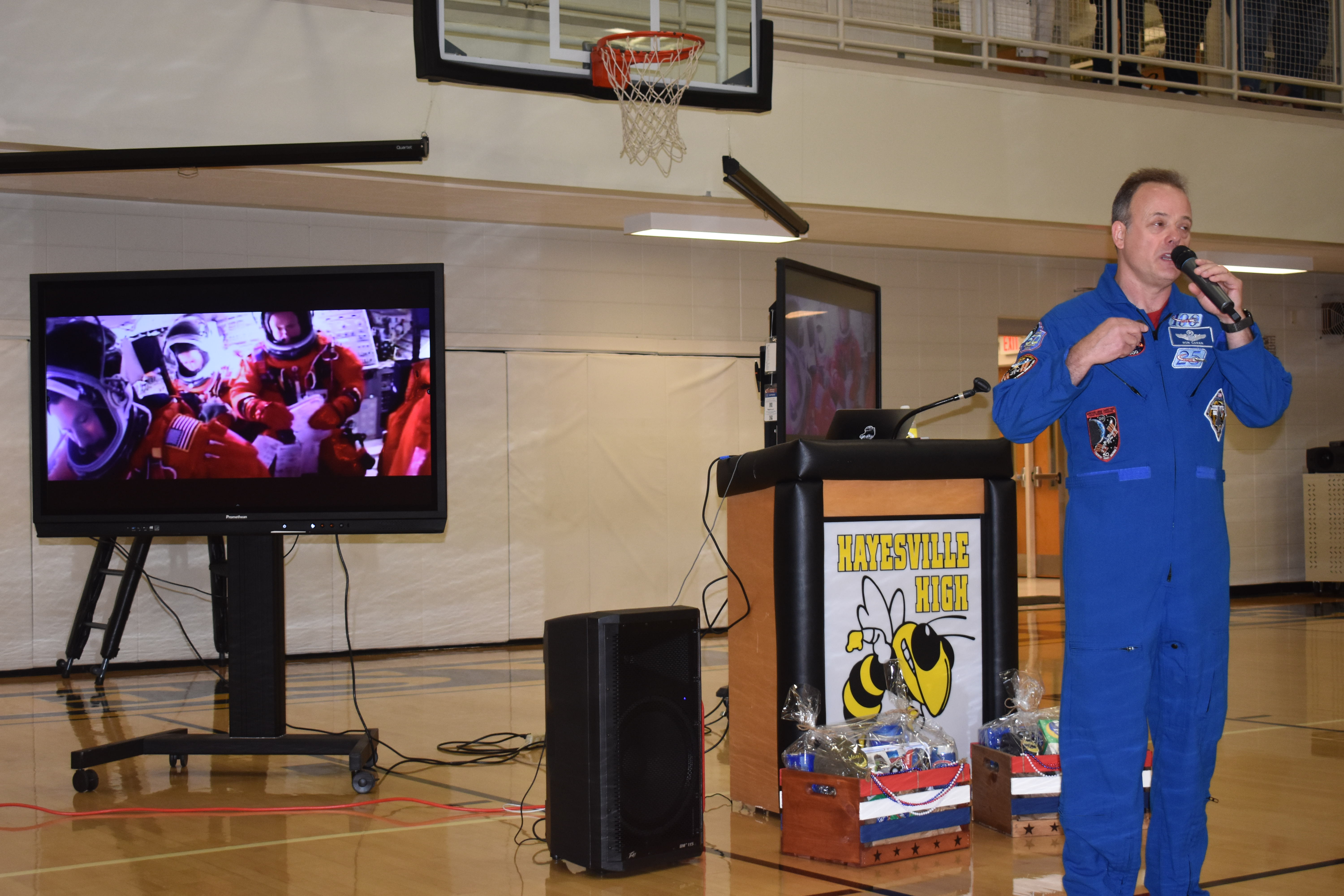
On Friday, Sept. 9, Garan traveled again. This time, he came to speak at Clay County Schools as a guest of the American Legion. He spoke to students from Hayesville High School, Hayesville Middle School, Carolina Christian Academy and Tri- County Early College.
After he was introduced by Robert Seibert, Garan smiled, “I’ve seen the world and have more than 2,000 orbits around the planet. This is one of the most beautiful places on our planet.”
He grew up in a small community, much like Clay County. Perseverance got him where he wanted to be. For many years, he would tell people he wanted to be an astronaut. He continued the dream until the demise of the Space Lab diminished the world’s interest in space travel. During his sophomore year of college, his interest grew again as the Space Shuttle program developed. He told a college counselor he wanted to take as much math and science as he could.
He graduated from the U.S. Naval Test Pilot School and became a decorated combat fighter pilot. During his career, he was a flight instructor at the USAF Fighter Weapons School, Air Force’s version of Top Gun, where he taught hundreds of elite fighter pilots. Prior to space, he conducted research and lived in Aquarius, the world’s only undersea research lab.
“Fifty years after Russian Yuri Gagarin was the first person to go into space, I launched into space with a couple of Russian military officers on a spacecraft from where it all began,” he continued. “As I walked into a spaceship about to launch with two Russians, I looked up from the base of the rocket which would take us to space for six months. I saw a Russian flag and American flag, side by side. That image was burned into my mind. For the first 15 years of my adult life I was trained to fight Russians.”
Garan described how his vision of the world was formed, starting with another space mission. “On Christmas Eve 1968, as the crew of Apollo 8 came out from behind the far side of the moon on their fourth orbit, they witnessed something never seen before by human eyes,” he explained. “They captured it for the rest of us. This famous image called, Earthrise, is probably the most famous photograph ever taken. This image revolutionized how we see ourselves with this simple message — that we are one people, traveling on one planet towards one shared future. As the crew of Apollo 8 saw the earth emerging from the lunar horizon, I wonder if they realized the significance of that moment?” Garan said the entire world rallied around the image.
Garan made four spacewalks for construction and maintenance of the International Space Station. He described what astronauts see in space as well as his own enlightenment from seeing the sights. “When in orbit, you see 16 daily orbital sunsets,” he said. “Dancing curtains of auroras. From space, you’d marvel at the paper thinness of our atmosphere.”
He referred to American Legion veterans in the audience. “Like many of the combat veterans here, I have flown combat in parts of the world and saw firsthand the horrors of war,” he continued. “Back then, I was operating in a two dimensional us versus them world. This is the image our civilization is currently based on — two dimensional landscape where nations fight over resources and ideologies.”
Pointing to the Earthrise photo again, “This image taken by Apollo astronauts is the real world,” he said. “It proclaims the fact every one of us is riding through the universe together on this spaceship called earth. We are all interconnected, we are all interdependent and we are all family. From this vantage point, all you can see is the fragile oasis that is our home planet earth. Despite Ukraine, cooperation still exists in space at the moment.”
Garan’s orbital perspective has turned him into an entrepreneur who has made worldwide humanitarian contributions with extensive work in sustainable development. A lot of his work focus has been at Manna Energy. He has also inspired other companies to evaluate their sustainability practices.
In addition, he authored three books, “The Orbital Perspective,” “Floating in Darkness” and the children’s book “Railroad to the Moon.” Not only did he speak at the school, but he donated projectors so they could have state-of-the-art equipment.
Garan recounted his trip on the Space Shuttle Discovery. “Day of launch, we climbed into our space suits, took the astro van to launch pad and elevator up to 196 feet. We took turns climbing into seats. For a couple of hours, I remember lying on my back with knees to chest, strapped to four and half million pounds of explosives. I briefly wondered what I was getting myself into. Eight and a half minutes after launch, all three engines came off according to plan. After being pushed into our seats at 3 G’s, we immediately went weightless. ‘We made it,’ I thought. I was also acutely aware — my childhood dream had just come true.”
He ended, “What I found was a profound sense of gratitude. Being visibly attached to earth but being deeply interdependent to everyone and everything on it. That developed my interest in the common origin as well as shared future.”