
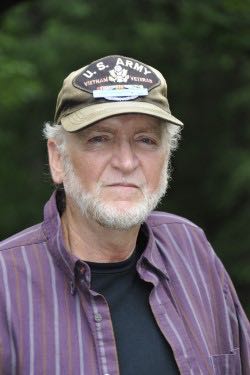
Photo by Charlie Stone Basil Clark in a photograph taken for the back cover of “War Wounded: Let the Healing Begin” published by Waldenhouse Publishers.
By Marcia Barnes
Guest Writer
Basil Clark is a man whose description and direction are not easily defined. Clark served 14 months in the Republic of Vietnam in D Company 1st Battalion, 12th Cavalry 1st Air Cavalry Division. He is a retired associate professor from the University of Pikeville in Kentucky. The father of two sons, Clark has authored five books and currently is at work on a sixth.
Clark isn’t unraveled by the past or his present-day life. Clark said, “I was born in Vermont and raised in Massachusetts. My father worked on poultry and fowl farms in New England. Our family was on a large duck farm until I was 12, then we lived on a farm with cows and horses for another year before moving to a small town.”
The rural life Clark describes was irrevocably changed on Christmas Eve, 1968. He was 19.
“I was on guard duty,” Clark said. “This was my first night of duty in Vietnam. They had sent me through a couple of weeks of acclamation to know how the infantry unit was operating.
“We walked point for several months when it was my squad’s turn in rotation and we were looking for activity. Then, they would call in an airstrike.
“September 16, 1969, my platoon leader took me aside. ‘If anything happens to me or the sergeant, you take over,’ he told me. The next night we were in the jungle when firefight broke out.
“We had a couple people out on an observation post who were pinned down close to the company perimeter. I remember saying, ‘I’m going out to get them.’ I remember arriving back with them, but there’s no memory of anything in between.”
Clark went into a wall of bullets that night to guide his people to the safety of the night position and was later awarded the Silver Star for gallantry in action. Upon returning he learned that the platoon sergeant had been wounded and he immediately assumed his duties.
Clark also received two Bronze Stars and a Purple Heart. One Bronze Star was awarded to Clark for his valor when his unit came under intense enemy attack. When his squad leader was disabled, Clark exposed himself to hostile fire and took command of the squad, deployed his comrades into an effective defensive position and organized a counterattack. Disregarding his own safety, Clark helped evacuate wounded personnel and distributed ammunition to the fighting positions repulsing the attack.
Clark completed his eight-year commitment with the U.S. Army and leaving a military life behind, returned to school. He earned a Master’s in Theatre from the University of Kentucky in 1984; a Masters in Communications from Morehead State University in 1991.
His desire to learn turned to a new direction at the University of Pikeville. Clark stepped back on the college campus as an associate professor where he taught public speaking, voice and articulation, interpersonal communication, political communication, mass media, and fundamentals of theatre and acting.
But Clark’s life became more than his students and books. In January 2009, Clark met Cora. It was their first face-to-face meeting after Clark had posted a selfie that was taken at the top of Seneca Rocks, W.Va. The photo was posted on e-Harmony.com. The couple married in 2011.
“I didn’t retire from the University of Pikeville until 2014. Cora and I weren’t living in the same town, so in five years we put around 120,000 miles on our vehicles giving my Elvis Gospel CD’s a workout.”
When Clark retired after 22 years at the university, it was on the cusp of his first book being published, “War Wounded: Let the Healing Begin.” Four more books were authored by Clark: “Poetic Healing;” “Massacre at Hill 303” co-authored with James M. Rudd; “Barabbas Son of a Father;” and “Life-Changing Events: Who We Are Now.”
Clark’s writing never left war too far behind, and Clark has stayed in contact with the men from D Company.
“Four or five men keep the group connected, all those in D Company from 1965 to 1973. Not everyone has been found. There is a roster at cattrack6india.com. Every year they meet. The last couple of years, it’s been in Las Vegas, but some veterans don’t want to respond.
“ I was asked to contact someone nick-named Taco who didn’t want to make contact with the group. We came in a week apart and were in the same unit for a year. Found out, Taco was living in Hendersonville. We stay in touch. We’re still looking for Sugarbear.”
Basil and Cora Clark moved to Hayesville in September 2020. Although Hayesville was the couple’s choice of where they wanted to retire and live, the move came with difficulty. Cora had suffered with Chronic Obstructive Pulmonary Disorder for years, but prior to coming to the mountains she was diagnosed with Lewy Body Dementia.
In Clark’s anthology, “Life Changing Events: Who We Are Now,” Cora tells her story. It is followed by Basil’s note. “There are times when it is difficult being on call 24/7, and even some nights having flashbacks to the sense of being on constant watchful guard in Vietnam, but I have never felt more in my life that I’m where I’m supposed to be, doing what I’m supposed to do.”