
By Becky Long
Publisher
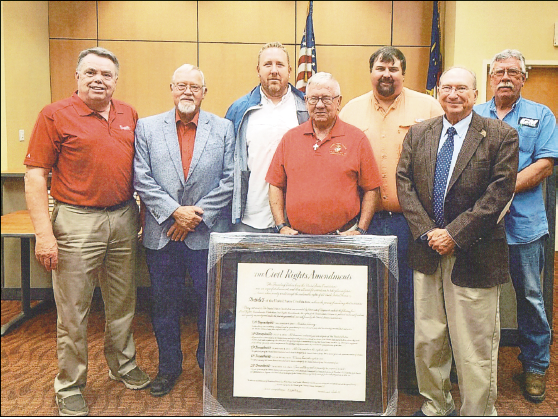
Clay County Commissioners were presented a framed document of Amendments to the U.S. Constitution during their monthly meeting on Thursday, Aug. 3.
The presenters were Ron Lewis and Dr. David Streater. Lewis explained that the presentation of the 13-15th, 19th and 24th amendments are known as the Civil Rights Amendments.
“They make all of us the same regardless of our gender or the color of our skin,” he said in a letter to the county. “ We are gifting to North Carolina counties that have a Charters of Freedom setting an authenticated framed print of the Civil Rights Amendments.”
Clay County Schools has a Charters of Freedom exhibit at the entrance to Frank R. Long Memorial Stadium. The setting of donated panels depicts the Declaration of Independence, a first draft of the U.S. Constitution and an early version of the Bill of Rights.
The monument, which includes a cavity for a time capsule, was dedicated on May 13, 2021 at the football stadium.
Lewis and Streater represent Foundation Forward where Lewis serves as a local government consultant and Streater is director of education.
Foundation Forward, Inc. is described on their website as an educational non-profit that installs life-size replicas of the United States’ Charters of Freedom: the Declaration of Independence, the Constitution and the Bill of Rights in communities across America.
Their mission: “To teach and preserve American history and civics, so all will know how our government is meant to serve and protect We the People.”
According to the National Archives, the framed amendments in the presentation to commissioners were:
• 13th Amendment: Neither slavery nor involuntary servitude, except as a punishment for crime whereof the party shall have been duly convicted, shall exist within the United States, or any place subject to their jurisdiction.
•14th Amendment: All persons born or naturalized in the United States, and subject to the jurisdiction thereof, are citizens of the United States and of the State wherein they reside. No State shall make or enforce any law which shall abridge the privileges or immunities of citizens of the United States; nor shall any State deprive any person of life, liberty or property, without due process of law; nor deny to any person within its jurisdiction the equal protection of the laws…
• 15th Amendment: The right of citizens of the United States to vote shall not be denied or abridged by the United States or by any State on account of race, color or previous condition of servitude.
• 19th Amendment: Giving women the right to vote: The right of citizens of the United States to vote shall not be denied or abridged by the United States or by any State on account of sex.
• 24th Amendment: The right of citizens of the United States to vote in any primary or other election for President or Vice President, for electors for President or Vice President, or for Senator or Representative in Congress, shall not be denied or abridged by the United States or any State by reason of failure to pay any poll tax or other tax.
In another matter before commissioners, County Manager Debbie Mauney presented an amendment resolution outlining how the county will use funding in the amount of $187,383 it is receiving from Opioid Settlement Funds. Most programs are to be conducted between 2023 and 2025. The recommendations were derived from a local advisory committee made up of the DSS director, Clay County Health director, sheriff, Emergency Management director and the county manager.
The outline includes:
• Recovery Support Services - $5,000: Fund evidence-based recovery support services, including peer support specialist or care navigators.
• Post-Overdose Response Team - $50,000: Support post-overdose response teams that connect persons who have experienced non-fatal overdoses to addiction treatment and recovery support.
• Treat Opioid Disorder (OUD) - $10,000: Support direct patient care, instructors for fellowships for addiction medicine specialists.
• Support People in Treatment and Recovery - $30,000: Engage non-profits, faith-based communities to support people in treatment and recovery and to support family members in their efforts to support the person with OUD in the family. Provide or support transportation to treatment or recovery programs or services for persons with OUD and any cooccurring SUD/MA conditions.
• Address the Needs of Pregnant or Parenting Women and their Families, including babies with Neonatal Abstinence Syndrome - $20,000: Provide enhanced support for children and family members suffering from trauma as a result of addiction in the family; and offer trauma-informed behavioral health treatment for adverse childhood events.
• Support for Children’s Services - $50,000: Fund additional services, including supportive housing and other residential services, related to children.
• Leadership, Planning and Coordination - $10,000: Support Regional, local or community planning to identify the root cause of addiction and overdose and areas and populations with the greatest need for treatment intervention services.
• Training - $12,383: Provide funding for staff training or networking programs and services to improve the capability of government, community and not for profit entities to abate the opioid crisis. Provide resources to staff government oversight and financial management of opioid abatement programs.