
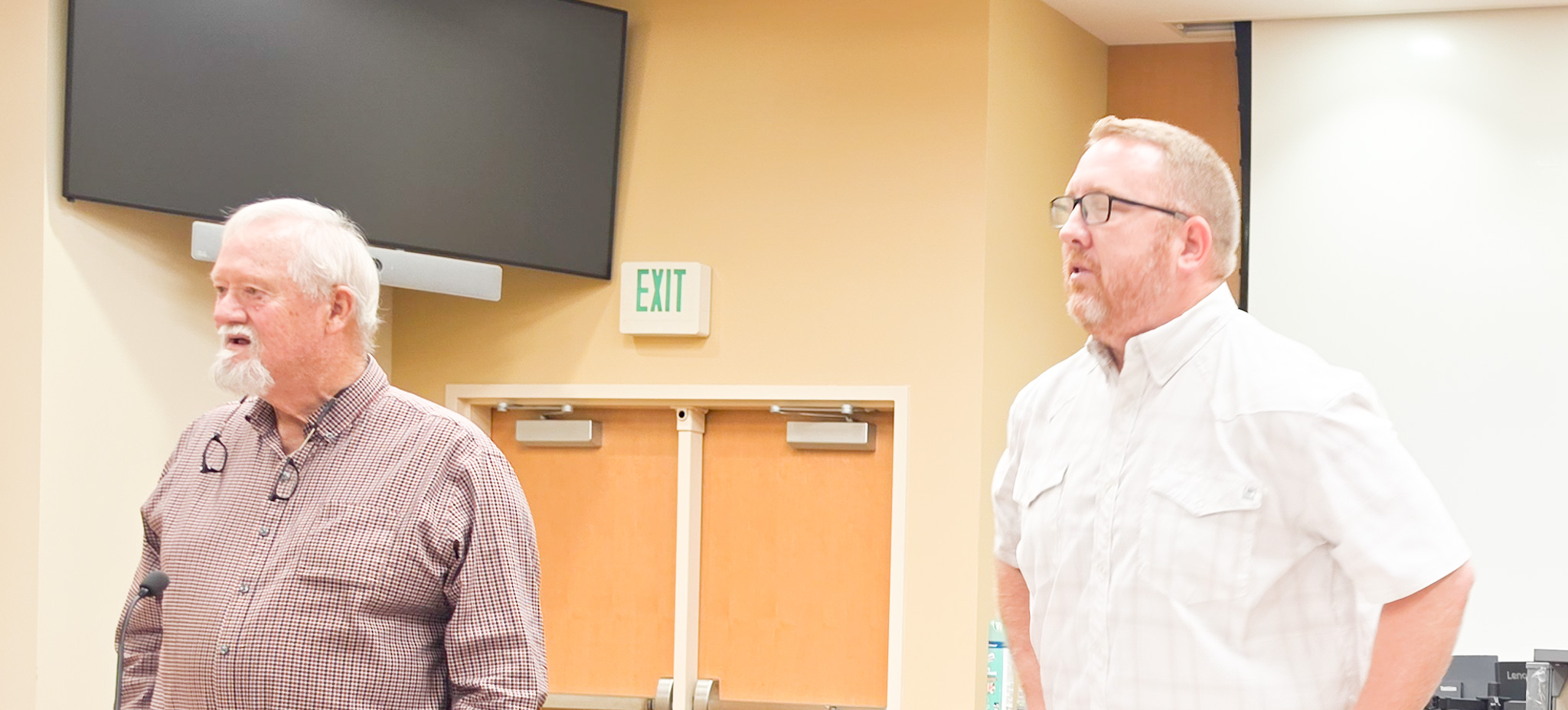
On Thursday, June 18 Clay County Commissioners opened a Special Called Meeting for the purpose of hearing from the public on the proposed budget for fiscal year 2026-2027. Having followed legal N.C. State statute 159 for the hearing, Chairman Rob Peck announced the budget set at $29,415,358.13 with $0.27 per $100 of appraised property value, following a re-evaluation of property values. Peck said that the budget was operational and revenue neutral.
The fire tax fund for the fiscal year beginning July 1, 2026 and ending June 30, 2027 for Warne, Brasstown, Shooting Creek and Hayesville, set at .04 cents on each $100.
Peck called for public comments on the proposed budget. No public comments were stated, a motion made to adopt the budget, seconded by Commissioner Bill Carter with the unanimous vote by commissioners and the budget was approved.
“We did our best to move our county forward,” Peck said.
Commissioner Randy Nichols said, “Twenty-nine million sounds like a lot of money until you start handing it out to everybody, then it's not that much money. Things cost so much, and so much to operate, and there's always somebody with their hand stuck out. I've always been an advocate of no tax increase.”
Commissioner Clay Logan thanked everyone who had worked on the budget to keep it revenue neutral and said that he thinks the next board coming will honor that. Carter said that Clay County is tied for the third lowest county in North Carolina for tax rates.
The budget passed within the first six minutes of the Special Called Meeting and Peck opened a regular meeting and discussion of the board's decision to appropriate monies to renovate the schools' athletic field. Peck said that the field and track are used by 1,200 students, athletes, cheerleaders, graduates and band and that it has been in use 14 years, passing its 10-year life expectancy.
Adoption of a Clay County Resolution and Application for a North Carolina Department of Commerce grant was requested of the Board by County Manager Debbie Mauney. “This is what we plan to do,” Mauney said.
The Clay County Resolution states:
• Clay County Board of Commissioner indicates a desire to assist in Hurricane Helene recovery efforts within Clay County; and,
• The Board fully supports the proposed project Bridge Infrastructure Project Post Helene which will result in the repair at 25 Riverside Circle, Hayesville, N.C.; and,
• The board wishes to pursue a formal application in the amount of one million dollars from the North Carolina Department of Commerce, Small Business Infrastructure Grant Program Rural Engagement and Investment Program; and,
• Now, therefore, be it resolved, by Clay County Board of Commissioners:
• That Clay County is authorized to submit a formal application to the North Carolina Department of Commerce, Rural Engagement and Investment Program in order to provide assistance to benefit Bridge Infrastructure Project Post Helene.
The request to the board received a motion, a second and was adopted unanimously.
Addressing old business, Peck said that the new youth playground project is nearing completion. “It's pretty impressive,” Peck said. “The first of its kind in the nation. Peck said that some re-engineering was needed, it needs to be filled with gravel, a rubber-safety material and fencing and will be opening in the next few weeks or so.
The consent agenda received approval and the regular meeting was adjourned. The board motioned to go into executive session.
An amended resolution by the County of Clay to direct the expenditure of opioid settlement funds was presented by Mauney to the board during the regular meeting held June 4.
Whereas, Clay County has joined national settlement agreements with companies engaged in manufacturing, distributing and dispensing of opioids, including settlement with drug distributors Cardinal, McKesson, AmerisourceBergen, Walgreens and the drug makers Johnson & Johnson and its subsidiary Janssen Pharmaceuticals;
Whereas, the allocation, use, and reporting of funds stemming from these national settlement agreements and certain bankruptcy resolutions (“Opioid Settlement Funds”) are governed by the Memorandum of Agreement between the State of North Carolina and Local Governments on Proceeds Relating to the Settlement of Opioid Litigation;
Whereas, the Clay County Board of Commissioners passed Resolutions on October 7, 2021 and on March 2, 2023 authorizing the Clay County Manager to take measures as necessary to comply with the terms of the MOA, including establishing an advisory committee, managing any settlement funds, and executing any documents necessary;
Whereas, an advisory team, has been established to make recommendations to the Clay County Board of Commissioners on the use of the Opioid funds. Members on this committee include the Department of Social Services Director, the Clay County Health Director, the Clay County Sheriff, the Clay County Emergency Management Director and the Clay County Manager;
Whereas, the strategies identified within this document were presented at the Annual Meeting, as required in Part 1, Section 8, E of the NC MOA.
Now, therefore be it resolved, in alignment with the N.C. MOA, the Clay County Board of Commissioners authorizes the expenditure of Opioid Settlement Funds as follows:
• First strategy authorized
- Name of strategy: Collaborative Strategic Planning.
- Included in: Exhibit A, Strategy 1.
- Amount authorized for strategy: $149,350.
- Period of time during which expenditure may take place: July 1, 2026 through June 30, 2027.
- Description of Program Activity: Support collaborative strategic planning to address opioid misuse, addiction, overdose or related issues, including staff support, facilitation services or any activity or combination of activities listed in Exhibit C to the MOA — collaborative strategic planning.
• Second strategy authorized
- Name of strategy: Evidence-based addiction treatment.
- Included in: Exhibit A, Strategy 2.
- Amount authorized for strategy: $25,000.
- Period of time during which expenditure may take place: July 1, 2026 through June 30, 2027.
- Description of Program Activity: Support evidence-based addiction treatment consistent with the American Society of Addiction Medicine's national practice guidelines for the treatment of OUD-including MAT with any medication approved for this purpose by the U.S. Food and Drug Administration through Opioid Treatment Programs, qualified providers of Office-Based Opioid Treatment, Federally Qualified Health Centers, treatment offered in conjunction with justice system programs or other community-based programs offering evidence-based addiction treatment. This may include capital expenditures for facilities that offer evidence-based treatment for OUD.
• Third strategy authorized
- Name of strategy: Recovery Support Services.
- Included in: Exhibit A, Strategy 3.
- Amount authorized for strategy: $120,000.
- Period of time during which expenditure may take place: July 1, 2026 through June 30, 2027.
- Description of Program Activity: Fund evidence-based recovery support services, including peer support specialists or care navigators based in local health departments, social service offices, detention facilities, community-based organizations or other settings that support people in treatment or recovery or people who use drugs, in accessing addiction treatment, recovery support, harm reduction services, primary healthcare, or other services or supports they need to improve their health or well-being.
• Fourth strategy authorized
- Name of strategy: Naloxone Distribution.
- Included in: Exhibit A, Strategy 7.
- Amount authorized for strategy: $5,000.
- Period of time during which expenditure may take place: July 1, 2026 through June 30, 2027.
- Description of Program Activity: Support programs or organizations that distribute naloxone to persons at risk of overdose or their social networks, such as Syringe Service Programs, post-overdose response teams, programs that provide naloxone to persons upon release from jail or prison, emergency medical service providers or hospital emergency departments that provide naloxone to persons at risk of overdose or community-based organizations that provide services to people who use drugs. Programs or organizations involved in community distribution of naloxone may, in addition, provide naloxone to first responders.
• Fifth Strategy Authorized
- Name of strategy: Post-Overdose Response Team.
- Included in: Exhibit A, Strategy 8.
- Amount authorized for strategy: $25,000.
- Period of time during which expenditure may take place: July 1, 2026 through June 30, 2027.
- Description of Program Activity: Support post-overdose response teams that connect persons who have experienced non-fatal drug overdoses to addiction treatment, recovery support, harm reduction services, primary healthcare or other services or supports they need to improve their health or well-being.
• Sixth strategy authorized
- Name of strategy: Re-entry Programs.
- Included in: Exhibit A, Strategy 12.
- Amount authorized for strategy: $52,000.
- Period of time during which expenditure may take place: July 1, 2026 through June 30, 2027.
- Description of Program Activity: Support programs that connect incarcerated persons to addiction treatment, recovery support, harm reduction services, primary healthcare or other services or supports they need upon release from jail, prison or that provide any of these services.
This amended resolution was approved and signed by the Commissioners of Clay County on Thursday, June 4.