
By Abigail Hickman
Staff Correspondent
There is a certain irony in the fact that some students joke they feel like prisoners at Tri-County Community College and Early College, yet they attend classes on the site of the old Cherokee County Prison Camp.
While many of the buildings were torn down, the original cell house has been converted into classrooms. The prison camp opened in 1939 and was used to house local criminals. There were no “white collar” prisoners then; the guilty were all tossed in together, from politician to murderer.
Before there was air conditioning, both guardsmen and prisoners alike suffered inside the metal buildings during the heat of summer. The guard’s house, which is still standing, was built farther out into the woods, so perhaps it was cooler. The cells themselves, even with the iron latticed windows, made serving time repellent.
That, of course, was the point of prison systems at the time. Then, criminal action resulted in harsh confinement as a guest of the state. It wasn’t until the 1970s, years after the prison camp was sold to the college, that the social conversation concerning prison reform turned from punitive to rehabilitation.
So the Cherokee County Prison Camp was decades away from identifying or even considering the mental or environmental causes for deviant behavior. If a criminal was dumb enough to get caught, he deserved what he got — and what he got was very little. The solitary confinement hut, for example, was a gruesome experience.
Trevis Hicks, an information systems instructor for the college, knows quite a bit about it. An armchair historian, Hicks carries some ethos on historic stories, having Cherokee County roots miles deep. The history of the prison is of particular interest to Hicks, as he spends most of his days inside the old prison building.
“The prison closed in ’63 or ’64,” he said. “The college opened in ’66.”
Hicks, who has been a part of the Tri-County Community College family since 1992, has seen parts of the old prison building revealed during modern renovation projects.
“There’s a catwalk up here,” he said, pointing to a long hallway housing computer classrooms. “These were all original cells.
“Now up here,” he said, pointing to the drop ceiling, “up above that there used to be iron bars. They placed them all the way to the roof, so if a prisoner managed to break out through the roof of his cell, there’d be nowhere for him to go.”
The bars were taken out years ago, but the contractors left a catwalk that spans the entire hallway.
“That last cell down there at the end,” Hicks said, looking down the hallway as if seeing prisoners in uniforms.
“That cell was restricted for the tools the prisoners needed during their day work. They had to lock up the tools like a prisoner,” he added with a laugh.
Hicks walked outside under an unforgiving sun and used a broad, palm-size key to wrestle open the solitary confinement house, built about 30 feet away from the general population housing. From the outside, the building is less foreboding than what one imagines on the inside.
With a heavy squint, one can picture flower boxes and a pebble path to the swinging door. However, once Hicks widens the entrance with a hearty push on the door, the cuteness factor melts away under the heat wave that rushes out like a prisoner trying to escape.
Like the main cell block, there are barred windows, which the campus keeps open to discourage the growing iron stalactites that point down from the metal ceiling like judging fingers. The open windows do little to alleviate the pressing heat.
Everything inside is made of metal but for the concrete walls. The building holds two cells, each with two bunk bed slats welded to the wall, meaning the claustrophobic space could house up to four people at once.
Hicks stood inside one of the cells, wiping sweat from his forehead
“Can you imagine sharing this space with some hardened criminal?” he asked, scanning the walls and ceiling for hieroglyphics left behind by the unfortunate men who could answer his question with a “yes.”
Aside from the expected girly etchings and a few tidy calendars, one prisoner, according to his engravings, spent a good deal of time in one of the cells. Jimmy Collins may have been placed there after he escaped from the camp. He was a prisoner in the first place for raping three women; in his time as a fugitive, he raped three more.
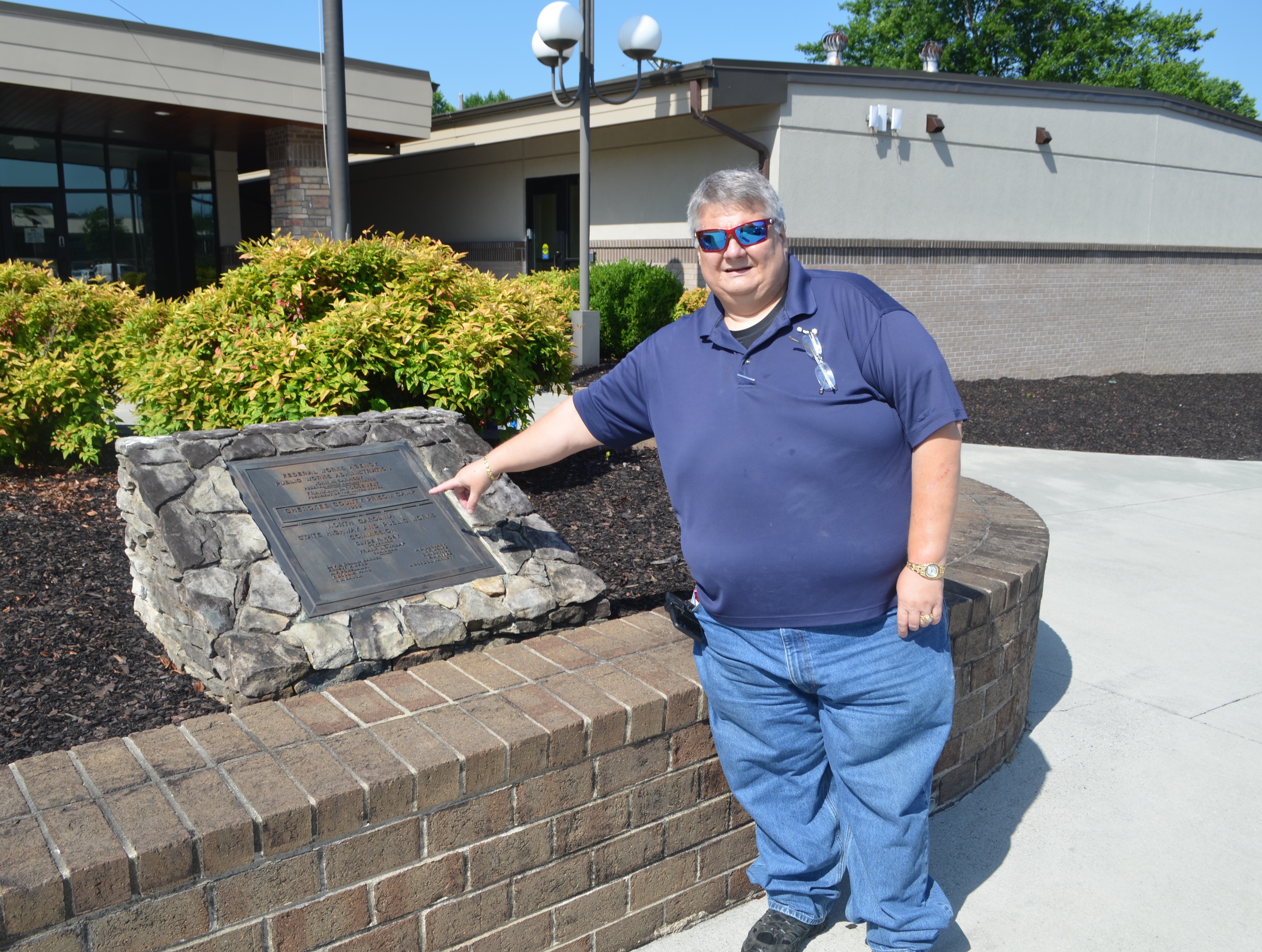
Suddenly the merciless harshness of the cells feels appropriate. The college rescued and memorialized the plaque that originally hung on the entrance to the main prison. Today, it sits under a flag, surrounded by happy foliage that betrays the history of what the sign represents.