
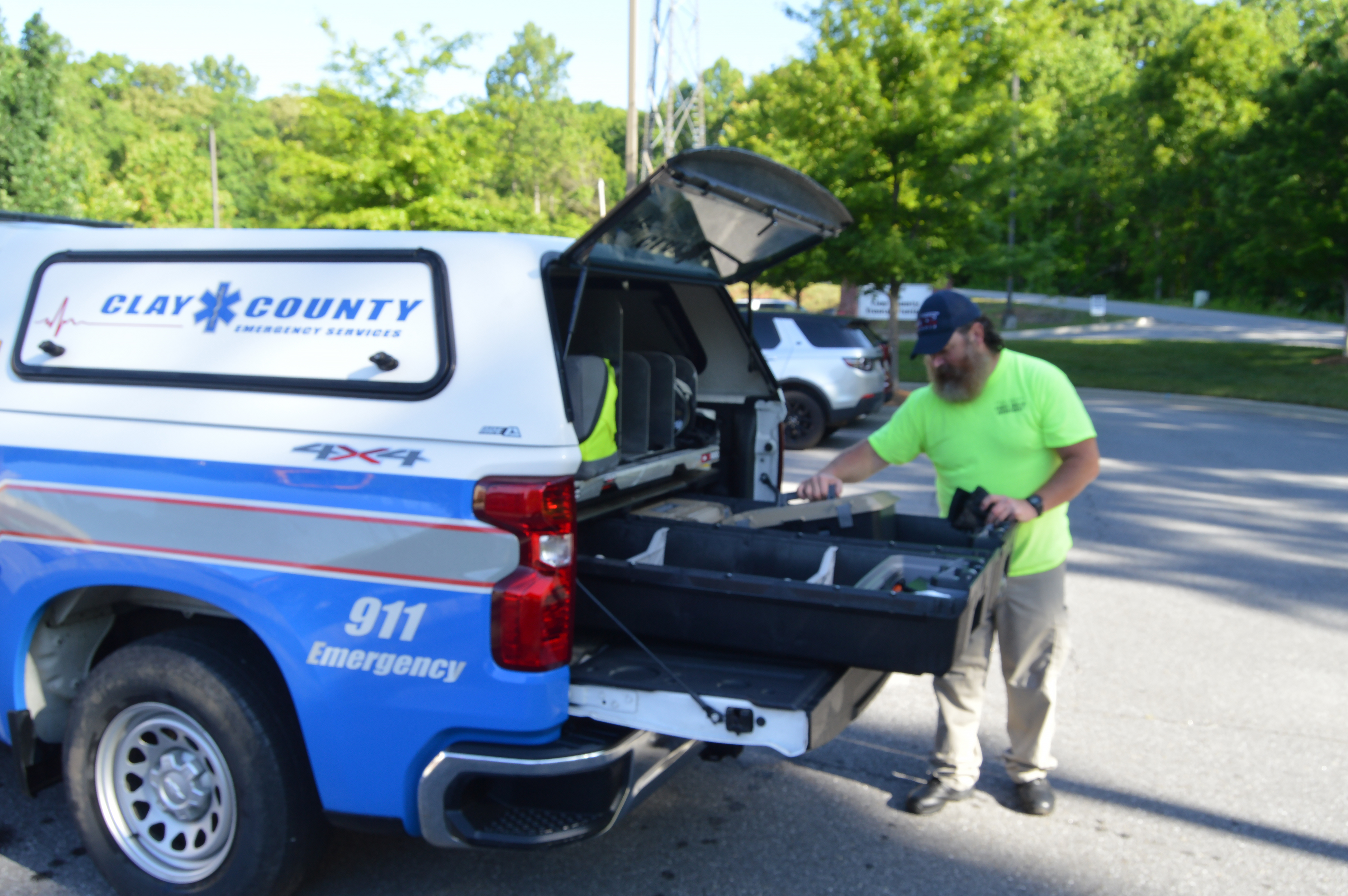
By Gary Corsair
Staff Writer
The days of doctors making house calls is long past, but Clay County offers the next best thing — a community mobile paramedic unit.
“It’s a little bit of home health care, part social services and a little bit of paramedics. It’s a little bit of everything. We do as much social work as we do medical work. Mobile paramedics are a clearing house — we connect people with the services they need,” said Clay County shift paramedic Jeff Ledford.
In addition to working alongside Clay County’s 16 full-time paramedics who work 24 hours on and 72 hours off, Ledford is Chatuge Family Practice’s mobile paramedic.
What’s the difference in his jobs? Shift paramedics respond to emergency calls; community mobile paramedics deliver health service, information and other resources. Think Mr. Fixit.
Ben English’s job description calls for pre-emptive visits to shut-ins and at-risk residents, presenting community health clinics and providing preventive and urgent care. The mobile community paramedic may also conduct on-site school physicals and community health clinics, help people obtain bathroom rails and wheelchair ramps, provide mobile command facilities for disaster relief and more.
“There’s no typical day,” said English, the lone community mobile paramedic on the county payroll. We try to get people hooked up to the social and medical services they need. The goal is to keep people out of the hospital. It’s more for patients with chronic management situations, like heart and breathing issues. I deliver prescriptions and in some cases administer them. It’s not the blood and guts stuff you see on the ambulance.”
English doesn’t use flashing lights and wailing sirens when he helps underserved citizens improve their quality of life, but he’s clearly involved in life-saving work. That was obvious during the height of the COVID-19 Omicron pandemic.
“Jeff and I ran the whole REGEN-COV clinic. We tailored a program for COVID,” English said. “We said, ‘Let’s keep people out of the hospital’. We saw 400 patients.”
“We did the county’s first monoclonal antibody clinic,” Clay County Manager Debbie Mauney said.
Locally, Chatuge Family Practice pioneered the concept of dedicating a paramedic to preventative medicine and education by securing a grant to fund the position.
“It started with Chatuge Family Practice a couple of years ago. In fact, they still have the grant,” said Mauney. “They wanted to expand it.”
County administrators and commissioners were happy to partner with Chatuge Family Practice. The feeling has been mutual. “It was a great partnership from the beginning,” Mauney remarked.
Today, just a few years later, Clay County is a model of public and private sectors working for the wellbeing of the community they serve.
“We are the only community paramedic program in the state that’s part public, part private,” Ledford said.
That’s not the only unique aspect of Clay County’s Community Mobile Paramedic program.
“What’s really unique about the program is that we’ve moved it under Public Health,” Mauney said. “A lot of counties don’t have community mobile paramedic programs.”
Mauney says that assigning mobile paramedic Ben English to the Health Department increases the odds of obtaining additional grants.
English has been the lone community mobile paramedic since the county scored a $450,000 ($150,000 for three years) grant in the summer of 2021. The program will expand to two full-time paramedics this fall thanks to a $315,000 grant Clay County recently received from Dogwood Health Trust for Community Paramedic Mobile Unit.
The grant will fund a second community paramedic for two years.
It will also pay for a 2022 Chevrolet Silverado 2500 HD, 4-wheel drive with crew cab and 28-foot enclosed, fully furnished trailer with dual AC and awning that’s wired for full generator power.
“We hope to have the mobile clinic and paramedic in play by September/Octoberish,” Mauney said.
According to Mauney, the community paramedic mobile unit eases the burden on the county’s EMS Department.
“I think it’s been one of the better things done without using county money. We look at it expanding,” Mauney said.
The need for a mobile paramedic appears to be considerable.
Clay County’s population has increased for eight consecutive years, from 10,623 in 2015 to 11,552 in 2022.
The number of shut-ins is likely to increase. According to 2000 census figures, 22.7 percent of Clay County residents were 65 and older. By 2019, senior citizens comprised 30.1 percent of the county population according to the North Carolina Department of Commerce. Median age has increased from 47 in 2000 to 53.6 in 2020.
If you or someone you know needs medical or social service help of a non-emergency nature, contact the Clay County Health Department at 389-8052.