
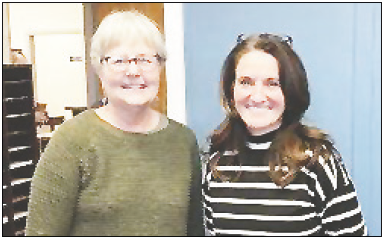
Photo • Julie Rogers From left, Clay County Social Worker Terri Hager and Angel Owens, Chief Officer of Human Resources and Federal Programs form the core of the Department of Exceptional Children.
By Marcia Barnes
Staff Writer
Angel Owens, Chief Officer of Human Resources and Federal Programs runs a tight ship. Owens and Terri Hager who is the social worker for the district do so because that is what it takes for every school day to keep the Department of Exceptional Children sailing smooth and on course.
Beneficially, they have real help and aid in time of need from the Department of Social Services. A Memorandum of Understanding between Clay County Schools and the Department of Social Services clarifies joint responsibilities, Clay County Schools’ responsibilities and areas where helping exceptional students is best served solely by the Department of Social Services.
The language of that agreement ensures things are done right and as written by the terms of the MOU but how that relates to everyday educating and health and welfare for the 194 students within the Department of Exceptional Children is a human effort. Ranging from three years of age to 22, the department will serve just under 200 exceptional students in the 2023-2024 school year. Owens said that there is always an ebb and flow in the enrolled number in all counties.
Educating, graduating and training exceptional students all the way to becoming employed is the focus of Owens and Hager. There is a team of others working at Clay County Schools who help students reach their potential and personal goals. The others consist of 12 teachers, three speech therapists, one school psychologist and one part time physical therapist.
“They always say it takes a village. This is the village,” Hager said.
Within the invisible walls of the Department for Exceptional Children is the very visible working staff and support staff of all four schools. That is because these special and unique children and young adults learn within the classrooms of the primary, elementary schools, middle school and high school.
The difference is that exceptional students are those students who could not earn a diploma without some form of exceptional help. The nuts and bolts of that help are complex.
Hager said that some students will go on to college. If the student has significant mental issues then Hager will find a rehabilitation program best suited for the student. The goal remains the same irregardless of the challenges faced by the student and teacher. It is to educate, graduate and provide a foundation for a useful life after the completion of their studies on the Clay County School campus.
“We want them to be thinking about what they are going to do when they get out of school, what are their goals or what kind of school do they want to go to?” Hager said. “Melissa Cheek is our transition specialist. She is great at helping these students.”
Another bonus for students who require more time to complete their educational journey at a public school, or who learn better in a hands-on environment is in Career and Technology Education. This is where students experience much more than book learning.
“Our CTE program is top notch,” Hager said.
Currently, there are 320 students enrolled in CTE. It is directed by Revonda Palmer and some exceptional students at Clay County Schools are receiving tremendous benefits from the program which offers certifications often necessary in technical jobs. There are opportunities for students to actually work for a semester at Clay County Chamber of Commerce, an animal clinic or Western Carolina Regional Airport and a myriad of other local work places.
When what is viewed as an impairment to learning is categorized, there are 11 listed disabilities for students in the 2023 child count. These range from visual impairment, traumatic brain injury, speech and/or language impairment, developmental delay, autism and multiple disabilities.
Owens and Hager hold their view finder on solutions. They have worked through tough situations fully aware that circumstances faced by the student are even tougher.
There is the child who is placed in foster care or experiences a change in their placement. It is the responsibility of Clay County Schools to ensure immediate enrollment of foster children and to remove barriers to immediate enrollment and record transfers.
There are transportation issues which could delay or interrupt a child’s learning. There is the burden of finding federal, state and local funding to support a student’s physical, educational or emotional needs which are not being met in the home. Title I funds are available to support additional transportation costs but not Set-Aside funds for homeless students.
When it comes to parental rights and responsibilities for exceptional students the bond of family looms even larger. Owens and Hager have worked through difficult scenarios. One situation included a student whose legal parent was incarcerated. Through meetings where Owens and Hager met with the parent at the prison, the best solution for the student was agreed on and parental rights respected.
Owens, in her 10th year in this role, said that it is a must to include parents. “It’s the law,” she said. “Man, woman, prisoner, the parent is first and the school counselor, second.”
Another challenge faced by Owens and the Department of Exceptional Children in the past school year included a large influx of students with disabilities when two charter schools closed. Thirty-three new students came from the Learning Center in Murphy, N.C.
With the overnight increase in enrollment Owens said there was an immediate need for more help in occupational and physical therapy. Teachers worked additional hours to accommodate the incoming students’ needs. The task at hand was enormous, but Owens main concern was that new students would feel welcomed at the school.
Assimilating the incoming students and providing for their physical and educational needs could have been an administrative nightmare. Owens and a team of teachers worked through stacks of documents, medical records and more to make the transition happen.
Later, Owens made a plea in a request to the Clay County Board of Education during a regular meeting. She asked the board for a one-time supplemental increase in pay for teachers who had contributed extra hours during that period. The board unanimously approved.
“We did not bill Medicaid until fours ago,” Owen said. “Now a company codes the therapeutic services.”
There is the ongoing work of finding funding and managing the funding. ESSER funds which were the federal funds given to aid schools financially during the season of COVID-19 will end in 2024. Owens said that monies are also funded down from the Cares Act.
Owens’ office is the hub for the Department of Exceptional Children and she starts her day when the first text comes in. She is on call 24/7 district-wide. That could take her through a day of student support meetings communicating with the Department of Social Services or applying for a grant.
Hager continually works to help students within the Department of Exceptional Children to become advocates for themselves. This is among her many other responsibilities.
The mission of Clay County Schools is to build high quality learning environments that ensure all students learn at high levels. The Department of Exceptional Children continually is at work to achieve the goal set in place by the Board of Education.