
Still Waters Farm
By Marcia Barnes
Feature Writer
Still Waters Landing is in a remarkable evolution. The 10 acre remnant is a parcel of land, a piece of an Appalachian homestead which once crossed Fires Creek Road and stretched to Tusquittee Creek. A large part of the original farm was sold off, but the remaining Gibby land which rested for a long time is now alive with produce, pigs and chickens.
Afters years of remaining idle the land was restored to a productive farm in a relatively short period of time. Now it is a partner in community supported agriculture. Even more remarkable, in January 2022, Still Waters Landing officially initiated an outreach program to feed people.
Rescuing old farmland from nature and transforming it into what Still Waters Landing is today didn’t happen all at once.
“A few years ago it was just weeds, in some areas it was over our heads,” Keith Gibby said. “It was a mixture of thick weeds and grass and I was working full-time as an engineer.”
Everything began to change when Gibby met Bryan Wilson who was pastoring at Oak Forest Church. Gibby said they met through the church body and Wilson just wanted to do some farming. When Wilson called Gibby with news that a friend in Tennessee had sold his farm and that pigs and chickens were not included in the sale, Gibby’s wife Kathy, Wilson and another member of the church headed out.
“That was in February 2016,” Kathy said, “and we went to Tennessee to get the pigs, two of them were pregnant. Then, five more pigs came later.”
Temporarily, the Gibbys were raising the pigs at their house while they started building paddocks on the land. Paddocks are enclosed areas used especially for pasturing or exercising animals. The area for the paddocks was cleared to the fence line. The pigs would clear the rest of the area which was a natural habitat for them.
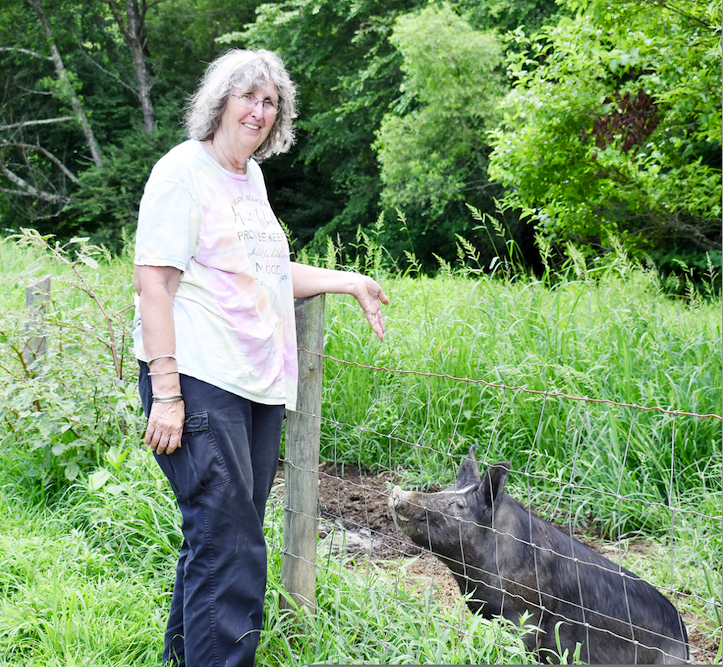
“Some of the pigs were market-size,” Kathy said. They were Berkshires, later, we bought Duroc pigs and both are heritage breeds. Chestnut, a Berkshire, has learned how to sit. My daughter Amy taught him. Pigs are smart animals and Chestnut is social.”
The current pig count at the farm is 22 and the number stays about there because the Gibbys don’t want to over-graze the land or over-breed the pigs.
Expanding the farm’s usefulness continued at the beginning of May 2018, when the remaining grass and field were bush hogged and brought under control. Andrew Jones, the farm’s manager, had been working as a recreation director in Clay County when Wilson walked in and asked Jones if he liked his job.
Wilson said, “We got the grant.”
Wilson’s grant writing for the farm to come under 501c status had been accepted and the farm was in need of a manager.
Jones said, “Let me print this notice out and I’ll be coming over.”
Jones had been farming and experimenting with different methods for more than 15 years. He had a permaculture design certification and preferred permaculture farming methods because they produce high yields and do it in an environmentally friendly way.
“I started with a 50 by 100 foot bed just using an old tiller and hand planting to get something in the ground with a diversity of produce,” Jones said. “Everything was up and growing by June. I had a two-week trip to Washington state coming in July.”
Jones left for the trip leaving Keith, Kathy and Wilson with very strict instructions. They had already set a certain number of weeks that CSA produce would be available with a total price listed and those in the community who wanted to buy in would come with checks. Marketing was by word of mouth.
“The first year,” Jones said, “besides the garden and CSA, we were building greenhouses and high tunnels. How to irrigate was the next step.”
Keith said that when the field was planted they knew about the spring on the property, but hadn’t worked out how to use it. Today, water from the mountain spring is gravity-fed to the crops.
The crops have multiplied along with the livestock. Still Waters Landing now has six 50 by 100 foot beds up and growing in bodacious greens and other vegetables and two 30 by 96 foot high tunnels growing heirloom tomatoes. Fifty chickens, all hens, enjoy a coup that is a chicken tractor and rotated regularly. The 22 pigs are rotated every 7 to 14 days, depending on the paddock size and the number of pigs.
“This is the most the farm has produced as far as vegetables go,” Jones said. “Local restaurants and breweries are purchasing our produce. Our customers truly are invested in the local economy. I’m a fan of growing and producing, I’m not a fan of everything that goes with marketing.”
“We had to figure that out,” Kathy said.
“In December, we started seeing more customers and we converted CSA to ‘a la carte.’ Customers can order through group texting and order what they want. On Fridays, between 3 p.m. and 7 p.m., they stop by and pick up their food.
The Appalachian farm which remains 100 percent devoid of electricity, looked again to the future and a greater purpose. In January 2022, Still Waters Landing initiated an outreach to feed people by inviting donors to adopt a row or adopt a pig.
The program allows individuals, businesses, churches and civic groups to provide fresh food to Clay County Food Pantry and Matt’s Ministry through the adoption program. There are designated volunteer days to participate in caring for an adopted row of green beans, kale, collards, zuccchini or chard.
“It is all working together,” said Amy Mackey, who helps her parents at the farm. “We go the extra mile and every adoption supports the non-profit farm and provides nutritious produce and meat to the hungriest in our community.”
“The same quality of produce and meats that the farm delivers to its high-end customers is the same quality we deliver to charity,” Jones said.
Wilson, a catalyst in the early days of Still Waters Landing is in Georgia and in training. He was assigned to Fort Hood, Texas as a military chaplain.