
By Marcia Barnes
Guest Writer
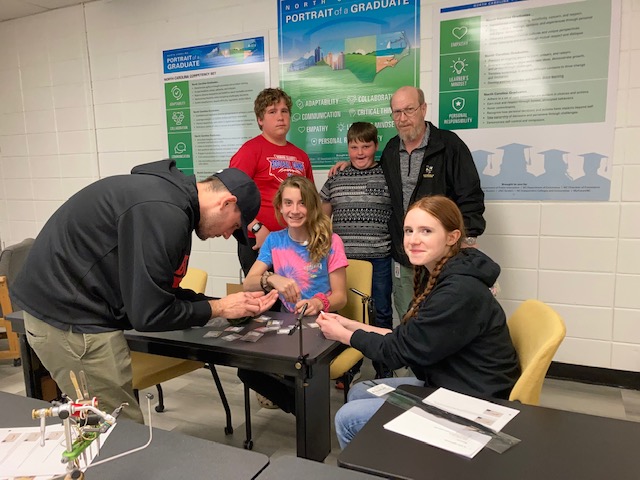
Greg Charles planted new seed at the Hayesville High and Middle Schools as students returned from Christmas break to their traditional studies. In February, a newly formed Fly Fishing Club was birthed, six students attending Charles’ introduction into the world of fly tying and fly fishing. Charles said that eight years ago he started the idea of a fly fishing club at Murphy Middle School. That’s where the students met and Charles lives in Murphy.
“The kids loved it,” Charles said, “because it was getting so big, I needed help and converted the club into 4-H. That made it manageable. There were 14 students and it’s not a math lesson. It’s all hands on.”
Charles said there were many opportunities in converting to a 4-H club. It’s a nationwide organization and it is managed through the co-operative extension in each county. It is also a non-profit entity. “I’m not a teacher, not a counselor,” Charles said. “I’m a network engineer and I’ve been here at the Hayesville schools since April 2002.Projects and presentations that the 4-H club in Murphy are doing right now is what we’re going to be doing here at Clay County schools once they get a little more acclimated. Right now in Murphy they’re learning about the 16 traditional Southern Appalachian flies. So they have to tie each fly and learn who created the fly. Some of these are from the 1800s, some of the materials you can’t even get anymore because they’re a protected specie. So you have to come up with an alternative source. Then, they have to do an oral and visual presentation. They are learning public speaking and organizational skills. I call it paying rent. They are paying for the opportunity to learn what they are learning. We have fun and they’re learning while they’re doing that and don’t realize it. It’s not a book report, they’re tying flies and they have to show the fly.”
Charles said that four years ago on March 9 was the last contest he’d had for members of the club. Charles created the contest and each member did an A to Z with the fly pattern they chose. They had five weeks to work on it, plus the presentation and then Charles presented the flies on Facebook in the Fly Fishing Group and people voted on it.
“I think we had like 4,000 people vote on the 10 submissions. I gave everyone a full fly rod and reel combination, all brand-new gear. I’m a product ambassador for a couple of companies and get a tremendous amount of support from them. At Christmas all 16 kids got a fly fishing vest, fly rod and reel combination and a brand new net.” Charles said they had more and better gear than when he started fly fishing for tarpon out of a canoe on the Indian River when he was twelve years old. The largest tarpon he caught was 70 pounds.
He added that right here last summer on Lake Hiawassee, he caught a 30-pound flat-head that carried him the length of three football fields in his kayak before he could get it up to see what it was. Beyond personal fishing, Charles was ready to start a club in Hayesville.
Ground work at Clay County Schools needed to come first, talking to the superintendent and principals and finding out what Charles needed to do. “I was asked to wait until the new year to start. I had to get approval through the superintendent and there was a discussion at the board.”
Students on the Fly, the name of the club, started with six students in February and more are welcomed to join the club which meets after school on the second and fourth Thursday of each month. Superintendent Dale Cole said, “It’s not part of our standard course of study. You can make connections to the standard course of studies in science and different areas, but it’s a non-curricular club.”
Charles said that in mending with the school part, he is applying for an AIM grant for $8000 and he is working with the biology teachers in the middle school and high school to do stream biology for aquatic macro invertebrates.
“If you’re going to be a good fly fisherman, you’ve got to match the hatch,” Cole said. Charles said members of the club are going to be turning rocks over and doing biology. In referring to Southern Appalachia, he said there’s a lot of culture with those lures and the old timers and then, the blue lines which are all native trout lines.
“Blue lines, that’s what you call the water that keeps native fish. On forestry and wild game maps, they’re shown with blue lines,” Charles said. “There’s a whole lot of science and a lot of understanding the water conditions and how that changes the approach you want to use to fish. Creating the lures themselves, there are traditional lures and colors that work at certain times of the year specific to the region no matter where you are,” Cole said.
Charles said that this is a school club and it’s a benefit to students. He said that it’s not part of the curriculum, but at the same time students have to be accountable for discipline and behavior.
“We’ve done this before as far as collecting insects and cataloging them. Now, I’m taking this a step further to our county waters and working with Zach Moss who is our biology teacher and Austin Hedden, middle school biology teacher,” Charles said.
“We’re actually going to be cataloging our local streams with water temps. I’ve teamed up with the county soil and water agent and she’s going to be helping us. These kids are going to be building a database that we plan on publishing through the North Carolina State University. The teachers are helping me with the lesson plan part of this.”
Clay County Schools are also working with Open Way Learning, a nationwide consulting company based in Brasstown. Cole said that with a grant of $90,000, the schools are working to come up with the state’s version of portrait of a graduate.
“There are approaches, strategies and there are values that can be added and blended into that, such as fly fishing and fly tying,” Cole said.
Cole said that from newly formed focus groups, a student focus group and a community focus group of citizens, new insights have been learned. “A big thing that the students made loud and clear is that they wanted to see more experiential learning, like hands-on learning and they wanted more community-based service projects.
“They like to make a difference in their community and they like to get out of the classroom. Fly fishing is an excellent example of taking something that is experiential that allows them to get out into their own local community and then, tie it to the standard course of study in biology and science, and probably some environmental consciousness.”
Charles, the club’s leader, says that there are students who will never fish, but they like the art, the craft of tying flies. There are students who are interested in computer technology who are going to be in a good place when it comes to collecting data.
“Some of them just want to go fishing and get better at,” Cole said. “You have non-curriculum clubs because not every kid plays sports, not every kid wants to be in the band, not every kid likes art, but they might like fly fishing. So, whatever you can do, if you can hook them in and say ‘hey, if you want to be a part of this club, you’ve got to behave yourself at school and at least, keep decent grades.’ Charles said, “Everything we do, we do as a team.”