
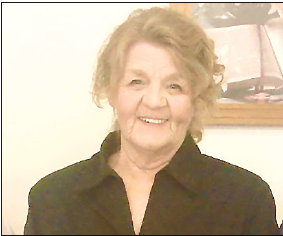
Audrey Shelton shares many memories including her time spent working in the jail system.
By Deby Jo Ferguson
Staff Writer
Audrey Shelton, 76, is the daughter of Thomas and Christine Chance Roach. She was born Sept. 2, 1947, married Larry Shelton in 1971 and he passed away in 2019. They had two children, Candy and Clancy, two grandchildren and one great-granddaughter.
Growing up, Shelton attended school in Hayesville, one year in Murphy and then returned to Hayesville with her family where she graduated from Hayesville High School. Most of her childhood was spent in Clay County where she started and finished school.
The first job Shelton held when she graduated high school was at Levis in Murphy. She worked at Carolina Dress in Hayesville and Clifton Precision for a year in Peachtree.
“I liked working at Clifton but had a hard time getting back and forth to work because I didn’t have a car of my own. After I left Clifton, I went back to work at Carolina Dress in Hayesville until 1972 then Larry and I moved to Hiawassee where I went to work at Carolina Dress located there. We lived there six years then came back to Hayesville but I liked the people where I was working in Hiawassee, so I stayed there for 15 years as a sewing machine operator,” Shelton said.
In 1985 Shelton and her husband Larry moved to Lake Toxaway outside of Brevard, N.C. “Larry was offered a job as a carpenter working with Brodus Jones.
“After he hired Larry, Brodus decided he wanted to get a women’s crew going so he asked if I wanted to go to work as a carpenter and of course I did. It was fun for me, but Larry said it really got on his nerves. He said I drove him crazy because us women would go around making mistakes and yell for the men to come fix it. Larry got so aggravated he fired me one time. I went and told Brodus on him and he said that Larry couldn’t fire me because he was the boss,” she laughed.
“When we moved back to Hayesville, I went to work back at Carolina Dress then at General Textiles for Betty Jo Guest in Hayesville. In the 1990s when NAFTA was passed, sewing plants went out and I had to draw unemployment. Just about the time my unemployment was going to run out I went to work at the old jail while Tony Woody was sheriff,” Shelton said.
Shelton went to school with Sheriff Woody. Carvel Barnard was working for Woody as his secretary and jail administrator. “She asked my mom who worked cleaning for the county if I would be interested in working at the jail, so I put in an application and started working a couple days later.”
I worked third shift about three and a half years which I didn’t care much about, but once the Sheriff’s Department opened the 911 building most of the ones from the jail went there. I was lucky enough to be offered the jail administrator job and started working eight-hour shifts during the day. Not many people enjoyed working at the jail, but I did and I think it was mainly they didn’t like third shift,” Shelton said.
As I was listening to Shelton talk about the old jail it came to me that I started my 13 years of working at the jail around 2004 under Sheriff Tony Woody and Shelton was the one who trained me. I got my two days training and went to work. Back then only one person worked a shift, I worked third shift and as long as I worked at the jail both the old and new jail, I wanted to work third shift.
I also remember asking Audrey why we didn’t hold women and mainly held men. She said that I would figure it out because she had rather have 20 drunk men than one woman. A man would spend the next week saying how sorry he was for acting up while he was drunk, but the woman would fight you when she came in and fight you again after she woke up. I came to understand her logic.
Shelton said, “Back at the old jail we housed mainly local people. You either knew them, knew their parents, went to school with them or was related to em’. There were days and days when we wouldn’t have a single inmate, so Tony would get a bunch of fish and invite the people from all over the town to come and eat. It was a special time.”
“Back then if a senior citizen needed something he’d send one of the deputies to go and help them, even if it was changing a light bulb. That’s just the way Tony was. He loved to play jokes on you and of course we did our share of getting even with him. If you got mad and went to complain to Tony about the problem, he would say okay here’s you a “sugar tit” and reach behind his desk and get a long stick he kept with a nipple on the end of it and that was your “sugar tit.” That’s how it got solved,” Shelton laughed.
Although they had lots of laughs and what she describes a close family, Shelton said she believed in doing her job right and going by the book when it came to the care of the inmates.
“I remember one inmate I had to pay special attention to as we didn’t know if he would try to take off,” she said. “It was the first time I can remember holding an inmate for murder charges, back when that man got killed at the car wash. But he never caused any trouble while he was there. After that we did house a few from Cherokee County that had murder charges, but that was the first for us.
“I also remember holding this one guy from Cherokee County that didn’t know the layout of the old jail. It was a round circle with cells on two sides. He had gone out to visitation and as I was putting him back in the cell, he made a dash to escape. He took off running around the circle of the jail the long way and I ran for the exit door the short way and slammed the main door shut. I called Melvin Cantrell over and we locked him back up. It was rather funny as I think back now,” Shelton said.
Shelton shared that Miss Roberts from the school used to bring kids to the jail when there weren’t any inmates to take a tour of the jail.
“I’d get together wool blankets and jump suits and take them into the cells. I let them see that the inmates brushed their teeth over the same place they went to the bathroom. Sometimes we’d even put the hand cuffs on them so they would never want that to happen when they grew up,” Shelton recalled.
It was not on their job description, but Shelton spoke of how they would try to help inmates who were getting out of jail look for a job so they could work once they got out. Also, during earlier times people would call if they thought they had warrants and if they did would asked Shelton to let the sheriff know they would be in as quick as they could find someone to bond them out and would actually show up.
“The old jail held 11 inmates so sometimes we had to send them to Macon County if we got too many, but I can remember one time before court we had 22 and they were sleeping on mats all over the floor for a couple nights,” Shelton said.
In May of 2008 the new jail was completed and everything and everybody relocated there. Woody had retired and Joe Shook was sheriff.
“I remember they were planning to build a sallyport at the new jail. Joe and I talked about it and I mentioned to him we would have a 48-bed capacity instead of 11 which meant a lot more to feed. I guess he thought about it and decided to go with the kitchen instead of the sallyport, which I think was a good move on his part,” she said.
Shelton liked working at the new jail which brought less responsibility.
“At the old jail I had to do meds, doctor appointments and more, but at the new jail we had an in-house nurse which was a relief and a lot off me. When we went there Shook told me that I didn’t have to make rounds working in the jail, just do the paperwork for the office. I chose to do the rounds myself. I wanted to know what kind of inmates we had, their state of mind, what they might do and if they were dangerous or not. You lose a lot of that insite if you don’t come in contact with people. I felt it was better for me and for the officers for me to do this. At the old jail the inmates were locked up but once we moved to the new jail were walked all among them which was a higher security risk for the officers,” Shelton continued.
Shelton explained that one of the major differences between the old and new jail there was a lot more inmates with more serious charges like drugs and such.
“There were a lot more officers working which is why I couldn’t understand that there was more back-stabbing among the officers to try and get rid of someone,” she noted. “At a jail there isn’t a lot of room for promotions and if you get rid of someone it doesn’t really benefit you because there’s still going to be that 12-hour shift there to cover by someone.”
She retired because of her husband’s health, but came back and worked parttime for four years then retired in 2016.
“I remember the good things about my job, but there was also sadness. Sadness when a mother came to say goodbye to her grown children who were going away to serve time and the sadness of the ones going away with no one to come to say goodbye. There was the sadness of parents who bonded their kids out and they were back in there before morning, overdosed or got into a car wreck after leaving,” said Shelton.
“The rewards came when someone came up and thanked you for helping them or you heard that they got straight after leaving the jail. I loved working at both the old and new jail. I still miss it,” she said. “I’d give anything to walk through them side doors right now into my office, put my stuff down and go make my rounds. Yes, I miss all the years I spent there because I loved what I did and I wish I could do it all over again,” Shelton said.