
Want to support Freedom Cemetery?
Mail checks to Ft. Hembree Baptist Church, PO Box 557, Hayesville, NC 28904. The Go Fund me page is Freedom Cemetery Cleanup & Care or donations can be taken to First Citizens Bank for Ft. Hembree Baptist Church.
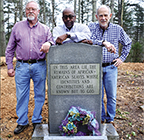
Becky Long • Clay County Progress Among the committee members working to improve Freedom Cemetery are Commissioner Clay Logan, Pastor Harold Holbrook Jr. and George Gains who gathered at the cemetery’s marker that had been placed by the Clay County Historical & Arts Council. The group is raising money to preserve and enhance the historical site.
By Becky Long
Publisher
A group of local people are working to raise money to preserve, improve and honor a part of local history, those buried in an African American slave cemetery in Clay County.
The site, Freedom Cemetery, is believed to be located on a former plantation belonging to a Dr. Tate. The ground is dotted with tiny red flags signifying about 27 graves Western Carolina University researchers identified a few years ago. It is located about 2 miles from Hayesville, just off Tusquittee Road, on Slave Drive.
Last year the cemetery was deeded to Fort Hembree Baptist Church from the Rural Development Authority. Pastor Harold Lee Holbrook Jr., is among a small group spearheading the project. Their goal is to raise $30,000.
“The plan is to have trees cut down in the site. Install fencing around the perimeter, add headstones to identify each grave site,” said Holbrook. “We will also have the area landscaped around the outside and low ground covering on the inside. Our next phase will be to put a kiosk at the gate with information on the history of this site and we are looking to get the site on the registry of cemeteries and National Register of Historic Places.”
Researchers were able to detect the graves using ground penetrating radar, but the graves have yet to be personally identified. The radar showed breaks in the gr0und which is where the ground has settled or caved in as the containers or coffins, probably made of wood, had deteriorated, according to a WCU researcher Blair Tormey.
There is still hope the identities of those buried will be revealed some day.
“We will work with WNC and the Cannon Foundation and their genealogy groups to help identify those that are buried in Freedom Cemetery,” Holbrook said.
While the land was donated to Fort Hembree last year, the project took seed about three years ago when Hinton Center and Truett Baptist Camp had summer interns looking for projects, according to Holbrook.
“Because of our relationships they would clean the cemetery as a project for the church,” he said. “Last year Clay County Commissioner Clay Logan and I were at the site and he mentioned that someone should take control of the property. I said if feasible Fort Hembree would be interested in doing that and that started the wheels turning.”
Holbrook said he and Logan spent several hours getting quotes and meeting with people to get their opinion as to what should be done to make the cemetery reflect “the honor those there deserve.” The committee they put together includes Betty Bradley, Clay Logan, George Gaines, Tighe White and Ann Woodford.
In February 2016, County Historical & Arts Council placed a marker and bench at the site and recently clearing of trees and debris has been done, but there are much more to be done to create a respectful place where people can visit and reflect.
“Freedom Cemetery in Clay County will be one of a very small number of sites that recall that African Americans ever existed in this region. This site stands as a memorial to those who have been here and gone but are not forgotten,” noted Woodford. “I believe the spirits of the ancestors will be proud of our work to remember them and provide a place of dignity and honor to preserve their memories. It fills me with great joy to know that the community of Clay County and the general Baptist State Convention of North Carolina are working with us in memorializing those that are buried here, but not forgotten in Clay County.”
The history behind
Freedom Cemetery
By Jim Glock
Printed in the Progress
Feb. 4, 2016.
Without doubt, Tate owned most, if not all, of the slaves interred on Moore Hill. Perhaps, some once belonged to other Fort Hembree area owners.
Here is a brief chronology of property transactions for the land containing the Slave Cemetery: Tate sold the property to William M. Sanderson in 1861. Sanderson was not a slave owner.
Sanderson’s heirs sold it to K. Elias from Macon County in 1892. In 1906, Elias and his wife sold it to W.J. Moore of Haywood County. In 1917, W.J. Moore’s heirs distributed the property with the portion containing the cemetery going to T.M. Moore and his wife Alma.
In 1966, Alma sold the property to the Clay County Rural Development Authority. The CCRDA developed the property and sold the lot containing the cemetery to Frank Galloway and wife in 1971. The Galloways sold the property to the Hunters in 1978.
In the summer of 2015, Guinnell Hunter approached the Clay County Historical & Arts Council requesting assistance in marking the Slave Cemetery site. “These precious people were buried in my front yard long before our family moved here,” Hunter said. “It is essential that their burial ground be recognized.
I have come to feel that in some unfathomable way I have been given the important task of making sure the people of Clay County know they lived. They died. They matter.”