
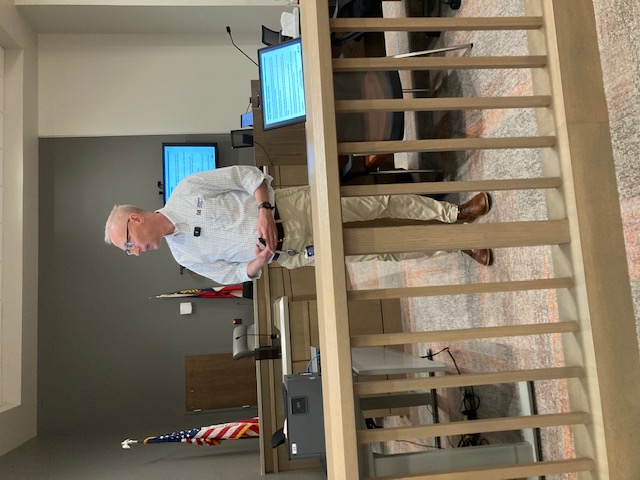
Marcia Barnes • Clay County Progress Chris Saucier, TVA Senior Project Manager for Dam Safety gave an update on the Chatuge Dam safety project on Wednesday, June 25 at the Towns County Courthouse.
By Marcia Barnes
Staff Writer
While Tennessee Valley Authority continues to study safety issues at the 83-year-old Chatuge Dam, Chris Saucier provided an update on Wednesday, June 25 on refinements to modifications which are still being considered to fix the spillway.
TVA’s Senior Project Manager for Dam Safety said that Alternative B which would have required rehabilitation of spillway joints with a draw-down of the reservoir for up to eight years has been eliminated and removed from further consideration.
For the three remaining modification alternatives, the draw-down time frames have been significantly reduced to periods of up to two years with the draw-down of the pool occurring outside the recreational spring and summer months. Draw-downs would still be necessary to ensure worker safety, but all draw-down durations have been reduced.
The dam safety study was initiated by TVA due to concerns that if a large volume of water should flow quickly over the Chatuge spillway during an extreme rainfall event that it could lift the concrete slabs. Once lifted and ground exposed to the force of the water, that could erode the spillway all the way back until it breached the reservoir.
In the update on the Chatuge Dam safety study, Saucier explained where TVA is on their recent refinements supporting alternative evaluation, plans for a Socio-Economic Impact Study and the Chatuge Dam safety risk assessment. Based on new information collected during the recent phase of the project and additional consultation with construction contractors, TVA has been able to optimize the draw-down duration estimates which were presented in the public meetings last month in Hayesville on May 8 and in Young Harris on May 13.
“We are in a study now to decide what is the concept that will be used to fix the dam, we’re not in the construction phase. We need to inform the public of what we’re looking at,” Saucier said. “The Public Scoping Period that many people participated in was for us to get the scope of our study of the impacts right.
“So, we have to do a study of the impacts for each one of these projects, the scale, the size, the scope, things like that. What we were doing was collecting in-put from the community about what that was all about. What did the community think, so we get the scale of this impact study correct.”
Saucier said that TVA was transparent largely about where they were using benchmarks for the draw-downs, what construction times might be, and none exactly like the ones they are proposing. He said that flushing it out was work that wasn’t complete at the time they started the process.
“We aggressively pursued that in the last few weeks and are able to come with some of those refinements, even how the construction might be sequenced. We’ve done a lot more work on the design and construction side that gives us a better picture and greater confidence in what we can say today.
“As you go through a study like this, what the plan is to speak confidently about the numbers when you can give them,” Saucier said.
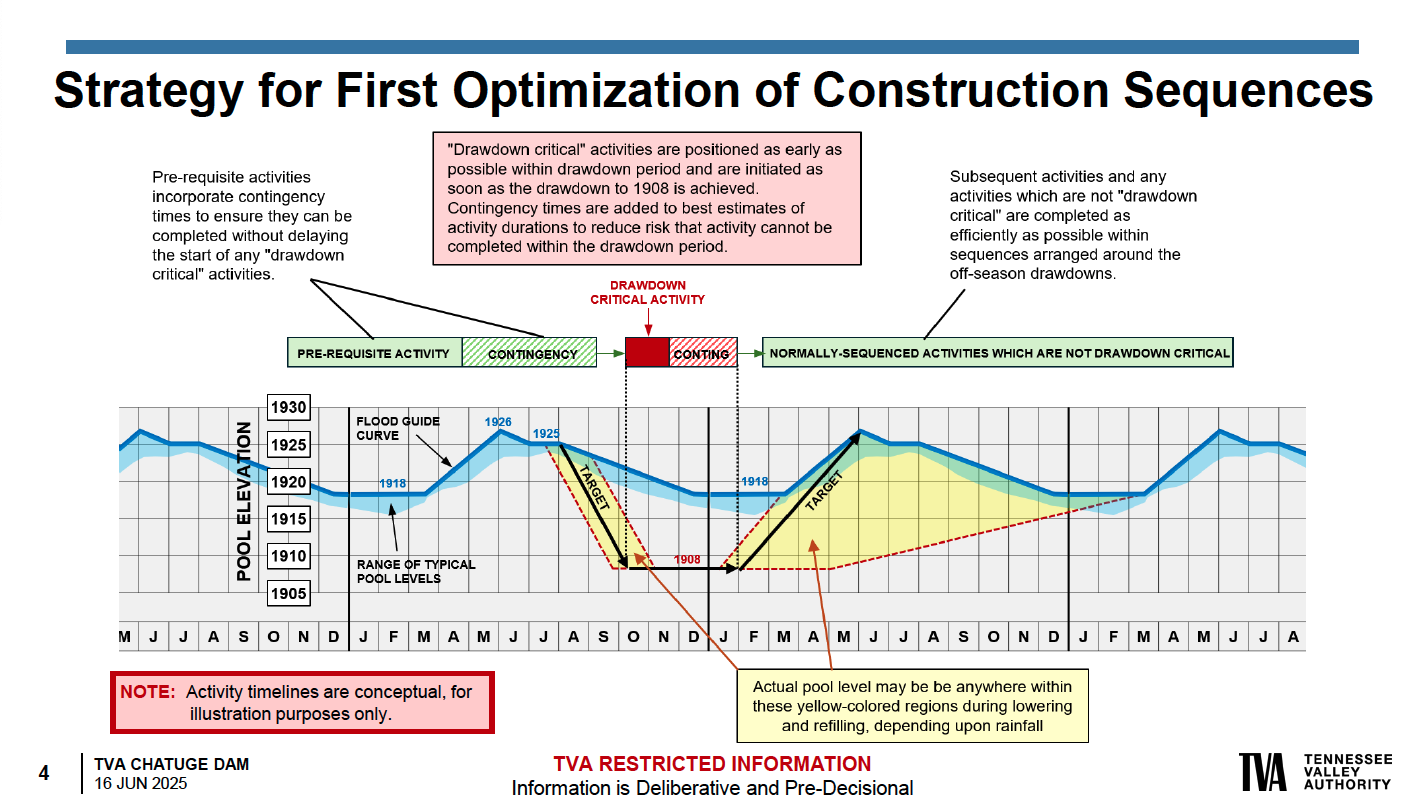
TVA arrived at the refinements in studying the flood guide curve, 1,925-1,926, and the typical draw-down on the reservoir around Aug. 1. There were four alternatives, today TVA’s refinements focus on three modification alternatives.
Saucier said that they went to every single one of the plans and looked at what were the steps, the pieces of work that they were going to have to execute and implement. They looked at what were the items that were absolutely critical to having the pool drawn-down.
In order to arrive at the recent refinements, water would be pulled down faster, as quickly as TVA can to the 1,908 elevation. Then, work through the draw-down period would be as quick as possible in a 24/7 work schedule building in enough of a buffer that they can say release the pool for normal operations.
“We are going to operate the pool the way we always do, that doesn’t mean the pool level will be where it always is because it depends on how much rainfall, if you happen to be in a dry year or something goes awry. You get pushed out a little further when there’s a lot of rain, but if there’s less rain it will take more time for it to get up after we release the pool. We can control the release of the pool, we can’t control the rain,” Saucier said.
A very critical piece of the refinements to Alternatives C, D and E is that every one of the modification alternatives is built around the critical draw-down periods. Schedules are built around newer construction schedules and newer draw-down duration.
Mitigating a lot of uncertainty with the pool being drawn down the entire time and because the duration was pretty scary to the community’s socio-economic life, Alternative B is no longer on the table. It also presented greater risk in terms of dam safety for the TVA.
For Alternative C: Spillway Rehab by Concrete Lining still includes that it may or may not involve change to spillway gate configurations in order to rehabilitate the existing flume in-place by constructing a new concrete lining inside existing footprint and improvements to pen-stock piping and valve at powerhouse. The draw-down has been revised to draw-downs occurring outside the recreational spring and summer months during no more than two years, though the two years could be consecutive; construction time, reduced to up to five years.
For Alternative D and E, which involve a new spillway and or repairs to the existing spillway, the previous 4-year and 5-year draw-down estimates have been revised to reflect draw-downs occurring in the off-seasons during no more than two years with the two years being non-consecutive.
All refined alternatives reflect the duration of draw-down to the pool being reduced significantly even with a new bridge added to the scope of work. The bridge is necessary and included as a bridge component that makes possible bringing heavy equipment to the site. It replaces an existing 1920-era bridge.
“Alternative D — building a brand-new spillway — we now believe the scope up to five years, no more than two winter draw-downs and building a cofferdam out in front of this brand-new spillway. Then, open this pretty large hole in the ground to build this brand-new spillway. Once that’s completed, we’d use this new spillway and then, go over and just dam off the existing spillway and it couldn’t be used after that,” Saucier said.
The last option, Alternative E: new spillway, rehab existing spillway is similar and would take up to five years construction duration with no more than two years of off-season draw-downs. The draw-downs occurring only in the winter months are still required and conditions at the site like soil and rock can dictate change.
“There are still opportunities as we go forward to maybe look at these and make them even better. In summary, Alternative B is off the table, Alternative C, D, E, up to five years construction duration, draw-down required, but in the winter months.
“We’ve spoken with your local, state and your federal representatives about this. They are very strong advocates on behalf of their constituents. It’s been a very productive conversation with them, but also with the community.
“Right now, construction would begin late calendar year of ‘27, early calendar year ‘28. The alternatives will be studied in more detail, late this calendar year the draft documents will be out, then a preference, it’s coming. No decision has been made on C, D or E,” Saucier said.
The National Environmental Protection Act does require TVA to do a socio-economic impact study. This will be part of the draft which will be published late this year, or beginning of next year. Saucier said that what they needed from the public in-put was the scope and scale and size that would inform them and could be examined.
“We think it is appropriate to engage local communities. I can tell you, we don’t know how we’re going to do that yet. We are going to integrate some form of local interaction in that study and that’s still being decided, but in the next four to eight weeks you’ll see that happening in the local community.”
Saucier said that there may be surveys in several communities, there may be continuous participation in some form from local business leaders, several mechanisms. There may be focus groups assembled to help inform how TVA can tweak the pieces.
“The final point is we have several pieces on the table and we are going to do that,” Saucier said.
The socio-economic piece does inform the draft and the public will be able to look at that draft and comment on that.
Using new numbers, there is a possibility that this summer, next summer and the next summer the lake will be normal, but not a guarantee. The time frame for construction has changed for each alternative modification from six years to up to five years. The time frame is from the award date to the actual completion date.
Summers will be fairly normal on the lake if we get rainfall. The draw-down will be off-season. The cofferdam in some capacity for Alternative C is smaller; Alternative D and E, much, much larger. The cofferdam was always considered for each alternative.
Saucier said that once on board with design engineering and the construction engineering contractor, the people who are actually going to put their stamps on it, who are actually going to be doing the building, there’s one more look at it to make it better.
While revisions were ongoing at TVA, several elected officials were asking for revision and Saucier said that they are still trying to make it even better and realize the need to aggressively communicate about the updates.
“At all levels that was communicated and we’re being responsive. We got it.”
There will be a couple of opportunities before TVA finishes the study up, before the draft is completed for one more look. “It’s another look,” Saucier said.
In risk management assessment of the Chatuge Dam spillway, TVA follows the same process used by the Corps of Engineers, the Bureau of Reclamation and others. They all ascribe to the best practices for risk assessment and dam safety. If TVA assesses that the spillway at Chatuge Dam is outside their risk tolerance, it is outside the risk tolerance for all other agencies because they all use the same methods of evaluation and these are based on historical rates of performances and failures of dams.
Saucier said that inside the world of dam safety engineers who are studying risk assessment, they are trying to do two things, look at two things. What is the likelihood that the dam will fail? And, how many people are harmed if the dam fails? Loss of human life is the prime driver.
TVA’s Senior Project Manager for Dam Safety explained the process and that at TVA there is a team of about 40 technical people, civil engineers, mechanical engineers, geologists, operation specialists at the site, social scientists, construction professionals in a room about the size of the Towns County courtroom, looking at ways to fail the dam, working 10-hour and 12-hour days for two weeks.
Those teams write up every single step and provide supporting documentation for their judgment of those steps and assign probabilities to how those steps will occur and probability of failure. That’s step one.
Step two is the modeling scenario. Saucier said that in this part, you breach the dam to the size that corresponds, you model space to that probable failure, map the inundated area downstream covered by water. You count up the number of people inside that model and you do some social response. Can they get out? Will they get out? Do they have enough warning to get out? What time of day did it happen?
“Based on some rules of thumb, the depth of the water, the velocity of the water, you decide who dies. It is a really harsh reality. We do that because we’re trying to prevent those things.”
Saucier said that this information will not be released to the public because in the wrong hands that would be an instruction manual for someone to fail our dam and kill the most people. This policy is shared by the Corps of Engineers and others.
“Our heart is in the interest of the people and their safety is exactly why we are not releasing it.”
The appropriate questions are, “Am I in danger, am I in the zone?” These will be addressed with key landmarks, information on warning and answering “How do we get out?
“The next piece the community will see will probably be the pamphlet.
"Historically, the chance of failure of dams is 1 in 10,000 per year. What matters is the consequence of a failure.
“At TVA, we do understand those communities we serve and we are trying our best to work in the public interest even if they can’t see it all times, but this was an opportunity for us. We said we’d get back to you mid-September with better numbers. We’re here early to do what we said we were going to do. We’ve built these optimized schedules around the 24/7 draw-down period work,” Saucier said.