
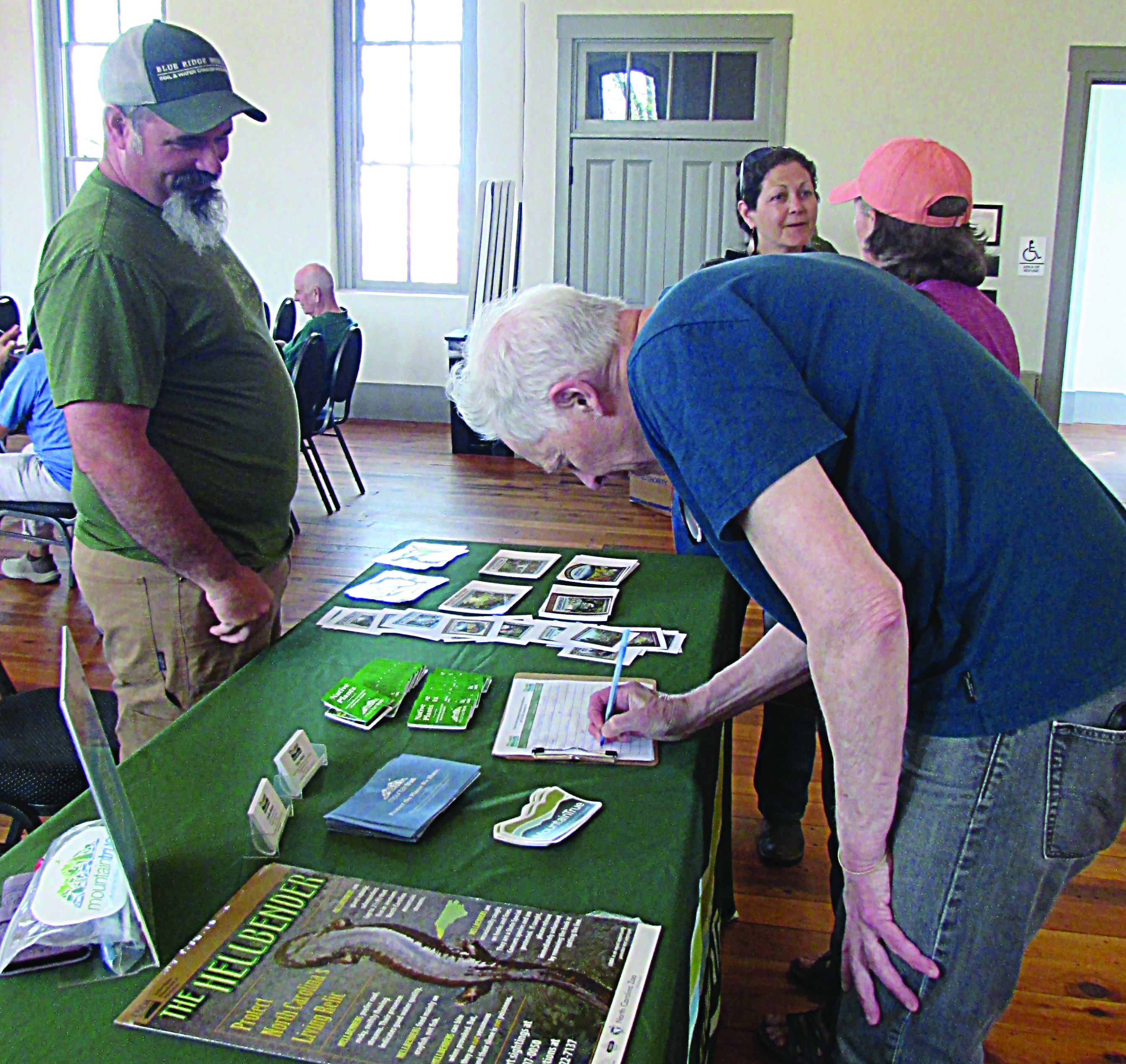
About three dozen people showed up Thursday evening at Hayesville’s Historic Courthouse Beal Center to learn more about the Roadless Rule and voice their input.
At issue was the U.S. Forest Service proposal to roll back the 25-year-old conservation rule protecting millions of acres of forest land to make way for road building, logging and development.
According to Mountain True, the nonprofit group dedicated to the sustainability of water quality in the Hiwassee River region, the federal government has reduced transparency requirements, thereby making it more difficult for advocates of forest lands to speak out.
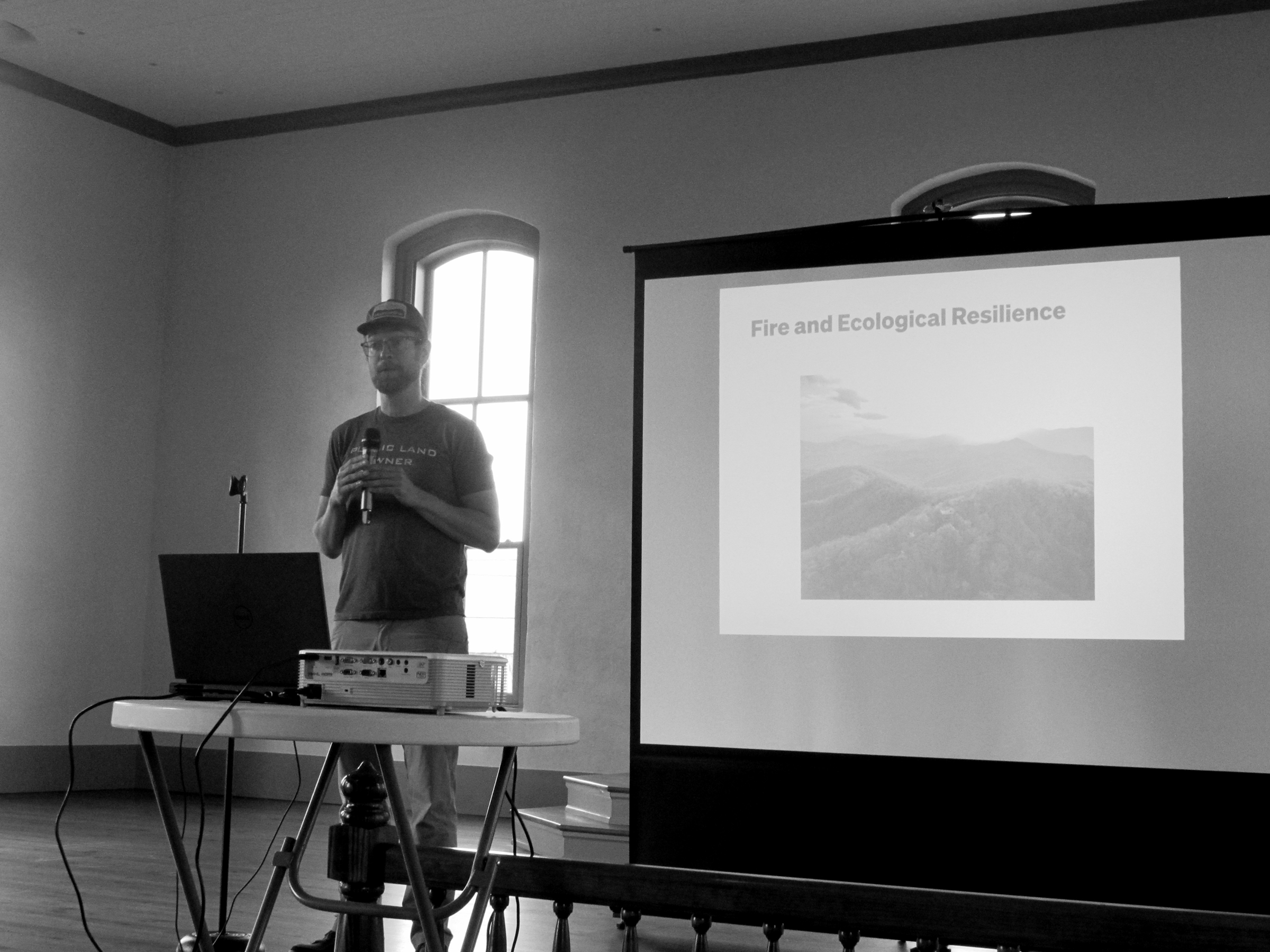
In June 2025 the U.S. Department of Agriculture announced plans to rescind the Roadless Rule. Mountain True is joining with other groups including the N.C. Sierra Club and the Center for Biological Diversity in sponsoring public hearings on the matter. Mountain True’s Resilient Forests Director Josh Kelly opened the evening by asking local residents for their input to be recorded or to write their concerns on postcards, which Mountain True produced at the meeting.
“We’re holding this public hearing because the government needs to hear from people. We encourage people to send postcards. We will put stamps on these so you can share your thoughts and let folks know how you feel, or we will transcribe your comments,” Kelly said.
The main object of the hearings is to give citizens an opportunity to get involved in the protection of their environment, he added.
Giving a background statement with slide presentation, Kelly said there are millions of acres of land managed by the U.S. Forest Service, including 158,000 miles of trails and 13 million acres in the southern Appalachian region alone.
“We need the Roadless Rule because 371,000 miles of road – more than the U.S. Highway System – are involved,” he said.
The 2001 Roadless Rule, Kelly said, was incredibly popular. Its intent was to ensure such areas remain as they are in perpetuity.
North Carolina and Virginia are two main states for roadless areas in the east, Kelly said. One advantage to keeping them that way is providing clean drinking water because 14.5 million people in the Southeast get their drinking water from roadless area watersheds. Roadless areas contribute to the economy by offering recreational spots for rock climbing, bike paths, fishing, mountain biking and huge wildlife habitats, he explained.
“Without the Roadless Rule the government argues it will be easier to fight fires, but almost all forest fires are started by people near roads,” Kelly noted.
What is at stake if the Roadless Rule is rescinded includes losing places to go where humans can be alone with nature, good fishing, clean water, pristine wildlife habitat, and leaving a legacy for future generations, he said.
Kelly invited participants to leave written comments at Roadless.org if they can.
Some of Thursday evening’s personal comments included:
• “Who lobbied to rescind the rule? Was it the timber industry?”
• “We don’t want roads in the Nantahala Forest. Roads are dangerous to hikers,
bikers, fishermen, and horseback riders.”
• “Most of us are grateful to be living here. What we do collectively affects everyone. We can still have growth but it has to be smart.”
• “What brought me here was seeing how much the land was valued.”
• “Think about what unsupervised logging does to indigenous sites. It destroys them. I love the Roadless Rule and I hope it doesn’t change but a lot of things are changing. You have to speak up.”
• “We need to protect what we’ve got. Without organizations like Mountain True and the Wilderness Society, it could be bleak.”
• “The more you are educated about our environment and the trees we have here, the more we can do to protect them. I am so proud of this area and I do not want it destroyed.”
• “As wild as Fires Creek Wilderness Area is already without roads being developed, we’ve seen trash, and Fires Creek is one of the most pristine creeks around.”
• “What’s wrong with having a few special places away from traffic and noise?”
• “Let’s keep things the way they are for themselves. I’m for more wild places to be established for the land itself.”
• “They’re not making any more land. There is not going to be another earth. We’re interdependent. We have to be aware that if it’s gone we don’t get it back.”
• “You’ve got to put pressure on the Forest Service. Murphy stopped the TVA from turning lake land into developable land.”
• “If we keep profiting off the forests soon they will be gone. I feel more people should be very angry about what’s going on. Wilderness is essential to the human spirit.”
• “Growing up here I took it for granted. If you get out you’ll see how priceless and beautiful and unique this place is. I do not want it to change.”
Mountain True’s Western Regional Director Callie Moore told the hearing, “Citizen voices do matter. A development in Cherokee County was halted because a significant number of people spoke against it. It’s important that we voice our opinion.”
Comprehensive information on the Roadless Rule is available at www.roadless.org.