
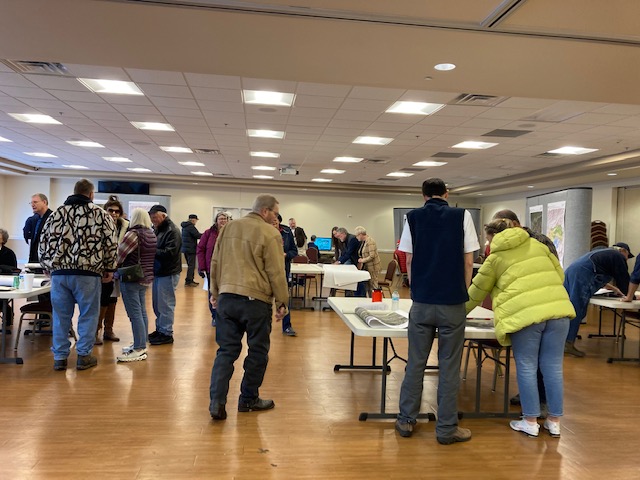
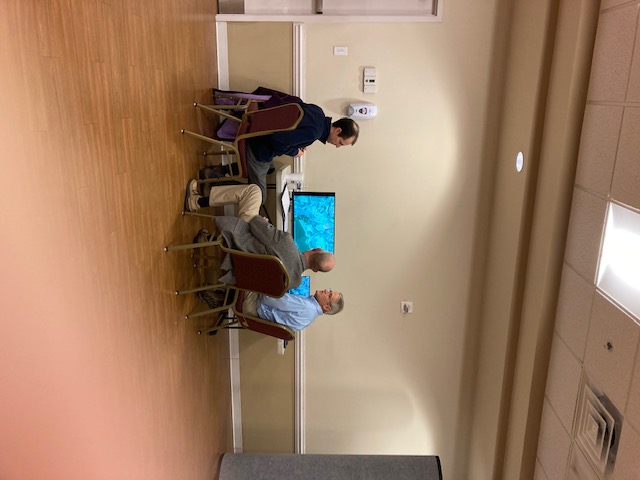
Marcia Barnes • Clay County Progress TVA Siting Engineer John West listened to comments and answered questions on the Shooting Creek Proposed Transmission Project at an open house held in Towns County. West used visual area maps showing TVA's proposed transmission line routes to landowners and guests.
By Marcia Barnes
Staff Writer
The Tennessee Valley Authority heard comments and answered questions from landowners and residents in the area on the proposed transmission routes which will tie into a new Blue Ridge Mountain Electric Membership Corporation substation on Burnt Schoolhouse Road in Shooting Creek.
A media advisory was sent in late November from TVA asking for public input on proposed transmission system improvements to serve the growing electrical load and increase power reliability in the Clay County area.
At the six-hour open house held Thursday, Dec. 4 at the Towns County Recreation Center in Young Harris, 241 guests registered their names and contact information. Although some individuals refused to sign in, attendance was well over 300 people.
TVA siting engineers, engineers in related fields and John West, TVA’s contact for the project, as well as BRMEMC Engineer Daniel Frizzell were available to everyone with a question or a comment on a one-to-one basis throughout the afternoon.
Questions about the project ranged from why additional power capacity is needed, what alternatives are available to supply an increase of power, questions on demographics and questions on 161 kilovolts, the standard voltage that TVA uses. Questions were asked about land easements.
Attendees at the open house were furnished four pages of information on the project which included a map, but more information was being exchanged on the floor between those in attendance and the TVA staff that had come to gather public input.
Taylor Warden, TVA Transmission Siting Engineer answered several questions during the open house.
Question: What would be the proposed length of the preferred transmission line route once it is announced and has it been selected?
Taylor: “That would be seven to nine miles. It has not been selected, that’s why we’re here today. We’re presenting multiple alternatives across the area to gain feedback from potentially impacted landowners because these potentially impacted landowners play key decision making in our process. We evaluate new transmission lines into three categories. Engineering, environmental and social. Social is the big reason why we’re here today. Landowners have different avenues to submit comments. Those comments are documented. A 30-day public comment period began today and that period will end Monday, Jan. 5. The comments go directly into TVA’s decision making, into the analysis that TVA performs when selecting a new transmission route.”
Question: What type of review will the Shooting Creek project have to go through?
Taylor: “Right now, the review would be doing our studies on the transmission siting, and the team that we are here with today would be performing. After a decision has been made for a preferred route, then the appropriate environmental review process would start, the National Environmental Policy Act. Every new project has to go through an environmental review, depending on the size of the project, it warrants what type of environmental review it would go through.”
Question: Who generates proposed growth numbers?
Taylor: “We have a joint ownership program, so we have the obligation to serve BRMEMC’s needs. The purpose behind this proposed project, BRMEMC is seeing some capacity issues on their existing system in the generalized area. They saw the need to build a new substation and for us to provide that needed capacity for the future, which would allow for more capacity and operational flexibility. We have to build this new transmission line to interconnect into our grid for them, so they can have that added capacity and flexibility in the future.”
Question: How much power is needed to provide for that capacity and flexibility?
Taylor: “We would be building a 161 kV transmission line, that would be the voltage of the transmission line we would be building and that’s the voltage the TVA and BRMEMC planning team has determined the best path forward.”
Question: Within the seven to nine mile transmission line path, will landowners and the public see enormous towers running across fields and rural terrain?
Taylor: “This project would be predominately mono-pole or single pole construction. It wouldn’t be the big towers that you see on some of our highest voltage lines. This would be single-pole construction. Now, there is potential for H-frame or two-pole structure types in some more mountainous terrain areas, but predominately, the single-pole mono-pole structure is what would be used on this project.”
Question: Where will it tie in?
Taylor: “There are two potential options connecting to our existing assets in the area. Those two options are part of the decision making process of why we’re here today, that ties into our analysis process. We have one area near our existing Hayesville 161 kV as one potential connection point and then, we also have a another potential option here closer to Chatuge Dam which also connects to one of our existing lines. One would be selected as our preferred alternative. We would be connecting into TVA assets.”
Question: What if the social input outweighs BRMEMC’s request for additional power? Is there an alternative?
Taylor: “This proposed seven to nine mile 161 kV line is the preferred alternative based on options that have been evaluated in the planning phases of this project.”
Question: Are other alternatives geographically difficult or too costly?
Taylor: “BRMEMC sees their needs on their system and they come to TVA and TVA works with them. Together with BRMEMC, based on geographic cost, stability, they evaluate all of these options. This option from all of those factors was the best option for TVA and BRMEMC and the general area in order to provide that needed capacity, operational flexibility for the next 5, 10, 15, 20 plus years. The entire project is within North Carolina. Lake Chatuge is a factor that constrains the area and based on the proposed location of the Shooting Creek substation that limits TVA to where we can show potential transmission line routes that can be built to serve this substation.”
Question: How much land would need to be purchased?
Taylor: “Let me talk a little bit about our process. Once a route has been identified, landowners that would be impacted by that transmission line route would get letters in the mail, and then a siting representative from TVA would start working with those landowners, to maybe make some fine tune adjustments, insure that we’re having the least impact possible on their property. From there, we have survey crews that come out. They tie property boundaries, locate features along that easement that would potentially be there in the future, and from there, our office folks go in and work with our realty team who ultimately determine how much acreage is affected on each landowner. So, our realty team would then go to each impacted land owner with their appraised value of the easement on the property and work with each land owner on the compensation value for that easement. The landowner that would have an easement on their property still owns the property.”
Question: Is an easement a purchasing fee?
Taylor: “Landowners would still own their property. An easement is not a purchasing fee. TVA would have certain rights within our easement, but if there’s a forest area where maybe people like to hunt, or if there’s open farm land, farmers are still able to do their day-to-day operations, whether that’s baling hay, row crops, something like that.”
Question: How much time do landowners have to reply?
Taylor: “Starting today, landowners have 30 days to submit formal written comments and the material we’re providing today provides landowners different avenues, whether that’s going through our website, mailing them in via United States mail or whether that’s calling our 1 (800) number.”
Question: What happens when the 30 day comment period ends?
Taylor: “So, after that 30 days, we would start working on our decision-making process based on the other factors. Landowners can expect to receive the final route announcement or preferred route announcement in the spring of next year. When the landowner gets that mail, that does not mean that it’s the final route. The route is not final until we go out and survey and put those points on the ground. We do our best to work with each impacted landowner, to make fine tune adjustments, insure that we’re having the least impact possible.”
TVA Senior Strategic Communicator Tom Satkowiak said that the best thing about how they do a lengthy open house is that everybody who comes in basically gets that one-on-one discussion with an engineer, ask questions, it’s a very personalized service.
“We find that this is the best way to do these. Landowners feel valued because they are having that one-on-one conversation and that’s really important to us,” Satkowiak said.
BRMEMC Engineer Daniel Frizzell was available throughout the open house and answered questions specific to the geography of the area to be serviced by the Shooting Creek substation and various questions concerning the growing area that they serve.
Question: How large is the area serviced by BRMEMC?
Frizzell: “We serve all of Clay County, all of Towns County, all of Union County, and the eastern and southern part of Fannin County. In Cherokee County, we serve the far north, up around Hanging Dog and that area, and 294 out to just past Hiawassee Dam School, and that area along Highway 64 to the Tennessee line. Our power lines stop at Tennessee.”
Question: For customers within Shooting Creek, was any notification sent from BRMEMC about the proposed transmission project?
Frizzell: “The first notice was sent in the media advisory from TVA. Our footprint in the project is pretty small compared to the transmission line in this particular project.”
Question: How much growth in electrical power usage within the BRMEMC area has occurred since the pandemic?
Frizzell: “We’ve experienced, even in the hard economic times, one flat-growth in our area, but every other time has been a positive growth rate and then, when the pandemic occurred it certainly accelerated growth. This has always been a huge vacation area and people had second homes here that might be visited two weekends a year. Then all of a sudden, those people who used to be here only a couple of weekends a year and worked in the city, they had the ability to come here and stay. It’s not just the new homes being built here, but people living full time in the homes that were already here.”
Question: Shooting Creek is a rural area, what part does the Shooting Creek area have in electrical power needs?
Frizzell: “When we talk about the Shooting Creek area, it’s a broader area than what people may consider. Let’s broaden it out a little bit. This is called the Shooting Creek substation and pretty much when you go east of Downings Creek, that’s Shooting Creek to the end of our lines. So, when you’re looking at the Shooting Creek substation, it’s not just serving Shooting Creek, that’s just the name that we chose, it’s the name of the station. It’s going to serve Shooting Creek from Burnt Schoolhouse east, serving Muskrat, Eagle Fork, all of those areas. It’s also serving Bell Creek all the way down to Towns County, all of that section along Highway 175, 75 into Georgia, and then, basically all of Mountain Harbour, Peckerwood, Deer Brook, not all the way to the Tusquittee side, this side of the gap and serving the corridor along 64, Walker Ridge, Dogwood Estates and those little points that go out around the lake, Elf School, all of that area, Ledford Chapel.”
Frizzell said that there’s a much broader area that this substation will feed and allow for growth, and also allow for back feeding of other substations, Hayesville, Macedonia and Woods Grove.
“It’s assisting, if we need to have an outing on a substation, or worse yet, something happens to a substation, it’s damaged in some way, all those customers still want to have lights. So, you have to back feed from other places back into that area. Hayesville is one of the concerns we have going into the future, if we lose Hayesville, it’s a currently heavily-loaded station, how are we going to feed it?
“Macedonia, over in eastern Towns County, on the east side of Hiawassee, that’s an area. Those are areas we’re looking at, there’s nothing wrong with them now, but the projected load growth is going forward, is moving forward, there’s coming a day when we’re going to have issues. So, it’s more of an over reaching plan.
“Shooting Creek is not the only substation that we’ve got planned. We’ve got others in other counties that are helping to fix the same issue, which is just people moving into the area,” Frizzell said.
BRMEMC has purchased the land for the Shooting Creek substation and they have preliminary plans for that. The only thing they need to have permitted is the fence. The substation will be 161 kV, that’s the capacity of the line. Frizzell said that’s the combination of the voltage and wire sizing and the design parameters. A 161 kV line is already existing in the Hayesville substation. That same transmission, 161 kV is the standard voltage that TVA uses and they’re going to continue what they have all over the system.
“Capacity is a combination of wire, design specs, and the voltage, a combination of all those pieces. When we’re designing a substation, we’re designing it for a certain capacity. All of TVA’s supply points to us are all at 161, every one.
“BRMEMC does own some substation transmission lines at 69. So, TVA does deliver it at 161, and we step it down to 69, and we’re working on that because it’s used up. We’re talking about peak loads, not on a day like today,” Frizzell said.
Frizzell is talking about winter days in the mountains when the temperature stays around 3 F for about three days. Frizzell said that all of their planning is done for those three days. Most people don’t heat by wood any more, most people have electric heat and you’ve got to build it for the wintertime when the heat is critical.
Comments will be accepted through Monday, Jan. 5,. Any comments received, including names and addresses will become part of the administrative record. For information or to submit comments:
John West, Siting Engineering
Tennessee Valley Authority
1101 Market Street (MR 4G)
Chattanooga, Tennessee 37402-2801