
Veterans Day series features HAL-3 Helicopter Squadron ‘Seawolves’ member
By Deby Jo Ferguson
Staff Writer
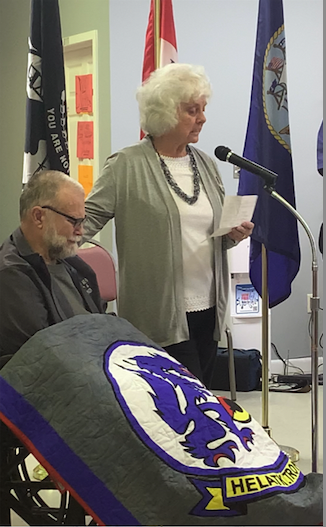
On Oct. 13, George Robert Leduc, of Hayesville, was presented the Quilt of Valor during a ceremony at Truett Baptist Church.
Stitched in the Quilt of Valor is, “Thank you for your service and sacrifice in serving our nation.”
The quilt was presented to Leduc by American Legion Post 532 with family and friends by his side including his wife, Marie Leduc; son Thom and wife Gift and granddaughter Riley; son, Geoff and granddaughter Winter; with Patriot Guard Riders staging the flag line.
Serving in Vietnam, Leduc was part of an elite group of sailors, the HAL-3 Squadron “Seawolves,” created in April 1967. The HAL-3 Helicopter Squadron provided quick air support to SEAL, Patrol Boat Recovery, Special Forces and their troops along with the River Rats. Leduc flew several hundred combat missions doing his part to protect and cover Navy Patrol Boats which were being ambushed from the banks of the Mekong River, as well as support and rescue missions for Special Forces.
During the five years the unit existed there were approximately 3,000 men who rotated through squadron. There were nine detachments of Seawolves who flew 78,000 missions with 8,200 enemy killed and 8,700 sampans sunk, along with 9,500 structures destroyed. The sailors of HAL-3 collected a total of 17,339 medals.
Seawolves were the Navy’s answer to Seal support (UH-1 Bell helicopter gunship.) Mounted on each side of the helicopters were 2.75 inch rocket launchers and two M60 flex mounted machine guns later replaced with pylon mounted “mini” guns, which could fire 2,000 or 4,000 rounds per minute. Early on they had two gunners, one seated on each side of the helicopter with a shoulder fired M60 machine gun.
The gunners hung out of the helicopter with one foot on the rocket pad or pylon gun mount. Fixed to the inside rear wall was a ‘monkey-belt” attached to the gunner allowing movement in the helicopter but kept them from falling out as the gunship rolled in and out of battle. These “free guns” were replaced with fixed mounted twin M-60s, one pair per side. With the pylon mounted “mini” guns on the left side of each helicopter, this created a Heavy Fire Team.
The soldiers of HAL-3 Seawolves were awarded five Navy crosses, 31 Silver Stars, two Legion of Merit Medals, five Navy and Marine Corps Medals, 219 Distinguished Flying Crosses, 156 Purple Hearts, 101 Bronze Stars, 142 Gallantry Crosses, over 16,000 Air Medals, 439 Navy Commendation Medals, 228 Navy Achievement Medals, six Presidential Unit Citations, two Meritorious Unit Commendations and one Vietnam Meritorious Unit Commendation. George Leduc was one of the 219 who earned the Distinguished Flying Crosses.
The four Landing Ship Tanks used to support TF-116 were USS Garrett County LST-786, USS Harnett County LST-821, USS Huntertown County LST-838 and USS Jennings County LST-846. The HAL-3 Seawolves was decommissioned in March of 1972 with approximately 3,000 men rotated through the squadron.
“I was already old when I went in the Navy,” Leduc laughed. “I enlisted at 20 years-old in 1968. After high school I attended East Coast Aero Tech, located in Massachusetts, and became a federal aviation certified aircraft technician. Then I went to work in the experimental hangar at Sikorsky Helicopters in Stafford, Connecticut for 18 months. I worked with a four man crew in the hanger and out on the flight line. We worked on the CH-53 “Jolly Green Giant” helicopter. My crew chief during that time was a retired Navy chief. I supposed that did influence my choice when I decided to enlist.
“I was bored and wanted to get into the airlines, but they were not to keen on hiring anyone who was draft eligible. So I decided to go Navy, figuring that at least I won’t have to be in-country. I signed up on what they called a 120-delay enlistment. That meant I was in but not on active duty until that time expired. What I didn’t consider was when I actually did report to boot camp, it would be at the Great Lakes training center in Michigan, during Thanksgiving, Christmas and New Year’s, not exactly the best time of year to be there. We had to hang our uniforms outside to dry after washing them and they would just freeze solid like a board.
“My father and uncles were in the military, Army for my father and two uncles and Navy for one uncle. Later on, I used to joke with my dad that he had more sea duty than I had because my sea duty was in Vietnam. Before I got out of the Navy, I did volunteer to do a five-day cruise on the aircraft carrier Saratoga.
“After boot camp I was sent to Naval Air Station in Jacksonville, Florida for a six month school to earn an Aviation Electricians Mate rating. Having already had some aviation experience helped here, not only with school but also with a little, and I do mean very little extra money in my pay. Then it came time to fill out the Navy “Dream” sheet for your next duty station. You are supposed to list a job or place that you were interested in. What I didn’t know was that if you requested what you wanted, chances were very good that you would end up somewhere else. But in my case, they were happy to send me where I thought I wanted to go.
“Myself, along with several of my so called shipmates decided that we would like to be assigned to this Helicopter Squadron that was looking for volunteers. It sounded exciting. Well, it turned out that I was the only one who went through with the request. Okay, I should have paid closer attention. This squadron was commissioned in Vietnam, and it never appeared in the U.S. When I went to Vietnam I was rated as an Aviation Electricians Mate and door gunner.
“The Navy didn’t have any type of school to train us on the “Huey” helicopter, so we were sent to Fort Rucker Army Aviation School in Alabama for a two-month maintenance and door gunner school. There hadn’t been any Enlisted Aviation Combat Crewmen in the Navy since WWII. I left Fort Rucker as a qualified Army door gunner and was allowed to wear Army Aircrew Wings even though I was in the Navy.
“Fort Rucker was a blast. There were only eight of us Navy personnel in the class. Two were 1st Class petty officers (E-6) and six guys not long out of boot camp. I seem to remember one of the 1st classes as being a Navy SEAL. When we first arrived there, we were quartered along with Army personal, but that didn’t last long. The Army’s schedule of getting up at 4 or 5 a.m. each morning was not going to work for us. If I remember correctly, Bob Talbot had arrived first and the second or third morning that someone came into the barracks screaming at these Army dudes, he came up out of his bunk with a baseball bat. There seemed to be a miscommunication problem. We weren’t here for anymore boot camp. Well, the Army did accommodate us by giving us our own two story barracks; imagine that just for eight men. It turned out to be an old boarded up and condemned barracks, nice, with no heat. Wasn’t that just truly wonderful of them?
“Well, from then on things got really interesting. For one thing none of us wore any rank insignis or unit patches. We wore Army green utilities and black berets, which had a Task Force 116 patch. In the beginning the majority of the Army personal didn’t know who the hell we were, and we liked it that way. All of us went to the movie theater on base. At one point when the action favored the sailors, we all jumped up cheering, then sat back down quietly through the rest of the movie. The rest of the soldiers didn’t know what to make of us,” Leduc laughed. “Each morning we would alternate our arrival for class. One day we would arrive by taxi, another by personal vehicle, some days we just walked to class until just before we were within view than we would jog the rest of the way.
“The Army had a baby alligator for a mascot. It was kept in the duty office. Well one day, someone got the brainy idea that we should conduct a night raid and capture the Army’s mascot. We must have been getting bored; there wasn’t even an EM-club on base and the fort was located in a dry county to boot. We had noticed prior to this that the duty officer would fall asleep on watch, not a good thing.
The raid went off without a hitch. We blackened our faces, then belly crawled right out in front of the open duty office door. There was enough light from the open door to allow us to spray paint these two artillery shell stanchions a beautiful “Navy Blue” and stick on a few “Go Navy” bumper stickers, of course we snatched the gator right out of the office while the poor guy slept.
“The next morning, we brought the mascot back. It was probably really happy after spending a cozy night in the sink in our barracks. Well, things got exciting after that. We were informed by a friendly soldier that there was going to be a raid on our barracks that night. Not only were some soldiers pissed off at us for the embarrassment we caused, but they also knew we had beer in the barracks, this was a big no. Anyway, we were going to have our butts kicked. So, what could we do, after all we were just eight men strong against so many. First thing is we found some bricks and positioned some just above the doors leading into each end of the barracks and also a few buckets of water. Then all there was to do was wait and drink our nice cold “illegal” beer. As it turned out there was no action that night or any other.
“We did make some friends during those two months. For the most part we still remained anonymous as to rank and who we were other than being sailors. We all passed and earned our Army Aircrew Insignias. At the conclusion of graduation, we were each given a nice new set of wings along with airline tickets and told to the out of Dodge immediately. I guess they just couldn’t wait for the Navy to be gone but I’m sure some of the soldiers missed us.
“Several months later after being on DET-4 it was my turn to fly crew of an empty gun ship to Binh Thuy. Every 100 hours the helicopter went in for routine maintenance and we would just swap one ship for another. To make the switch quicker we would strip all guns, rocket pods and weapon equipment from the bird and only one crew member would accompany the pilots. Before we left, I went to the mailroom to get the Det-4 mail and while there I overheard some sailors talking. They were talking about this bunch of Seawolves who had harassed the Army at Fort Rucker so much that a Navy Liaison Officer had to be stationed on the base to keep peace. Imagine that we were famous. I just smiled and headed out to catch my waiting crew. I didn’t know if the rest of the team ever heard about this conversation.
“After survival, escape, evasion and weapons training it was time to go across the big pond. I became close to the other eight soldiers I trained with over the last four months, but once we arrived in Nam, we all went to different places. I may have seen one or two of them the whole time I was there.
“Prior to HAL-3, the Army was flying support for the Navy, but they didn’t fly at night, and they were not to excited about landing on a barge or ship. The Navy decided to form a Squadron using Navy personnel. There were eight detachments plus the home base detachment at Binh Thuy. Two were aboard LST’s (troop landing ships with helicopter pads) stationed on the river, two off the coast and the rest were land based.
“I reported to boot camp on Nov. 8, 1968, then arrived in Saigon on Nov. 8, 1969. I recall when I landed in Vietnam, we were put on a bus with chicken wire on the windows and the heat was unreal, not to mention the smell. I thought, what the hell did I get myself into?
“My first two days were spent in Saigon at Caravelle Hotel. The first night I had to stand guard duty at the front entrance behind a wall of sandbags. I can’t recall my feelings, but I’d bet I wasn’t too excited about that. A couple of days later on November 10 a helicopter picked me up and we flew down along the Saigon River arriving at Bihn Thuy, our main headquarters at that time.
“I was working on the flight line and in the shop, but I had trained to be more than just an electrician. I had gotten a taste of flying and that was what I wanted to do. I could have stayed in Binh Thuy and never flew if I had chosen to. Flying was strictly on a volunteer basis. You could t at any time no questions. One of my good friends quit after the third time going into the ocean while taking off from the ship, he’d had enough. Sometimes there just wasn’t enough power to get lift in such a short space for takeoff.
“I recall the first time we had to land on an LST, I couldn’t believe it and from where I was sitting, I could hold my thumb in front of me and couldn’t see the ship. I don’t remember the landing or taking off, must have had my eyes closed but I do have pictures,” Leduc added.
“Bihn Thuy was like being on any large base, you worked, pulled guard duty and put up with the chicken shit. This is not what I volunteered for. I wanted to be in the air. Once I got a taste of hanging out of a helicopter, anything else would be boring. I loved flying along with the doors open and that is what I did. I had thoughts about having to kill someone and being shot at, but to overcome that I thought about how many more of my own people I was saving. I guess that salvaged my sanity, so I thought.
“I was on guard duty one night out on the rear perimeter of the base, when at one point a flair went off above my head. That was the first time I almost killed someone and it would have been another American; This guy was drunk and he just set off a pop flare. What stopped me from pulling the trigger I don’t know. I just hit the deck and I had him in my sights but didn’t pull the trigger. He didn’t know how lucky he was. The MPs came along and dragged him away, that bothered me for a long time,” Leduc said.
“It was always a strange feeling pulling guard duty at night. There was a road between the Vietnamese Army Base and us and at night a lot of vehicles seem to congregate there at the corner. You could not understand what they said and you didn’t know who was really on your side. It was a four hour watch but it always seemed a hell of a lot longer.
“I was finally able to get on flight status by doing a lot of griping and coercing. The squadron was on short on electricians, so they didn’t want to lose me, but I was determined to go. Finally, I got on flight training and qualified as a Navy Aircrew man on slicks hauling mail, supplies and parts. This meant there were no mounted guns or rocket pods, we only carried side arms and M-16 or M-14. I didn’t care, I just wanted to be in the air and from the air the country was beautiful.
“One day while we were on a routine mission, we were called to a hot area that had just had a firefight. We were to pick up a body bag. I recall the smell was so bad that I almost got left behind because the pilots took off as fast as possible. We were under fire and I was standing on the skids. I’ll never forget the smell of that body, but I can’t remember being shot at. There are a lot of things I can’t remember,” Leduc said.
“Around the end of 1970, a gunner was going home and they needed someone to replace him. I was finally given permission to go out on a detachment. We had a total of eight detachments and I went to number four. It worked out big time for me because they were stationed at Ben Luc, which was a Vietnamese Army base. DET-4 had just been moved off of an LST to be land based. We had running water, air conditioning in our hooch and a club; everything was there. It was heaven compared to some of the other DETs who had 50 gallon drums for showers. I was lucky to be stationed there the rest of my tour in Vietnam. We had SEALs and Seabees and river boats along with some Vietnamese Army stationed there right on the Ben Luc River. We had one job and that was to fly.
“Once again, I was in training. Even though I was Aircrew qualified both by the Army and the Navy, I had to complete actual combat Aircrew training. For this I would have to ride the “middle” seat in between the two gunners to observe and learn, written test and flying test then I could take my place on the left hand door of the Huey.
“Finally, I was done with my training, but found out the training and learning never stopped. I was assigned to a crew and ship, it remained to be seen how long I could stay alive. It’s said that a door gunner’s life expectancy was short.
“If a call came in while we were on patrol that someone was under fire, we would respond immediately. It was our job to go out and help. We flew for everyone who called for help. We covered Medi-vac, troop insertions and even covered an operation with the Vietnamese Air Force one day. They were flying some old WW11 fighters called “Spads”, and they flew pretty slow. The mission required them to come in low along the river, a dangerous situation for a slow moving large aircraft. To keep the enemy from shooting the Spads down on their slow departure from the target, we would have to fly in at 90 degrees across the river firing to keep the enemy’s head down. It was certainly unusual for us, but it worked out well.
“In my detachment no one used drugs; we drank a lot but not on duty. We had one person who was suspected of doing drugs but got rid of him really quick. You usually worked with the same guy and one day my partner and I both got pretty lit and it was hell the next day out there doing a pre-flight. You hit that heat and you’re hung over, it was miserable. It only happened once for me, I knew I’d never do it again,” Leduc chuckled.
“The hardest part of my job was the mental part, the waiting. We weren’t like the Army; we were only allowed to fly so many hours. I don’t think the Navy wanted to spend too much money on us. We were rationed fuel and weapon parts and had to beg, borrow or steal parts for our weapons or most anything else, including transportation, but we made do. We would just set and wait for someone to call for help.
“We were scheduled each day for a morning and evening patrol, which was usually a search and destroy mission. While out on patrol one day we came upon this huge Buddha statue and temple in the middle of nowhere. In between these patrols we would just sit and wait for someone to call for help.
“On March 21, 1970, we were scrambled to support a six-man Army Ranger team trapped near a cemetery. The team was surrounded and taking cover in a bomb crater when we got on station. We spent six hours keeping these guys alive until day light so the Army could get in to get them out. This was my most serious firefight. It was at night, and I could see tracers coming from everywhere in that cemetery. The enemy were hiding in the graves, I could see them lift a cover and fire at us as we passed over. I can still recall thinking I’m not going to be leaving this country alive. A calmness settled over me and I felt nothing mattered anymore,” Leduc added.
“I don’t remember ever taking a round in a helicopter, but I do recall when we almost crashed one night. We were told it was a heavily armed target, it was going to be a night strike. There were two helicopters and when we got to the fire line, one flew up high with lights on. We’d come in low with lights out. We would be coming in at 90 degrees to the river, across the rice paddies and pop up over the tree line and then down on the river. I was operating a door mounted mini gun with 4,000 rounds a minute. We were putting in so much fire on this target that everything was bright and I heard a screeching noise in my helmet from the intercom. On the way back I found elephant gras in my helmet and the screeching noise was the other helicopter screaming at us to pull up. What happened was all four crew members had become target fixated (concentrating so hard on the target area) that no one realized how close we were to flying straight into the ground.
“My left gunner realized it first; he took his gun barrel and beat our pilot on the helmet to break his concentration. It’s so dark and you’re watching for enemy fire hoping to get them first. That was probably the closest call I had. We did run out of fuel a few times and had to land in the middle of nowhere. We’d sit and wait for someone to get us fuel.
“I never had to pick up wounded although we would have. I asked myself if we really needed to be there. It was a civil war to start with and we didn’t need to involve in that part, but if we were going to be there, we should have done it right. We were flying helicopters the Army rejected because they were old and worn out. All we had was what the Army dumped, full of holes and patched up with Bondo. We even had some with skids so bent out of shape that a rocket would come out of the tube and deflect off it, but we made do.
“In April of 1970, our team was called to Cambodia to look for the remains of a crash site. Some of our people had crashed a year before as they wandered into Cambodia. We had two detachments (four helicopters) DET-7 and DET-4. Once we were over the area, one team would fly cover above as the other landed and then we rotated. We spent the night in a Cambodia village, Svay Rieng. We never found anything at the site. Several years ago, a search team found the site and some remains were found and returned.
Leduc said, “I received the Distinguished Flying Cross for an operation on May 8, 1970. I had no memory of what took place over that river. Even at one of our reunions when my second gunner and other crewman were discussing some of the events, I had no memory of it. In April 2004, my doctor was using some acupressure points, while in my mind, I put myself back in time. I could see the river and the boat that was under fire. I see muzzle flashes and could almost feel and smell the air…that was all I remembered.”
George Leduc was presented the Distinguished Flying Cross for heroism while participating in aerial flight on May 8, 1970. Leduc was the right door gunner in the trail aircraft of two attack helicopters attached to Helicopter Attack (light) Squadron when his fire team was scrambled to assist a patrol boat which was surrounded by a large enemy force. His fire team entered unfamiliar country on a black rainy night under actual instrument conditions. The patrol boat was still under savage automation weapons and rocket attack from both banks of the river as the fire team arrived overhead. It was impossible to determine the outline of the river or the target location due to the weather and darkness. Leduc bravely and selflessly attacked with devastating and accurate machine gun fire as his fire team leader turned on his landing lights to illuminate and identify the target, thereby drawing the enemy’s fire from the boat unit. Using this tactic, the fire team placed accurate fire into the enemy positions at time within 20 meters of the boat. Despite the intense automatic weapons and air-busting rocket fire directed against the aircraft after each attack, Leduc aided his aircraft commander in relocating the target and attacked with machine gun fire as the lead aircraft landing lights were turned on. The fire team continued to use this tactic until all enemy fire was suppressed and the patrol boat was able to withdraw safely. Leduc’s heroic actions in the face of intense enemy fire saved the boat unit from certain destruction and the loss of many lives. B. A. Clarey: Admiral, U.S. Navy; Commander in Chief U.S. Pacific Fleet.
“When President Nixon declared that he was going to send military troops into Cambodia the Sea Wolves had already been there for three days and U.S. soldiers were already dying. It was B.S. because we were not allowed to fly any missions until the naval forces made its way up river into Cambodia. All we could do was set there and do nothing.
“One night we got scrambled. The orders said that we had to pick up a village chief. We landed on a floating dock in the middle of the river near the village and got the chief. We had to wait about 20 minutes and burn off enough fuel before we could take off. When we got to the outpost they had been over run. We were too late because of that B.S.
“Everyone’s tour in Vietnam was different, my war was like flipping a light switch on and then off. We were on 48 hour and off 48, sometimes for a week and then a day off or any combination in between. Some of our detachments were shot down not long after I left. A good friend of mine got killed in Vietnam September of 1970. I always thought it was my fault because I didn’t train him good enough, I did find out later that it was mechanical failure that caused the crash. I had been carrying that guilt for a long time.
“I had this pup that flew with me, his name was Dog. I had a “Monkey” belt made up so he would not fall out. Dog was just a mutt from a local litter. I can remember the first time he went up with us. He was cool, after we landed and were reloading, I noticed him pacing in front of the helicopter, barking at an ARVN soldier that happened to be walking by the flight line. I guess he thought he was a big time dog now. One day when I got ready to go up someone told me that this other guy took Dog up and he fell out. I missed him a lot, it was a big deal to me. Years later I found out at the reunion that Dog had been traded for some dope by one of our gunners and that no one wanted to tell me at the time because they were afraid that I would have killed him if I had known what really happened. That gunner didn’t last long on DET-4, we got him sent back to Binh Thuy. He was a pothead and was not trusted, we all had to depend on each other to stay alive and there was no room for drugs.
“After a few days of flying I needed some down time and as I was setting at a bar in the hooch when I heard this voice, “Hi Sarge.” It took me a few minutes, but I knew that voice from the past. It was a guy named Richard I knew from the Boy Scouts, here was a walking pain in the butt and I couldn’t believe it. I knew he was Navy and in the country from a letter my sister wrote me. I also knew she was engaged to him, that was another surprise for me. I looked for a shotgun under the bar, but it wasn’t there, so I did the next best thing and got drunk for two days. Anyway, Richard and my sister, Sue did get married and we’re still friends.
“Most of the time I didn’t even know where I was. I just hopped in and hoped the pilots knew where we were going. I went on duty the same night I returned from R & R. We were scrambled sometime after midnight. Physically I was back in Ben Luc, but my mind was still in Sidney. I was operating on instinct. By the time my mind caught up with the rest of my body, the mission was over. I do remember that we were orbiting on station and I hear this noise that sounds like a freight train. That is when we aborted the scramble. My father told me once that’s what an artillery shell sounds like and as long as you can hear it, you’re okay. I found out after we landed that we were right over Ben Luc, it was a false alert.
“My last official flight was on Nov. 6, 1970, about a week before I went home. I had gone back to Binh Thuy to check out of the squadron and then came back to Ben Luc to kill time before I left country. Since I was no longer on duty, I hitched a ride over to visit with Richard. He was stationed near Saigon at NSA-Nah Be Naval Base. I spent a few days and when it was time for me to head back, the DET-2 pilots said they would fly me back to Ben Luc. But that didn’t happen, as we were leaving the team scrambled and I had to get off.
“Ben Luc was 35 miles southeast of Saigon. Prior to the Vietnamization program it was no problem to bum a ride on some U.S. military vehicle, but now there wasn’t much U.S. military traffic along the roads. I took a taxi form the Navy base to Hwy 4 hoping to catch a ride. I waited most of the day, didn’t trust riding with anyone who wasn’t U.S. I had turned down several rides and now it was getting late. All I had was my 45 on me. Finally, an Army ambulance stopped with two Vietnamese drivers jabbering away and pointing to the back of the truck for me to get in. I figured I’d go or be there all night. I kept my 45 handy as I had no idea what these two guys were talking about or how that night was going to end. Finally, I could see the Ben Luc Army base. What I didn’t know is these two Corpsmen driving had recognized me. One week before going home and I wasn’t planning to leave that base again for the remainder of the time,” Leduc laughed.
“Vietnam was being run from 12,000 miles away, no clear objective that I could see. I had a clear objective and it was to keep as many Americans alive as possible, including me in those 13 months I was there. I still had two more years to go on my enlistment and rather than report to a new duty station first and then have to take my leave for Christmas and travel again a month later, I extended for one month, so I left somewhere around December 8.
“You look at North Vietnam now and compare it to South Vietnam and there’s a big difference. They’re all communist now. We built them up and walked away. We didn’t support them after we left if we would have helped Ho Chi Min when he asked us for help, he wouldn’t have gone to the communist,” Leduc said.
“One day back in 1985 I spent some time at the “Wall” as I was leaving Washington, D.C. I stopped to get something to drink at a roadside venter. There was a young Vietnamese teenager working at the stand. I asked him if he thought our being there for 10 years gave them a better life. He seemed to feel that life was better. He was just a child back then. Was it worth the sacrifice of so many on either side? I do not think so. In the end it still became a communist country. Our government definitely didn’t do right by the Vietnamese and definitely didn’t do right by us veterans. I believe that a lot of the POWs were left behind alive. That was a tragedy. I believe that head injuries could have left some men not knowing who they were and maybe lucky enough to have found some sort of life, even new families. Not everyone was the enemy. I’m sure some probably decided to stay on their own, especially deserters, I don’t know their reasons, but I believe there are some still alive and not allowed to come home.
“When I landed in California, I recall being told to change into civies. I had heard a lot of stories about the protesters and name calling, but I can’t remember. I got on a plane and fell asleep until we landed in Boston. I don’t remember too much about coming home. I reported to my next duty station and had to deal with some of the same grief that were getting from the civilian. I can remember this Flight Line Chief cussing me when he thought I wouldn’t hear him and saying “Why the hell do they send us these guys” or something derogatory like that. There was no respect there. Within two months I wanted to go back to Vietnam, I put in a written request for a transfer back to HAL-3, but they turned me down. I had to stay. I did move to the electrical shop for the rest of my tour and got out after four years.
“After getting out I went to Avionics school in Tulsa, Oklahoma. Here I was in the aviation capital of the country, a licensed aviation electrician, and I couldn’t get a job once they found out I had been to Vietnam. I got married to my first wife, Linda in January of 1972. Everything was going along fine, so it seemed to me. I got out of the Navy, went back to school and got a job. Linda’s brother committed suicide. After coming back from Vietnam, he couldn’t handle the BS either. It was around 1980 when I started noticing something was wrong with me. I just didn’t care. I didn’t like myself: I didn’t feel anything but anger and depression. I had no idea what was wrong and it didn’t matter.
“Things got worse and Linda had a nervous breakdown. I didn’t know how to help her, hell I didn’t know how to help myself. Linda committed suicide in November of 1983. I don’t know what would have happened to me if Marie, a good friend of both Linda and I, had not been there to help me. Marie and I eventually got married. She gave me the encouragement to seek help. I didn’t want to lose someone else. I spent my 50th birthday in the waiting room at the Boston, VA. Two years later I was rated 100 percent for PTSD. I’m on medication now and don’t sleep with out it.
“When I tell people I was a door gunner in the Navy, they look like they want to say, yeah right. Very little history is documented about this squadron. Who are the heroes you ask? The men on the wall, the ones who died believing we were doing the right thing and the POWs left behind.” Leduc concluded.
On Jan. 3, 197 the Bureau of Naval Personal authorized retroactively, the awarding of Combat Aircrew insignia to the door gunners of the HAL-3 Seawolves, 25 years after the squadron was deactivated. The award ceremony took place at Patriots Grove, Naval Air Station in Jacksonville, Florida on June 18, 1998. This insignia has not been awarded to navel enlisted personal since the end of WWII.