
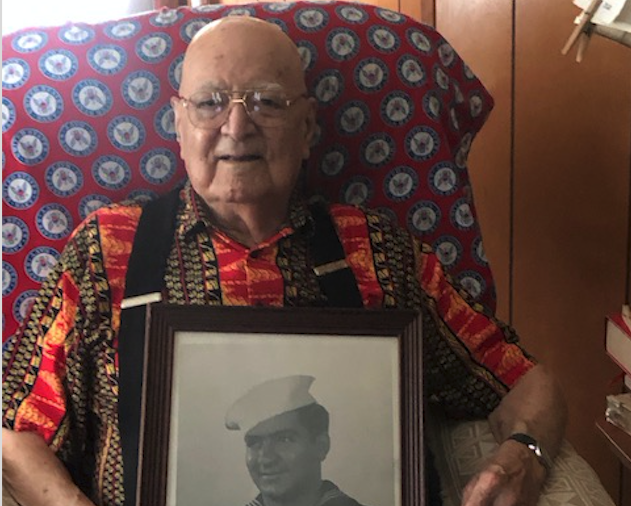
A lot happened in 1925. The first working television system was tested, the Grand Ole Opry began broadcasting as the WSM Barn Dance and Adolf Hitler published "Mein Kampf," to name a few things. Meanwhile, on Aug. 3, 1925, Oscar Gouveia was born to Portuguese immigrants Martinho and Josephine Gouveia in Rehobeth, Mass.
During a conversation on his birthday this week, the Hayesville man reminisced about his 95 years of life. He explained how his parents did not know each other in their homeland of Portugal, but met after they had both immigrated to the United States.
He finished grammar school and started working on a nearby dairy farm. It was common for young men of his time to start working early to learn a livelihood, rather than pursue more schooling.
At 17, he joined the Navy, just as World War II was going strong. “If I had waited until I was 18, they would have drafted me into the Army,” he said. “I didn’t want to be in the Army.”
Basic training was in Sampson, N.Y. where six men shared one motel room with bunk beds for four months. “We would go down for muster, then close order drills through town,” he said. “Our chief petty officer’s name was 'Sargent' and we gave him a hard time.” He smiled as he repeated the name. “Sargent.”
His voyage to Europe was on the Queen Mary and he was first sent to Wales. Then he was stationed at Exeter, Devon, England, where the base was a golf course. Despite being in the Navy as a coxswain or boatman, he worked in a supply base and was landlocked for the duration of his service. He helped distribute kitchen supplies, Navy food supplies and other essentials.
“England was alright,” he said. “The people were nice. The civilians were really good, but the Royal Marine base guys right down the street did not like the Navy guys.”
When asked what he learned in the U.S. military of the 1940s, Gouveia answered right away. “You learn you can’t have it your own way,” he said with a smile. “There are regulations to go by. We had a good group of fellows. There was always some guy making jokes of everything.”
His role in the supply base kept him from participating in battles, yet he did see fighting of a sort. “When I was stationed in England, I was on shore patrol sometimes and it was interesting,” he added with a laugh as he pondered for a moment. “When there were too many fights in the bar, I’d break them up.”
In March 1946, he was discharged and paid $53.63, according to his discharge papers. He was also given $2 travel pay. The remarks on his discharge papers describe the awards he earned: World War II Victory Medal, American Area Medal and the European African Area Ribbon Point System, although he was never given any of the awards so he only has them on paper.
Upon returning to the States, he bought a dairy farm with his brother and father. “After 20 years, I came to the conclusion there was no future in the dairy farm,” he said. He left to seek other things.
He traveled south to Marathon, in the Florida Keys where he worked at a generating plant. For a while, he worked in a northern rubber plant, where Spandex was developed.
“I did a lot of different things and kept going from one place to another,” he added. He was tempted to return to visit England many times yet he never had the money.
“I had intentions of staying in the Navy. I think the military is a good avenue for anyone,” he said. “I was needed at home. Sometimes I wonder how different my life would have been.”
For one thing, he probably would not have met the love of his life, a beautiful redhead named Dot. He pointed at the black and white photo hanging on his kitchen wall of a woman who looked like a movie star. “That’s her,” he said, quietly. “I was working nights in a kitchen. She was a waitress brought in to help. We met and that was it.”
He and Dot were married 40 years, but she still lives in his heart. The couple moved to Clay County in 1993. As he thought about that, he began laughing. “They called me a half-back,” he said. “I left Massachusetts and went to Florida. Then they said I came half-way back.”
He has no family nearby; however, his neighbor frequently checks on him. That neighbor, Kenneth Martin, also mows his lawn and helps in other ways. Gouveia said he has good neighbors looking out for him
At the time of the interview, his niece Ellen Borden, was visiting from Massachusetts. He jokingly threatened to kidnap her so she would stay longer. She said he is still very sharp. “He goes and exercises three times a week,” she said. He even drives himself. “I have to after quadruple bypass surgery,” he laughed out loud.
Gouveia shared lots of humorous anecdotes and jokes about people he knew in the Navy. Even though his career was not long, it is important to him, as evidenced by the Navy paraphernalia he has. Plus, not many people have a personal letter from President Harry Truman or Massachusetts Governor Maurice Tobin to show like he does.
Gouveia remembers the first television, the first man on the moon and much more. When asked what advice he has for such a long life, he replied immediately. “Nothing special. No advice except take it as it comes. That’s all. What else can you do? I guess everything falls in place.”