
EMC explains what’s behind expansion
of broadband in
rural areas
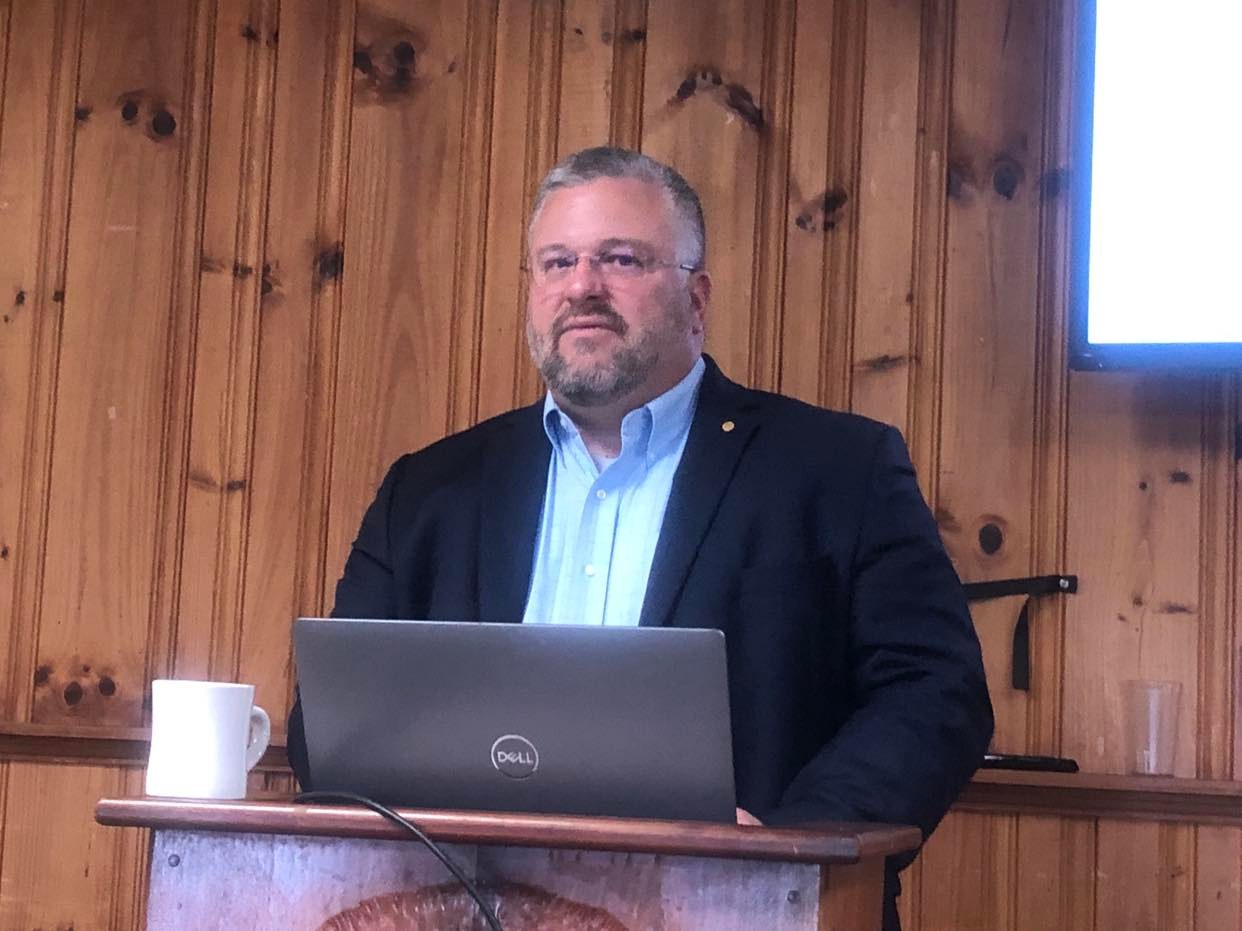
Lorrie Ross• Clay County Progress BRMEMC Director of Administrative Services and External Affairs, Erik Brinke explained broadband plans of BRMEMC.
By Lorrie Ross
Staff Writer
“It’s our mission to get broadband to every member.” That statement made by Blue Ridge Mountain Electric Membership Corporation Director of Administrative Services and External Affairs Erik Brinke drew smiles from attendees of Hinton Center’s Council of Collaborative Impact on Thursday, Aug. 11.
Brinke explained how BRMEMC entered the realm of broadband internet in 2002, the same year he started with the company as Director of Economic Development. Former General Manager Joe Satterfield saw the importance of high-speed internet as important to attract businesses. “There was a lot of resistance,” Brinke said. “Even among some staff who felt a power company should not get into the broadband business.”
It was a new venture, but BRMEMC has subsequently worked diligently to offer connectivity to members. To that end, the not-for-profit member-owned cooperative has applied for and received tens of millions of dollars in grant funds over the last several years. Some grant applications have been denied, but EMC often resubmits, sometimes receiving the award later.
BRMEMC serves 48,000 members with 57,000 meters in the north Georgia counties of Towns, Union and Fannin, along with Clay and Cherokee County in western North Carolina. Funds have been awarded to bring broadband to many of these areas. The awards range from a Fires Creek and Shooting Creek $5.5 million award with a 30 percent EMC match, to a $1.3 million project with a 30 percent match in Pine Log, Gum Log and Warne. A grant application has been made for $5.5 million to install broadband in Tusquittee. Yet installing fiber or other high speed options may not be as simple as many residents would like to believe. Brinke explained how the process works.
Each grant is awarded for a designated area, often one without internet, or in need of better internet options and cell phone service. There are also very specific guidelines required of each grant award. Sometimes a small portion of an area is carved out from a grant service area by the grantor. Occasionally, another company has already received funds to bring internet to the carved out area so EMC may not also request funds.
Some delays have been caused by archaeological studies. Brinke used the example of a $3.45 million USDA Community Connect Grant awarded to BRMEMC in 2017 to bring fiber to the Hanging Dog area of Cherokee County. It will offer Gigabit fiber optic network connection to 1,000 residences and small businesses and there is already a 42 percent take rate where the project is located. However, the project was delayed due to USDA archaeological and environmental concerns, according to Brinke. Mainline construction is now underway and electronics and drops are following. The anticipated project completion date is late 2024.
The rural mountainous terrain makes extending the network challenging, as does multi-state jurisdictions, the limited industry base and the low customer density of 8.3 per mile. Other challenges exist, as well. BRMEMC has traditionally had one of the lowest sales per customer in the nation; although there was a slight increase during COVID as people came to their vacation homes for longer periods. When broadband is available in an area, only about one in four people usually sign a contract for it.
Brinke encouraged people to take part in Neighborhood Networking. With this program, a local neighbor or two becomes a sort of local champion to share information about potential internet in their neighborhood. The resident contacts other residents about signing internet contracts. With enough interest, the company can begin to plan the connectivity for the neighborhood.
Some areas, like Tusquittee, have mature subdivisions with a high percentage of underground power lines and extensive landscaping. The cost of underground fiber is three times as much as to hang the lines. Directional drilling can cost six times as much, at $45,000 a mile.
Despite this, more than 1,300 miles of fiber have been planted to 25,000 homes and 13,000 customers. Brinke said new connections have been increasing an average of more than 160 a month. “Atlanta is the hub of internet traffic in the southeast,” Brinke continued. “And we have connectivity to it.” He said connections were built along two different corridors to insure a connection with that hub even if one is broken. “Otherwise, we are building on an island,” Brinke said. “We are also working on regional connectivity with multiple links within Tennessee and Georgia.”
In addition, EMC owns a large data bunker in Young Harris. The company hosts data backup space there as a return investment. There have also been fiber swaps with TVA, which create mutual benefits, including new connectivity to TVA’s generation and transmission assets.
Brinke shared other statistics about the cooperative. It is considered a 501c12-special designation. EMC has 6,259 miles of electric distribution line and 40 miles of transmission and sub-transmission line. To give perspective, Brinke said, “If we placed lines from Miami, Florida, to Anchorage, Alaska, it would still not be 6,250 miles.”
Brinke ended his presentation by saying, “Just because an award was announced, doesn’t mean it will be tomorrow. Please be patient with us.”
Complete details about each planned BRMEMC broadband sector are available at: www.brmemc.com.