
By Ann Atchison
Guest Writer
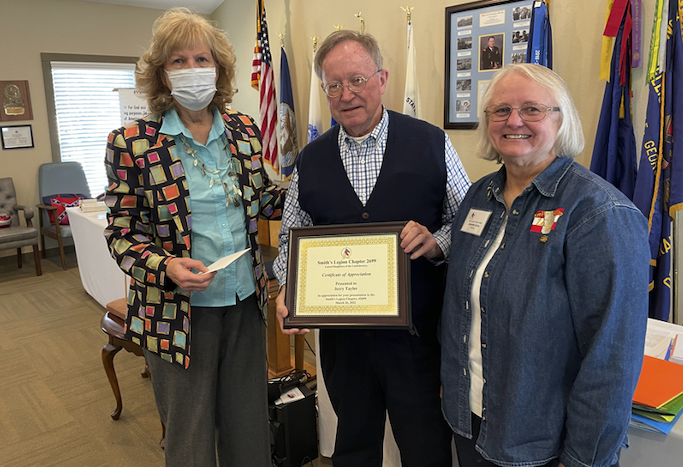
The Smith’s Legion Chapter #2699 of the United Daughters of the Confederacy, Blairsville, Ga., invited Jerry Taylor, local historian to speak on the origins of local place names with interesting little stories.
Have you ever wondered how the area got some of the names? Many of the names were formed years ago and have kept their original names, but many have been changed for E911 purposes and other reasons. A lot of the names are not even on local or state maps. Many street names are for people who lived in the area and many area names are named after state politicians. There are many stories told through the years of how the names came up.
Union County, Ga. was named after the United States, not in reference to the Union side of the War Between the States — it was created in 1832 from Cherokee County, Ga. Towns County, Ga. was named for Governor George W. Towns, but he never stepped foot there. Rabun County, Ga. was named after William Rabun who was a member of the Georgia House of Representatives and the 29th Governor of Georgia. Clay County was named after Henry Clay, the Great Compromiser.
Hiawassee is a Cherokee name. Young Harris had many names; Greenwood (1848), Eolia (1851), Mt. Eolia (1859), Brasstown (1866), McTyeire (1887) — the college was started and named after a Methodist preacher who had married into the Vanderbilt family, and finally, Young Harris, with Judge Young Lofton Gerdine Harris of Athens sending money to build the Susan B. Harris Chapel, about 1892, named after his wife.
There are names in the area like Puncheon Camp Branch, Naked Mountain Branch, Airline Road — no airport there, Streak Hill also known as Kelly Lane where racing happened in the 1920s and 30s, and Many Forks — established from Indian trails. There is Dismal Mountain, Scataway — corn farmers making moonshine; Bugscuffle — greater Kimsey Cove or poor Macedonia; Stink Branch or Hooper Branch — 1812 veteran received bounty land and two families had feuded; Sneaking Creek, Indian Grave Gap and Burnt Cabin Cove. Cynth’s Creek is named after early settler Cynthia Osborn. Cesar Gap is named after a slave who belonged to the Austin family — once he was freed, he moved to Clay County, called Cesar’s Cove in Tusquittee. One name that was told about through the years was Byers Creek, named after the bad Byers boys who sewed up a man into a carcass of a mule that was used to deliver the mail for 7 years — you’ll have to ask about the rest of this story.
These are just a few of the names Taylor presented out of many other names he spoke about.
Taylor is a native of Towns County and is a graduate of Towns County High School and Young Harris College. He retired after 32 years as a history teacher at Towns County High School. He was instrumental in founding the Towns County Historical Society and the Towns County History Museum at the Old Rock Jail in Hiawassee and is the official historian for Towns County. Taylor is also a talented organist who is a collector of antique reed organs, with some displayed at the Georgia Mountain Fair exhibit hall.
The Smith’s Legion Chapter meets at 11 a.m. most every fourth Saturday at the Veteran’s Building, Blairsville. Chapter members are from Clay and Cherokee counties of North Carolina, Towns, Union and Fannin counties of Georgia. Eligibility requirements for the UDC include women, 18 years of age and older, who have a Confederate veteran in their blood line, lineal or collateral. If you are interested in joining the UDC and you are not sure of your ancestry, we can help you search your family linage. For details, contact TARA62860@aol.com. There is also a local Sons of Confederate Veterans Camp in Blairsville, the David W. Payne Camp #1633.