
Aquatic weed on Towns Co. side of lake causing concern
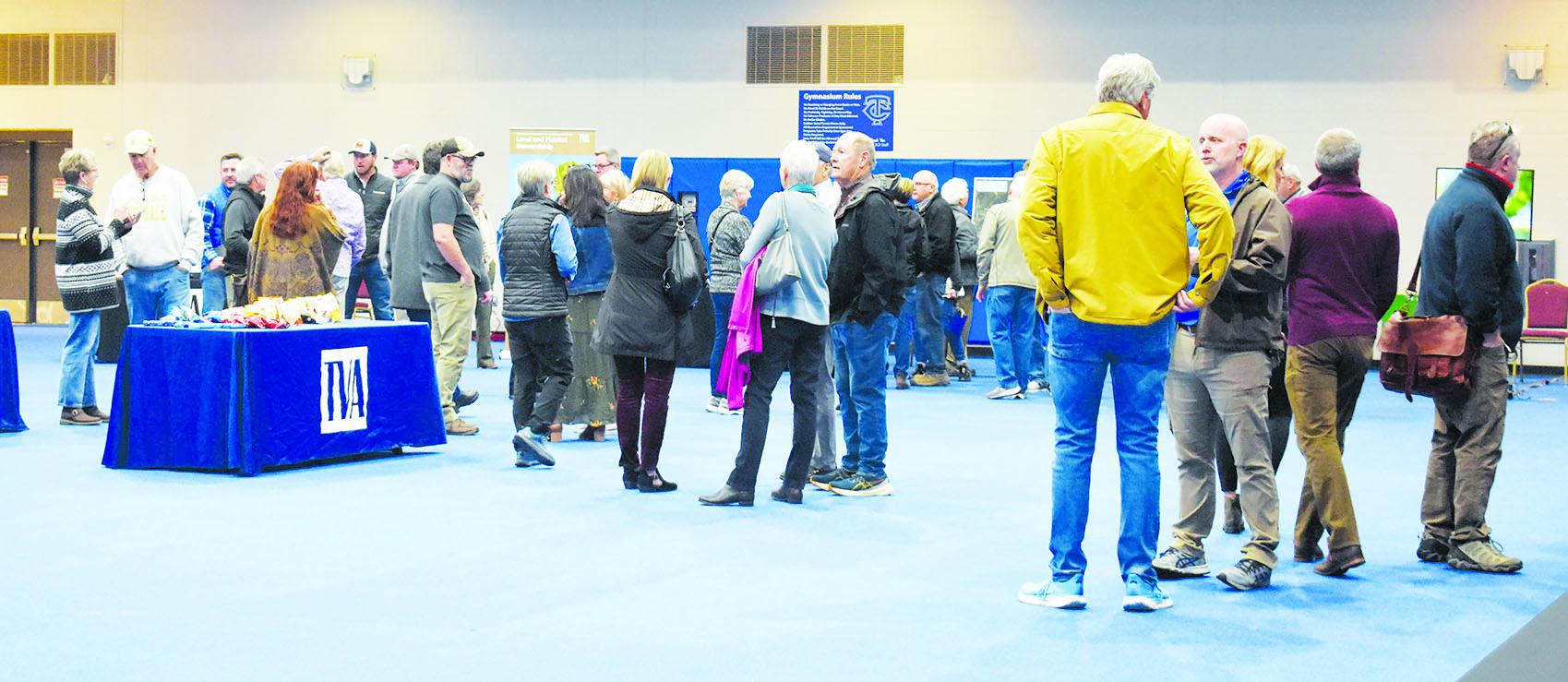
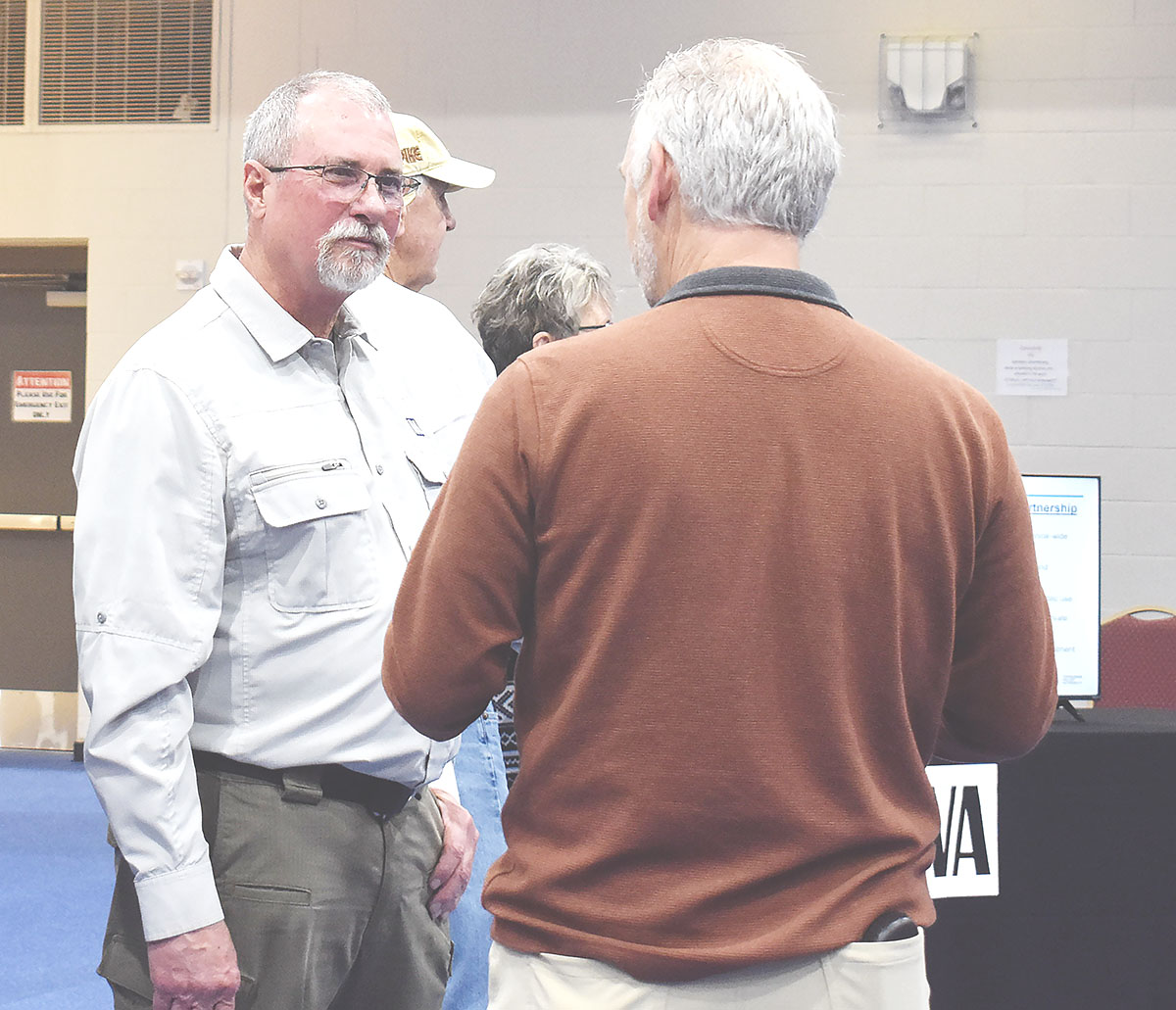
Marcia Barnes • Clay County Progress David Brewster, Tennessee Valley Authority Natural Resources Management Manager - West Operations, spoke with guests at an Open House held at Foster Park Recreation and Conference Center in Towns County, Georgia on Tuesday, Feb. 27.
By Marcia Barnes
Staff Writer
The Tennessee Valley Authority, the Georgia Department of Natural Resources and North Carolina Department of Environmental Quality recently met with citizens at an open house to discuss local concerns about parrot feather. The non-native aquatic weed has invaded areas on the south side of Lake Chatuge.
TVA is continuing to conduct an environmental study exploring multiple options for control of parrot feather in public access areas on the Chatuge Reservoir. The open house held at Foster Park Recreation and Conference Center in Towns County provided information and an opportunity for local citizens to ask questions. The event was attended by about 90 to 100 guests on Tuesday, Feb.27.
David G. Brewster who is Natural Resource Management Manager for TVA’s West Operations gave an overview about aquatic plants and parrot feather.
“We’ve got aquatic plants in the TVA system in the main stem on the river primarily from Watts Bar Reservoir all the way to Kentucky Reservoir, so that encompasses Watts Bar, Chickamauga, Guntersville, Nickajack. There’s none in Wilson, a little bit in Wheeler and Pickwick and in Kentucky.
“Not as much though as parrot feather, but primarily another specie called rock star, an eel grass, now our biggest issue. Some reservoirs have hydrilla verticillata, that’s an issue.”
How does Brewster rate the growth of parrot feather in Lake Chatuge currently on a scale of 0 to 10? Brewster said right now it would be a 6 in some areas and in some areas not as bad.
“All aquatic plants are good in some sense in providing aquatic habitat, primarily for fisheries and invertebrates. It’s good to have a good healthy mix of aquatic plants. We’d prefer to have the native specie versus some of the exotic non-natives, like parrot feather.”
How the TVA looks at solutions to invasive new aquatic species like rock star is scientific. The parent plants are from southern Europe and Africa. Rock star is a new fast-growing variant.
Brewster said that they’re not starting from scratch to control new variants of invasive species. In discussing rock star, he said that it’s in Florida and they talk with other agencies and scientists to find the best product, most environmentally sound product to use.
“Instead of trying to experiment with this and that, we get a good basis to know what kind of herbicide that everyone is getting a good control with. That’s where we start at,” Brewster said.
Towns County operates a water treatment plant on Lake Chatuge in Hiawassee. Brewster said that the water treatment plant is not affected now by parrot feather to the best of his knowledge.
“We’ll probably start having some discussions with that water treatment plant because we will be making treatments close to them. The products we use are labeled safe for public water systems.
“What we do, when we do make a treatment close to a water facility, we coordinate that treatment with them. Initially, we come in and we delineate how many acres the size of the body of water, how many acre feet are in that block of water and that’s what we base the chemical rate that we put in and we already know, depending on the species, what herbicide we’ll use.
“We take this area and we work with our river forecast center in Knoxville — we mainly want to know the movement of that water.”
Brewster said that they will already know the time and day of the treatment. From Knoxville the movement of the water can be modeled, whether it is going to the intake or away from the intake. If it heads to the intake, TVA contacts the water plant before TVA even makes the treatment.
“We contact and tell them what our intent is, what we’re going to use, particularly if we’re going to use an herbicide you can spray right over an intake. We give them a material data safety sheet on that product. They can see what we’re using.
“Then, we’ll tell them, ‘We’re going to treat this area, our modeler is telling us within six hours it’s going to go over your intake and you need to pull water samples to try to catch it, to try to see if you can detect it.’
“If we do our job correctly here with the right amount of application, it won’t show up in their water testing,” Brewster said.
Water levels in reservoirs are not regulated, lowered or raised, because of treatments. However, Brewster said that in the recent winter at Guntersville they knew there was a hard strong freeze temperature coming. Brewster requested lowering the reservoir to the bottom of the curve. The curve is where water intakes are not affected.
“When a band of shoreline was exposed to the air and then it froze, it killed all these plants. We used Mother Nature to do our work instead of herbicides,” Brewster said.
In controlling parrot feather in the Chatuge Reservoir, an herbicide will be needed. The TVA is waiting for the approval from the Environmental Protection Agency of that herbicide before moving forward to treat public areas.
In a word from Adam May, Senior Media Specialist at the TVA on March 12, approval for the use of an herbicide to treat parrot feather is close. May said that the study is continuing and expected to be complete by the end of March, if not sooner.