
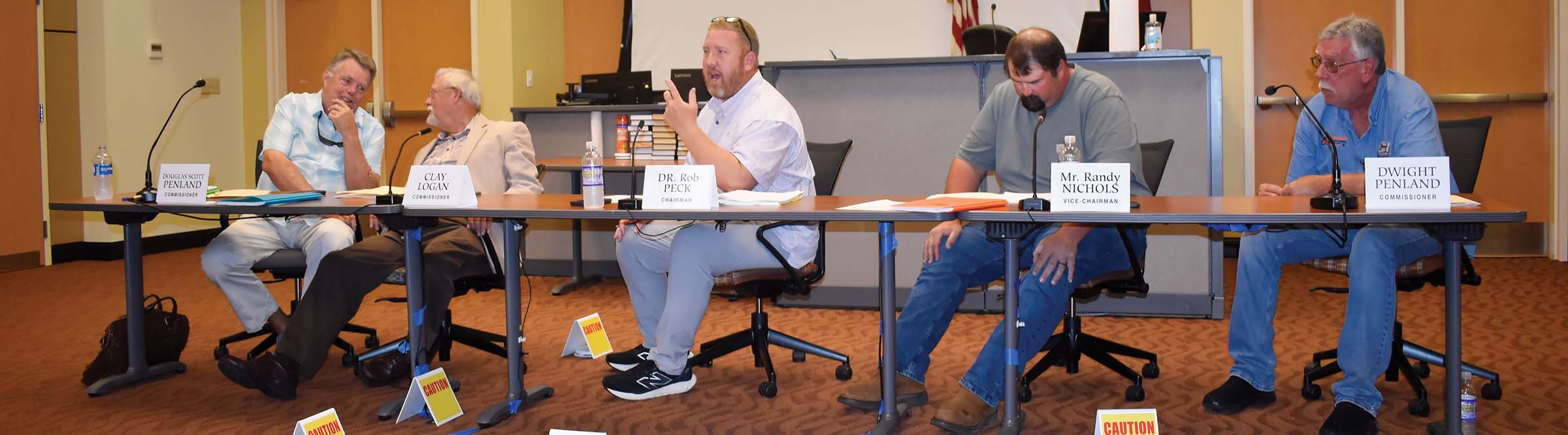
The follow document was prepared by Dr. Rob Peck and read in full during the Aug. 7 Clay County Commission meeting:
Structure of County Governance and Role of Board of Commissioners:
The county manager/county commissioner form of government is the most common structure for county governance, as outlined in the NC General Statutes Chapter 153A. This form of government often referred to as the commission-manager form is designed to combine elected representation (commissioners) with professional management (county manager), ensuring effective and efficient governance. This helps separate the policy makers from the administrators. Each with defined roles. The commissioners set the vision, policies and budget while the county manager executes and manages county operations. Your elected Clay County Board of Commissioners primary responsibilities include establishing county policies and ordinances, the appointment of key officials, overseeing the provision of mandated and optional services, setting of the property tax rate and adoption of the annual county budget. This is what we are elected to do.
Clay County Fiscal Year 2025/2026 Budget Process:
There have been some concerns raised which have questioned the timing and disclosure of the Solid Waste Availability Fee in regard to the budget process. I want to shed some light on the budget process itself and specifics with regard to the Availability Fee. The budget process in Clay County begins in March with department heads turning in their request in April. The County Manager is then tasked with preparing and recommending the annual budget to the Board of Commissioners, taking into consideration the totality of requests, historical data, and the needs of the county, both current and projected. The FY 2025-26 Proposed Budget was made available for review to both the BOC and the public on May 20, 2025, well in advance of the June 5th Public Hearing. As per NCGS 159-12(a) the budget must be made available to the general public at least 10 days prior to the Public Hearing on the Budget. A copy of the proposed budget was filed in the Clerk’s office for public inspection during normal business hours. The date, time and place of the public hearing was posted and published with the Clay County Progress.
The Clay County Board of Commissioners advertised the June 5th Public Hearing and Regularly Scheduled meeting in the May 29 and June 5th issues of the Clay County Progress. In addition, all meetings are posted online and at the office of the Clerk to the Board of Commissioners. This is consistent with the Open Meetings Law under NCGS 143-318.12 and related statutes, such as NCGS 153A-40 for County Commissioners.
On June 5, 2025, the FY 25-26 Budget was formally presented to the BOCs. During the June 5th Budget Hearing, County Manager Debbie Mauney proposed the budget which included no increase in the millage rate but did include a fire tax adjustment with an increase of $.01 for the Hayesville Fire District equalizing it with the other fire districts. This generates approximately $150,000.00 in additional revenue for Clay County Fire and Rescue to help meet rising operational costs. In addition, Manager Mauney, as part of her budget presentation noted the Solid Waste Availability Fee in the annual amount of $100 for improved residences and dwellings. These revenues would be applied to operational and maintenance costs of the Transfer Station. This was to be billed with the property tax bills for ease and efficiency. The Public Hearing was adjourned and the regular meeting of the Clay County Board of Commissioners (also properly advertised and posted) commenced with “Consideration of Adoption of Budget Ordinance 2025-2026” on the agenda. Manager Mauney again noted that the solid waste fee mentioned in the budget hearing was included in the proposal and if adopted, an ordinance on such would be presented at a later date. (See Minutes for June 5th, Public Hearing and Regular Meeting) Due to some questions on various issues of the budget by the board and in consideration of prior public comment, Board Chairman, Dr. Rob Peck, made a motion to table the adoption of the budget to allow for further review. This was seconded by Commissioner Scott Penland and approved 5-0. The June 5th meeting was recessed and later reconvened at 8:00AM on Monday, June 23rd. While not required under law, the continuation of the June 5th meeting was advertised in the June 12th and June 19th editions of the CCP. On the morning of June 23rd, the Clay County Fiscal Year 2025-2026 Budget in the amount of $27, 689, 610.00 was approved. Later that day, Chairman Peck made a Facebook post titled “CLAY COUNTY BOCs ADOPT FISCAL YEAR 25/26 BUDGET”. Among the highlights of that post was “The budget also includes a $100.00 annual solid waste fee for residential properties, replacing the annual permits (currently 125.00 per year) effective January 1, 2026. This post was shared on the “Hayesville NC Community, What’s Happening Page” and again by the page “moderator.”
On July 17th at the regularly scheduled Clay County Board of Commissioners meeting the proposed ordinance “Regulating the Assessment of Solid Waste Fees and Solid Waste Tipping Fees in Clay County, North Carolina Ordinance #25-0717 was adopted by the board. This also was posted and advertised, in the July 10th and July 17th Clay County Progress under Commission Board Agenda, Old Business: Ordinance-Regulating the Assessment of a Solid Waste User Fee- Merinda Woody, County Attorney. See CCP July 10th and July 17th papers As your elected officials, we are tasked with overseeing the provision of mandated services by adopting a county budget and setting the property tax rate or associated fees for service to be able to meet the operational costs of the county.
Since the late 1980’s Solid Waste Management in NC counties has been MANDATED for the safe disposal of solid waste produced within the county. This includes managing landfills, recycling programs, transfer stations and other waste disposal systems. As such, Clay County provides not just residential and commercial trash disposal, but also recycling to include the following: cardboard, paper, metal, aluminum, tin cans, and #1 and #2 plastics, as well as the disposal of more hazardous materials such as oil, antifreeze, fluorescent bulbs, lead batteries and propane tanks. Pallets and electronics are also accepted and weighed like trash at $.05/pound. It is estimated that 40-50% of staffs time is allocated to recycling.
So why the need for a Solid Waste Availability Fee?
Since FY 22/23 the Clay County Transfer Station has lost a total of $113,568.34. (expenditures $1,862,461.78 minus revenues $1,748,893.44 from 22/23 through 24/25) In the last fiscal year alone, the transfer station lost $85,433.36. This is primarily due to the increase in the cost of operating. During this time, revenue from permits, daily user fees, scrap metal, commercial hauler fees, white goods and scrap tires have remained essentially the same with only a slight increase in collections over that three-year period in a total amount of $27,405.42. The largest operational increase year after year is the increase in Solid Waste Transport. This is the cost associated with hauling off the refuse. In addition, there are increases in the cost of disposing of tires. Prior grants are falling short of covering this expense. In recent years, the old landfill had to drill and install monitoring gas wells and vents, make modifications in the old facility, and cover the cost to monitor the water testing of the closed landfill. In addition, other contracted services have increased including calibration of the scales. Currently, the scales are having to be reset every couple hours of operation by staff. The failure of the scales is due to worn bushings and rods. This is an item that will need to be addressed as it is essential for daily operations. The cost estimate from 2024 to be replaced as part of a larger plan to expand and improve the facility ran approximately $100,000.00. In addition, the scale house itself needs to be replaced. A prefab scale house has been estimated at $50,000.00.
Additionally, and of critical note, a November 1, 2022 Department of Environmental Quality (DEQ) Facility Compliance Inspection Report, Division of Waste Management, Solid Waste Section, noted the following:
#11. “Spalling was observed on the tipping floor and aggregate was visible. Some of the aggregate is becoming dislodged from the surface. Continue to monitor the floor and if any rebar becomes exposed, contact the Section, as a repair plan will be necessary. The tipping floor will have to be replaced or repaired in the future and significant costs should be expected during this process.”
#12. “The push wall on the south side of the building has been damaged and rebar is showing. The push wall should be repaired to prevent further damage and to ensure the facility is being maintained in accordance with the Permit to Operate, Attachment 3, Part I, #8.”
See DEQ Inspection Report dated 11/1/2022
The estimated cost to repair the transfer station in 2024 was $150,000.00.
On March 6, 2023, the Board of Commissioners took proactive measures to work towards addressing the concerns above while planning for the continued growth of the county by contracting with McGill Associates, 55 Broad Street, Asheville, NC 28801. McGill was charged with developing a plan to overcome the notable issues of the recent inspections on November 1, 2022. As noted by McGill, to resolve the issues, Clay County would need to cease operations at the current facility so repairs could take place. At the direction of the board, McGill was tasked with developing a capital improvement plan which would allow operations to continue, while simultaneously increasing safety and efficiency with expansion of the facility to meet the growing population. After numerous site visits, BOC feedback, and multiple conceptual drawings, Clay County received the “Master Plan Concept for Clay County’s Transfer Station” and associated cost estimates on April 4, 2024. The day after (4/5/24), County Manager Mauney was on a zoom call for another county project (EMS) with the USDA and inquired about a USDA grant/loan to fund the Transfer Station Project. The 2024 cost estimates from McGill for multiple proposals ranged from $5.65 to $8.34M. Obviously these costs estimates are now dated.
See Master Plan Concept for Clay County’s Transfer Station
Consistent with our board’s continued desire to minimize local dollars on capital improvement projects while maintaining a low tax burden on our property owners, it is our goal to cover the above improvements with a USDA Community Facilities Direct Loan and Grant Program. This provides affordable funding to develop essential community facilities in rural areas (population </= 20,000). These funds can be used to construct, enlarge, or improve essential community facilities including solid waste disposal facilities and/or transfer stations. To acquire these low interest loans/grants, the county must show that the county and transfer station operations can generate sufficient revenue to cover loan payments, operating costs, and maintenance. The grant portion requires the county to show they can sustain the facility post-funding, often through user fees, local taxes, or other revenue sources such as Solid Waste Availability Fees.
In the analysis of user fees, tipping fees, permit fees and such, it became apparent that increases to them alone would not be sufficient to meet the needs. The Solid Waste Availability Fee is necessary to offset Transfer Station losses, sustain operations and maintenance and provide for the required improvements. The benefit of doing the fee rather than a millage increase is that only improved real and personal properties used for residential/dwelling purposes are being accessed the fee rather than all real and personal property. (A 1% increase in millage would only equal an additional $198,727/year of revenue.) It would take over a 3 ½ mill increase in property taxes to come close to equaling the operating and maintenance costs of the Transfer Station. The availability fee also ensures that all revenue collected thereof remains within the Transfer Station. This board or future boards cannot use these funds to offset expenditures in other areas of the budget or conversely take funds away from other vital and mandated services such as public safety to help offset the losses and needs of the transfer station. Many would argue this is the most transparent means by which to fund the Transfer Station. Citizens know exactly how much and where their money is going.
Questions as to why residents within the Town of Hayesville are excluded from the fee:
The Ordinance Regulating the Assessment of a Solid Waste Use/Availability Fee and a Solid Waste Tipping Fee in Clay County, North Carolina, was drafted in accordance with NC General Statutes 153A-292 and 153A-122. In North Carolina, a county’s authority to impose a solid waste availability fee on municipalities within its jurisdiction is limited and subject to specific statutory conditions under NCGS 153A-292.
1. General Authority- Counties have the authority to impose an availability fee for solid waste disposal facilities on improved properties that benefit from the availability of such facilities. The fee is intended to cover the costs of providing and maintaining these facilities, such as landfills, recycling centers and transfer stations.
2. Restrictions on Municipalities-A County cannot impose an availability fee on properties within a municipality if the municipality already provides solid waste collection services that include a charge for availability and use of a county disposal facility.
3. Exceptions- If the county’s disposal facility provides additional services not offered by the municipality, (such as recycling) then the county may impose an availability fee.
The Town of Hayesville provides both residential trash pickup and recycling. Residential property in the town of Hayesville pays the county millage rate of .43 per $100 of assessed value plus an additional .265 (town rate) for a total of .695 mills. (158 residential properties)
Additionally, NCGS 153A-122 addresses the territorial jurisdiction of county ordinances in North Carolina defining the scope of a county’s authority to enact and enforce ordinances.
153A-122. Territorial Jurisdiction of County Ordinances. Except as otherwise provided in this Article, the Board of Commissioners may make any ordinance adopted pursuant to this Chapter applicable to any part of the county not within a city. A county ordinance may be made applicable to the county’s extraterritorial jurisdiction under Article 19 of this Chapter or under Article 18 of Chapter 160A of the General Statutes.
Surrounding Counties with Solid Waste Availability Fees:
A solid waste availability fee is not unique to Clay County. Cherokee County ($85), Macon County ($120), Jackson County ($125), Haywood County ($159) and Swain County ($115) all have similar fees. The only county in the 7 most Western North Carolina Region without a solid waste fee is Graham County. All the counties noted above imposed their fees on residential improved properties, including mobile homes, campers/RVs, and single-family residences. Clay County did not reinvent the wheel. While each county has its unique circumstances and may provide different levels of service such as convenience centers, etc., these fees are not apples to apples comparisons due to size of tax base, sources of additional funding, needs, etc. But the emphasis here is each has had to enact fees to offset the cost of mandated solid waste services and the continued cost to do business.
With Regards to Those Who Currently Pay for Residential Garbage Disposal:
As mentioned earlier, under NCGS 153A-292 a county can impose an availability fee on improved properties that benefit from the availability of county solid waste disposal facilities. This fee is meant to cover the cost of maintaining these facilities and is charged to property owners regardless of whether they use the Clay County Transfer Station or a private hauler. According to General Statute 153A-292(b) a county can not impose an availability fee on properties if the resident or private hauler already pays for the availability and use of a disposal facility through another mechanism (ex. Tipping fees or municipal services), UNLESS THE COUNTY PROVIDES ADDITIONAL SERVICES NOT COVERED BY THE HAULER’S DISPOSAL METHOD.
Except for the Town of Hayesville, no residential trash haulers in Clay County provide recycling services. As a reminder, 40+ percent of the Transfer Station staff’s time is spent on sorting, packing and processing recyclables. Because the county provides additional and distinct services NOT COVERED by the tipping fee (recycling and hazardous waste disposal), this is not considered double dipping.
Furthermore, NCGS 153A-292 requires that the solid waste availability fee be applied UNIFORMLY. The fee must be imposed consistently and equitably across all properties within the same defined class or category within the county’s jurisdiction without arbitrary or discriminatory distinctions. This ensures fairness and compliance with legal standards for fee imposition.
Can Counties Charge Different Fees for Residents/Dwellings and Campgrounds/Campsites?
Uniformity as mentioned above does not mean every property in the county pays the same fee; it means properties in the same class, based on reasonable criteria like property type and waste generation are treated the same. Per the General Statutes, counties can establish different fee amounts for different property types. The Clay County Solid Waste Availability Fee establishes different fee amounts for residences/dwellings ($100.00) and Campgrounds/Campsites ($50.00). This difference in fees is based on objective, rational criteria tied to the cost or nature of solid waste services. Residences typically generate more waste and recyclables compared to campgrounds which often have seasonal use. The general decrease in volume allows a lower fee to align with cost recovery principles. A 1993 advisory opinion of the North Carolina Department of Justice explicitly supported Pender County’s ability to impose different solid waste fees.
Financial Burden Placed on Residents, particularly the elderly, disabled and veterans:
The Clay County Board of Commissioners realizes that while most people pay for curb side pick-up out of convenience, some may have legitimate financial hardships or physical limitations which may require residential trash pickup. For those individuals, a combination of the solid waste availability fee and the cost for private pickup may be a burden. Fortunately, programs exist that offer property tax relief that may help offset the solid waste availability fee for qualifying homeowners. They include:
1. Homestead Exclusion (Elderly or Disabled) This program excludes the greater of the first $25,000 or 50% of the appraised value of the permanent residence from taxation for homeowners who are 65 or older or totally and permanently disabled, a Clay County permanent resident, with a 2025 income not exceeding $38,800.
2. Disabled Veteran Exclusion- Excludes up to $45,000 of the appraised value for disabled veterans with a service-connected total and permanent disability or their surviving spouse.
3. Circuit Breaker Deferment- For homeowners meeting the same age or disability criteria as the Homestead Exclusion, who have owned and lived in the property for at least five years, this program caps property tax payments at 4% of income if 2025 income is $38,800 or less, or 5% if income is between $38,800 and $58,200. Any taxes over the limitation amounts are deferred and remain a lien on the property. A disqualifying event will result in three years of deferred taxes to become due and payable with interest on the date of the disqualifying event. The program must be applied for annually.
Of note, for those who rely primarily or entirely on Social Security benefits as their income source, available data suggests the AVERAGE social security benefit for retired workers in 2025 is approximately $1976/month or $23,712/year. According to the Social Security Administration, about 12% of men and 15% of woman age 65 and older rely on Social Security for nearly all their income (90% or more). This would indicate that many of the elderly who may be burdened by the Solid Waste Availability Fee may be eligible for relief.
We strongly encourage those who may have a hardship to contact the Tax Office to see if you qualify.
Impact on Commercial Residential Trash Haulers:
It is not the intent to place an excessive burden on the residential trash haulers. In fact, talk on addressing revenue through increased tipping fees would have negatively impacted the hauler and potentially passed cost back on to the customer with no significant increase in revenue to the County. As designed, there is no increase in the tipping fees to the residential trash hauler. While there might be a slight change in service demand, residential haulers have an opportunity to market the benefits of curb side pick-up, such as convenience, time savings, and accessibility. It is likely that most who use residential trash service in lieu of the current $125.00 Transfer Station Permit will continue to do so for those very reasons. Haulers can also use this opportunity to diversify their services, such as considering adding bulk waste, and construction debris thereby expanding their scope of business. Calls to increase the permit fees would have a negligible effect on the bottom line (943 permits this year, 147 additional) and increasing minimum use fees comparable to surrounding counties like Cherokee would potentially impact some residents more than the availability fee itself. An example would be the resident who produces minimum trash and takes their own trash every other week to the Transfer Station. A $4 minimum every other week would amount to $104/year, $4 more than the new availability fee. All of these measures fail to provide any substantial revenue to meet the operational needs of the Transfer Station.
The Cost of Operating the County:
According to the Consumer Price Index (CPI) data from the Bureau of Labor Statistics, (the most common measure of inflation) total inflation from 2014 to June of 2025 is 35.79%. Alternative measures to gauge inflation are The Personal Consumption Expenditures (PCE) Price Index shows a slightly lower total inflation of 29.37% from 2014 to 2025. Core CPI (which excludes food and energy) shows inflation of 36.98% and Chained CPI which accounts for consumer substitutions, shows a total inflation of 30.98%. Our budgets have increased by nearly the same amount, but property taxes have not. (2014 Budget was $18,400,000 vs 2025 Budget of $27,689,610) In fact, there has only been one tax increase in the last 15 years, a 2% increase in 2017 raising the millage rate from .36 mills to .38 mills. The following year due to the property revaluation, the millage adjusted up to .43 mills. This was due to the lower average appraisals and the need for a revenue neutral property tax rate under NCGS 159-11(e). The requirement when a county conducts a property revaluation (required at least every 8 years per NCGS 105-286) is for the budget officer to include a statement of revenue-neutral property tax rate in the budget. This is calculated to generate approximately the same revenue for the next fiscal year as the current tax rate would have if no reappraisal had occurred. The BOCs reserves the right to add additional mills if necessary or desired to meet the financial goals of the County. We did not and have not increased the millage since 2017. We have been good stewards of the taxpayer’s money.
The actions of the Clay County Board of Commissioners over the last decade have saved the taxpayers substantial money. The board worked hard to end deficit spending, institute tight fiscal controls, implement strong budgetary processes, enhance business practices, consolidate departments and facilities, eliminate duplication of services, aggressively pursued delinquent taxes, pass the Article 46 ¼ cent sales tax, ambitiously pursued and were awarded numerous grants and legislative dollars for capital improvements and immediate needs (saving local tax dollars) and reduced our debt service. In fact, in the last 7 years alone, we have brought in over $85 million in grants and legislative dollars (including the two new schools). We have run a surplus for 8 consecutive years, growing our general fund. A strong general fund allows us to meet cash flow needs during months in our revenue cycles when outflows exceed inflows, helps avoid short term borrowing (just last month approved a new 2025 Ford F-550 4x4 ambulance for $330,000, with an additional $180,000 in equipment to outfit and bring other 3 units up to date), provides reserves for emergencies and unforeseen events, provides revenue for unexpected opportunities (such as grants), increases our investment income, helps protect our credit rating and provides for lower interest on borrowing. It also has helped us cover the losses of the Transfer Station.
We know there are many future needs facing Clay County as our communities continue to grow. We must be ready to face the challenges head-on. As has been stated, the easiest thing for the BOCs to do would have been to do nothing when it comes to the Transfer Station. We could have left it for future boards to address simply kicking the can down the road all the while watching costs continue to rise. This is not the character of our Board. We face that which is before us and tackle obstacles as they arise while trying to be cognizant of the future and its impact on our residents.
Like anything new there will be growing pains. The Solid Waste Availability Fee is far from perfect, but is what is needed to ensure the continuation of the services as mandated under law, while fulfilling the requirements of our operating permits. This board is committed to the success of Clay County and will continue to work together for the greater good of the communities we serve.