
TVA has studied four potential alternatives for a long-term solution
By Marcia Barnes
Staff Writer
Although there is no emergency condition at Chatuge Dam or its spillway Friday, March 28 the Tennessee Valley Authority gave the first of many meetings to come on the Chatuge Dam safety modification study that is in progress and why.
Chris Saucier, TVA Senior Project Manager for Dam Safety made the presentation to the media at the dam site. Saucier is part of TVA’s dam safety team and has 35 years of experience extending from Hurricane Katrina to university professor to research work at a military laboratory.
“As part of our routine dam safety program TVA examines every site in the inventory, 106 dams and 49 different sites,” Saucier said. He emphasized that it is important to the TVA to bring the highest level of service to the people of the valley and that includes a rigorous inspection program and risk assessment.
“We would like to be pro-active and make certain the dam will be here for generations to come. That is our objective. When we see something in these dams that looks like an anomaly or a threat, we have a special process to assess that risk.”
The central issue at Chatuge Dam is the spillway and increasing the safety of spillway operations to provide more protection for the public in accordance with TVA’s risk profile. Saucier pointed to the industry experience from Oroville Dam in Oroville, Calif. which is the background motivating the study.
On Feb. 11, 2017, when a heavy snow-melt and an incoming flood forced water to be put over the Oroville Dam spillway, the water moving over the spillway very fast entered a slab joint, pressurized the water underneath and lifted the slab out, scouring soil and rock. Water was diverted to an auxiliary spillway at the Oroville Dam site and the community downstream was evacuated.
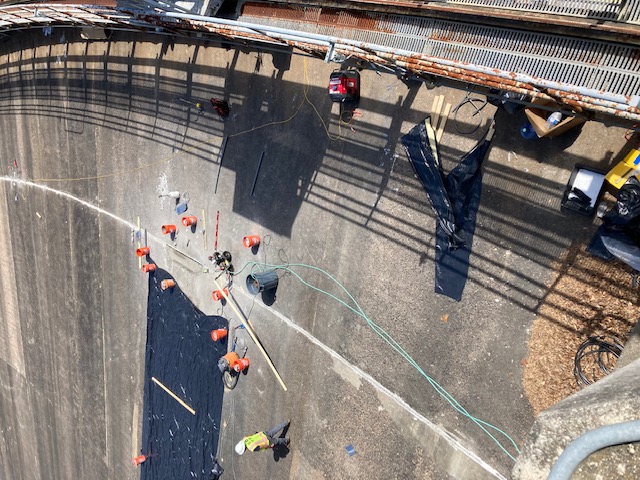
Risk assessment at Chatuge Dam has revealed a potential risk at the spillway. The modification study is the phase where the TVA is now. Interim measures to improve conditions at the spillway are ongoing to maintain chute spillway joints in order to provide an acceptable temporary solution.
The TVA has studied four potential alternatives for a long-term solution. One is to rehabilitate the spillway by joint reconstruction, by rehabilitating the existing flume in-place, excavating and reconstructing all joints and portions of chute slab. The reservoir would be drawn down over entire duration of construction. This alternative may or may not involve change to spillway gate configurations.
A second alternative is to rehabilitate the existing flume in-place by constructing new concrete lining inside existing footprint and this may or may not involve change to spillway gate configurations.
The third proposed alternative is a new spillway. The existing chute spillway would be abandoned after the new spillway is constructed and the new gate-controlled concrete chute spillway would be the solution. The reservoir would be drawn down for a portion of construction duration.
The fourth alternative is to construct a new gate-controlled concrete chute spillway and rehabilitate the existing chute spillway in-place to act as an auxiliary spillway for very rare storms. The reservoir would be drawn down for a portion of construction duration. Improvements would be made to the penstock piping and valve at the powerhouse with whichever modification is chosen.
The proposed draw down of the reservoir for construction/rehabilitation would be ten feet below the winter pool, a record draw down. TVA’s completed construction/rehabilitation at the Boone Dam in Cleveland, Tenn. was at eight feet below the winter pool.
Saucier said that in TVA’s study of the draw down on Chatuge reservoir the Hiawassee water supply would not be affected. The TVA is conscious of cultural impacts translating to the draw down uncovering ancient burial grounds.
“We are looking at concepts,” Saucier said. Also on TVA’s radar is how this interacts with parrot feather issues.
Right now, the TVA has an increased inspection program on what is the original spillway and it is the highly unusual event that the TVA wants to protect the dam against. Modernizing the dam and keeping it functional for generations to come is the objective.
“This same kind of dam is still built today, nothing has changed,” Saucier said.
Modifications to the existing spillway or the possibility of a new spillway being constructed will also open up opportunities to improve the Chatuge Dam site. Improved drainage at the toe of the dam, downstream channel improvements and rock buttresses along the face of the dam and around reservoir rim are possibilities.
Upcoming important dates for the Chatuge Dam modification study begin on Monday, April 21 with the issuance of Notice of Intent posted to the Federal Register. The document states that the TVA is going to study the alternatives. From April 22 to May 28, there will be a public commenting period.
The TVA hopes to hear from the public early on. A public meeting is tentatively scheduled from 5-7 p.m. Thursday, May 8 in Hayesville and from 5-7 p.m. Tuesday, May 13 in Hiawassee, Ga. Locations of meetings will be announced. For anyone who cannot attend, a virtual public meeting is scheduled for Thursday, May 15.